TCS NQT Logical Reasoning Study Plan: Which Chapters to Study First
In my last article, I shared the Numerical Ability study plan for TCS NQT. Now let's do the same for Logical Reasoning.The most important part of any study plan is how you group your chapters. Which chapters should you study together, so that one makes the next one easier?
Most students pick chapters at random. That's where the confusion starts. When you study connected chapters together, each one helps you with the next.
The 21 Reasoning Chapters, Grouped
Save this table on your phone. It works for any placement test with Logical Reasoning, not just TCS NQT.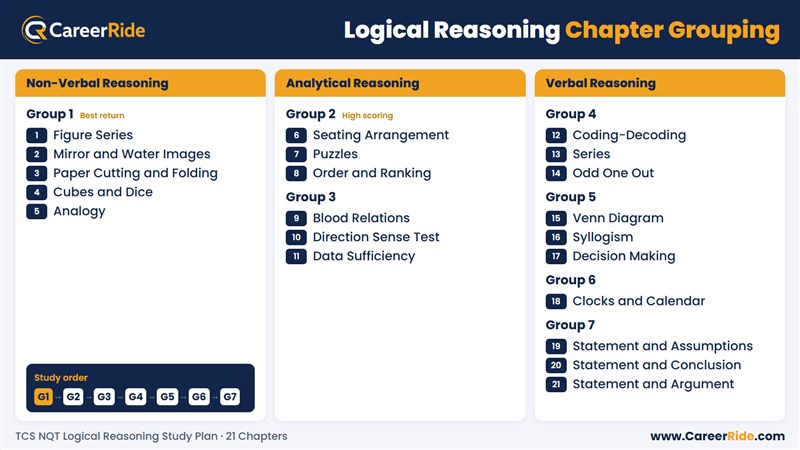
| Section | Group | Chapters |
|---|---|---|
| Non-Verbal Reasoning | Group 1 | 1. Figure Series, 2. Mirror and Water Images, 3. Paper Cutting and Folding, 4. Cubes and Dice, 5. Analogy |
| Analytical Reasoning | Group 2 | 6. Seating Arrangement, 7. Puzzles, 8. Order and Ranking |
| Group 3 | 9. Blood Relations, 10. Direction Sense Test, 11. Data Sufficiency | |
| Verbal Reasoning | Group 4 | 12. Coding-Decoding, 13. Series, 14. Odd One Out |
| Group 5 | 15. Venn Diagram, 16. Syllogism, 17. Decision Making | |
| Group 6 | 18. Clocks and Calendar | |
| Group 7 | 19. Statement and Assumptions, 20. Statement and Conclusion, 21. Statement and Argument |
Why These Groups Work
Group 1 gives you the best return on your time. A large number of questions came from Non-Verbal Reasoning last year. Students find it tricky because of the time pressure or weak concepts. But once your concepts are clear, you can solve these questions in seconds.Group 2 also scores high. Seating Arrangement (linear and circular), Puzzles, and Order and Ranking need the same way of thinking. Once seating arrangements are clear, puzzles and ranking questions become much easier.
Group 3 chapters are independent. Blood Relations, Direction Sense and Data Sufficiency don't depend on each other. I've grouped them so you can take each one on its own.
Group 4 is about spotting patterns. Coding-Decoding, Series and Odd One Out all use the same pattern-finding logic.
Group 5 is closely linked. Venn Diagrams and Syllogism use similar concepts and methods, so they're best done together.
Group 6 is for safety. Fewer questions came from Clocks and Calendars in TCS NQT last year. But don't skip it. Cover it later in case a question appears.
Group 7 puts all statement-based reasoning in one place: assumptions, conclusions and arguments.
Your Study Sequence
Don't study randomly. A fixed order takes less effort and gives better results.- Group 1: Non-Verbal Reasoning. It scores well, it's interesting to solve, and it builds your speed.
- Group 2: Seating Arrangement, Puzzles, Order and Ranking. This is where your score goes up.
- Group 3: Blood Relations, Direction Sense, Data Sufficiency.
- Group 4: Coding-Decoding, Series, Odd One Out.
- Group 5: Venn Diagrams, Syllogism, Decision Making.
- Group 6: Clocks and Calendars.
- Group 7: Statement Reasoning.
How to Plan Your Day
1 hour: watch the video. Every chapter is on CareerRide's YouTube channel as a single video covering concepts, solved examples and the common question types. Almost every video is under an hour.- For Group 1, watch the Non-Verbal Reasoning playlist.
- For Groups 2 to 7, watch the TCS NQT Reasoning Ability Tutorials playlist.
That's 1.5 hours per chapter a day. Don't let more than a day pass between the video and the practice. Same-day practice is what locks the concept in.
Keep One Day for Cumulative Practice
Block one day every weekend, Saturday or Sunday, to revise everything you covered that week.You're preparing Reasoning alongside Quantitative Aptitude and coding. Without a weekly revision day, the earlier chapters start slipping while you learn new ones.
After the Notification
Once the notification comes, stop learning new chapters. Use that time only for revision tests and full mock tests.Don't Ignore Coding
Whatever your score in Aptitude, Reasoning and Verbal, don't leave coding for later. If you're aiming for Digital or Prime, TCS says the Advanced section, which includes coding, is mandatory. Practise coding alongside your aptitude preparation from the start. Read TCS NQT Advanced Coding: How to Prepare for the 90-Minute Section.I'll share the Verbal Ability study plan next.