TCS NQT Numerical Ability Study Plan: Which Chapters to Study First
"I've decided to start preparing for TCS NQT. But where do I begin?"In my last article, I explained when you should start preparing for TCS NQT. My answer was at least 3 months before the test. Now, as promised, here's your study plan for Numerical Ability.
And I'll keep it simple. The more you complicate a plan, the harder it is to follow.
The 34 Chapters, Grouped
I've put all the Quantitative Aptitude chapters into groups of related chapters. Save this table on your phone. It works for other companies' aptitude tests too, not just TCS NQT.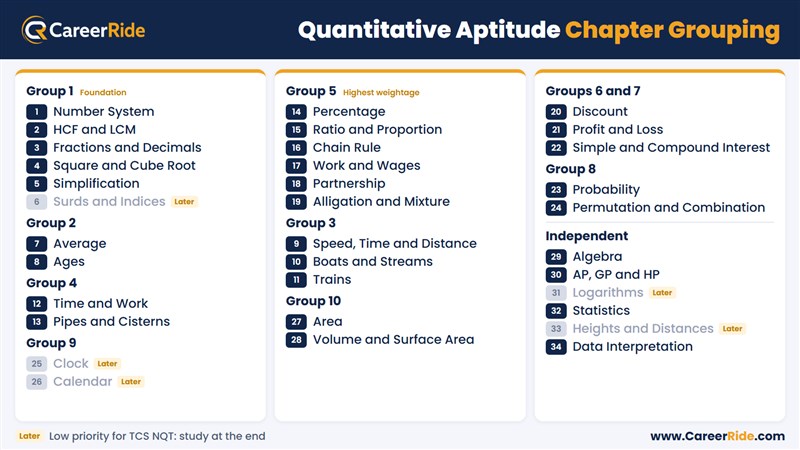
| Group | Chapters |
|---|---|
| Group 1 | 1. Number System, 2. HCF and LCM, 3. Fractions and Decimals, 4. Square and Cube Root, 5. Simplification, (6. Surds and Indices) |
| Group 2 | 7. Average, 8. Ages |
| Group 3 | 9. Speed, Time and Distance, 10. Boats and Streams, 11. Trains |
| Group 4 | 12. Time and Work, 13. Pipes and Cisterns |
| Group 5 | 14. Percentage, 15. Ratio and Proportion, 16. Chain Rule, 17. Work and Wages, 18. Partnership, 19. Alligation and Mixture |
| Group 6 | 20. Discount, 21. Profit and Loss |
| Group 7 | 22. Simple and Compound Interest |
| Group 8 | 23. Probability, 24. Permutation and Combination |
| Group 9 | (25. Clock, 26. Calendar) |
| Group 10 | 27. Area, 28. Volume and Surface Area |
| Independent | 29. Algebra, 30. AP, GP and HP, (31. Logarithms), 32. Statistics, (33. Heights and Distances), 34. Data Interpretation |
Leave the Chapters in Brackets for Later
The chapters in brackets aren't a priority for TCS NQT. Here's what I've seen in past papers:- Heights and Distances: questions hardly come from it. Skip it for TCS NQT.
- Logarithms: rarely asked, though it sometimes appears in the Advanced section. Do it at the end.
- Clock and Calendar: fewer questions in recent years.
- Surds and Indices: not a focus at the start.
Your Study Sequence
Every teacher has their own approach. This is the order I've seen work best over my years of teaching.1. Group 1: build your base. Many students skip these chapters because direct questions are few. Don't. They build your calculation speed, and speed decides how many questions you finish.
2. Group 5: the highest-scoring group. Most questions come from here. Follow the order 14 to 19 and don't skip any chapter in between. They're linked, so one chapter helps you with the next. Leave one out, and it's hard to fit it in later.
3. Groups 3 and 4 together. Once Speed, Time and Distance is clear, especially converting m/s to km/h, Boats and Streams and Trains become much easier. Then do Time and Work, and Pipes and Cisterns.
4. Groups 6 and 7 together. Many questions come from here. In Simple and Compound Interest, pay special attention to instalments. That's where students usually get stuck. When you reach it, watch our videos on Instalments in Simple Interest and Instalments in Compound Interest.
5. Group 2: Average and Ages. These are important, easy and quick to finish.
6. The independent chapters. Algebra (29), then Statistics (32), Data Interpretation (34), and AP, GP and HP (30). I call them independent because they don't depend on any other chapter.
7. Group 8: Probability, and Permutation and Combination. Both come up in the Advanced section too, so don't leave them out.
8. Group 10: Mensuration. Area, then Volume and Surface Area.
Last: the chapters in brackets, starting with Logarithms.
How to Plan Your Day
Now the execution: one chapter a day.1 hour: watch the video. On CareerRide's YouTube channel, each chapter is covered in one video, concepts and examples together, and almost every video is under an hour. Start with our TCS NQT 2027 playlist.
1 hour: practise questions the same day. This is the step most students skip. If you watch the video in the morning, solve questions at night. Practising on the same day is what makes a concept stick.
After each chapter, take the free chapter-wise Aptitude practice tests on CareerRide, and subscribe to our YouTube channel so you don't miss a new video.For how to study each chapter well, read Quantitative Aptitude Preparation: Your 5-Step Plan for TCS NQT.
At about 2 hours per chapter a day, you'll finish your Quantitative Aptitude syllabus in about 30 days, with proper preparation. That leaves the rest of your 3 months for Reasoning, Verbal, coding and mock tests.
Some videos were recorded a while ago. That doesn't matter. Maths concepts don't change with the year or the exam name. Only the difficulty level of the questions changes.
Cumulative Practice After Every Group
Once you finish a group, practise all its chapters together. Also keep one day a week, say Saturday, for a mixed set from everything you've covered so far.Without this, by the time you reach Mensuration, you'll have forgotten Percentage.
After the Syllabus
Once the chapters are done, move to revision tests and full mock tests. If the notification comes in February, that's what those weeks are for, not new chapters.Three Mistakes to Avoid
Skipping Group 1. Weak calculation slows you down in every other chapter.Watching without practising. A video with no questions solved is only half a day's work.
Studying chapters in random order. Related chapters studied together save you time.
You're starting early, so make Quantitative Aptitude a skill for life, not just for this placement.
I'll share the Reasoning and Verbal study plans next.