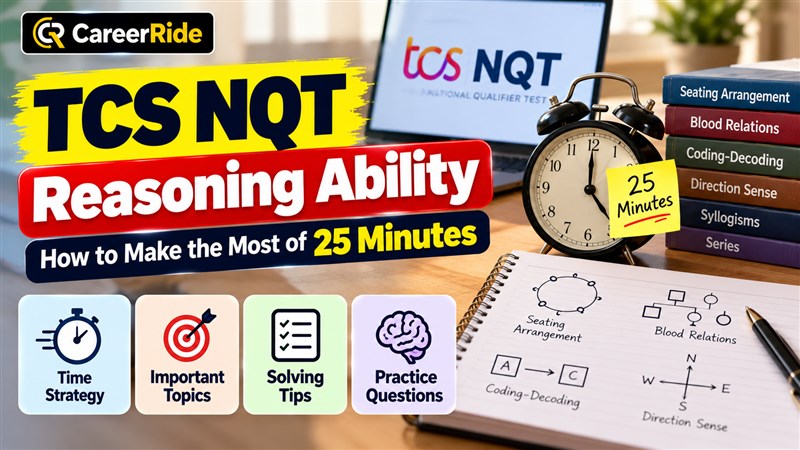
TCS NQT Reasoning Ability: How to Make the Most of 25 Minutes
In the TCS NQT, Reasoning Ability gets just 25 minutes.That's it. 25 minutes to read puzzles, draw diagrams, decode patterns and still keep your accuracy.
Many students prepare hard for Numerical Ability and coding, and then treat reasoning as "easy marks". But reasoning only feels easy when you have practised the patterns. Without practice, one seating arrangement can eat half your time.
So let's understand how this section works and how you should handle it.
Where Reasoning Comes in the TCS NQT
According to TCS's official test pattern, the NQT has two parts:| Section | Duration |
|---|---|
| Part A: Foundation (Numerical, Verbal and Reasoning Ability, 25 minutes each) | 75 minutes |
| Part B: Advanced (Advanced Quantitative and Reasoning Ability 25 minutes, Advanced Coding 90 minutes) | 115 minutes |
| Total | 190 minutes |
One honest note: TCS does not publish the number of reasoning questions or an official topic list on its hiring page. So be careful with websites that quote exact question counts.
Topics Candidates Commonly Report
Based on what candidates and placement-preparation sites commonly report, these topics come up again and again:Seating arrangement, blood relations, coding-decoding, direction sense, syllogisms and number or letter series.
Treat this as a guide, not a guarantee. If you are strong in these, you are ready for most of what reasoning can throw at you.
How to Use Your 25 Minutes
First, pick the quick ones first. Coding-decoding, series and direction sense questions usually take less time. Clear them first and build confidence.Second, draw before you think. For seating arrangement, draw the frame first and fill in only what is definitely given. For blood relations, use the same symbols every time, for example a square for male and a circle for female. Don't try to hold it all in your head.
Third, don't marry one question. If a puzzle is not opening up, move on and come back later. One stubborn question should not cost you three easy ones.
Fourth, practise against the clock. Solving 20 questions with no time limit is not preparation for a 25-minute section. Time yourself every single time.
Try These Three
1. In a code language, every letter is moved two places forward. CAT is written as ECV. How is DOG written?(A) FQI (B) EPH (C) FPI (D) GRJ
2. Pointing to a man, Riya says, "He is the only son of my mother's father." How is the man related to Riya?
(A) Brother (B) Father (C) Maternal uncle (D) Grandfather
3. Amit walks 5 km north, turns right and walks 3 km, then turns right again and walks 5 km. Where is he now from his starting point?
(A) 3 km West (B) 3 km East (C) 5 km South (D) 8 km East
Answers:
1. (A) FQI. D+2 = F, O+2 = Q, G+2 = I.
2. (C) Maternal uncle. Her mother's father's only son is her mother's brother.
3. (B) 3 km East. North 5, east 3, south 5: the north and south cancel out, leaving 3 km east.
Want more? Practise in our Logical Reasoning tests and Verbal Reasoning tests, and see everything for this exam in our TCS NQT section.1. (A) FQI. D+2 = F, O+2 = Q, G+2 = I.
2. (C) Maternal uncle. Her mother's father's only son is her mother's brother.
3. (B) 3 km East. North 5, east 3, south 5: the north and south cancel out, leaving 3 km east.
Reasoning is not about being clever.
It is about having seen the pattern before.