Practice Quantitative Aptitude questions on Area, covering squares, rectangles, triangles, circles, parallelograms, trapeziums, composite figures, and calculations involving dimensions and area units. Takes about 20–25 minutes and is useful for placement tests, TCS NQT, SSC, banking and MBA entrance exams.
Question 1
Two circles touch externally and their centres are 17 cm apart. If the sum of their areas is 169π cm2, what is the diameter of the smaller circle?
Explanation
Let the radii be a and b. The circles touch externally, so a + b = 17.
Sum of areas: π(a2 + b2) = 169π, so a2 + b2 = 169.
2ab = 172 − 169 = 289 − 169 = 120, so ab = 60.
a and b are the roots of t2 − 17t + 60 = 0, that is (t − 5)(t − 12) = 0.
The smaller radius is 5 cm, so the smaller diameter = 10 cm.
Sum of areas: π(a2 + b2) = 169π, so a2 + b2 = 169.
2ab = 172 − 169 = 289 − 169 = 120, so ab = 60.
a and b are the roots of t2 − 17t + 60 = 0, that is (t − 5)(t − 12) = 0.
The smaller radius is 5 cm, so the smaller diameter = 10 cm.
Shortcut Method
a + b = 17, a2 + b2 = 169
2ab = 289 − 169 = 120 → ab = 60
sum 17, product 60 → 5 and 12
∴ Smaller diameter = 2 × 5 = 10 cm ✓
2ab = 289 − 169 = 120 → ab = 60
sum 17, product 60 → 5 and 12
∴ Smaller diameter = 2 × 5 = 10 cm ✓
Question 2
A circle, a regular hexagon and an equilateral triangle have equal perimeters. If their areas are C, H and T respectively, then:
Explanation
Let the common perimeter be P.
Circle: C = P24π ≈ 0.0796 P2.
Regular hexagon: side = P ÷ 6, so H = (3√3 ÷ 2) × (P ÷ 6)2 ≈ 0.0722 P2.
Equilateral triangle: side = P ÷ 3, so T = (√3 ÷ 4) × (P ÷ 3)2 ≈ 0.0481 P2.
So C > H > T.
Circle: C = P24π ≈ 0.0796 P2.
Regular hexagon: side = P ÷ 6, so H = (3√3 ÷ 2) × (P ÷ 6)2 ≈ 0.0722 P2.
Equilateral triangle: side = P ÷ 3, so T = (√3 ÷ 4) × (P ÷ 3)2 ≈ 0.0481 P2.
So C > H > T.
Shortcut Method
Equal perimeter: more sides → more area, circle is the limit
C ≈ 0.0796, H ≈ 0.0722, T ≈ 0.0481 (× P2)
∴ C > H > T ✓
C ≈ 0.0796, H ≈ 0.0722, T ≈ 0.0481 (× P2)
∴ C > H > T ✓
Question 3
The front wheel of a tractor has a radius of 70 cm and the rear wheel has a radius of 28 cm. How many revolutions does the rear wheel make in the distance over which the front wheel makes 40 revolutions?
Explanation
The distance covered is the same, so revolutions × circumference is equal for both wheels.
Circumference = 2π× radius, so revolutions × radius is equal.
40 × 70 = n × 28
n = 2800 ÷ 28 = 100.
Circumference = 2π× radius, so revolutions × radius is equal.
40 × 70 = n × 28
n = 2800 ÷ 28 = 100.
Shortcut Method
Same distance → revolutions × radius = constant
40 × 70 = n × 28
∴ n = 2800 ÷ 28 = 100 ✓
40 × 70 = n × 28
∴ n = 2800 ÷ 28 = 100 ✓
Question 4
A triangle has an area of 60 cm2 and the radius of its incircle is 5 cm. Find the perimeter of the triangle.
Explanation
Area of a triangle = inradius × semi-perimeter (s).
60 = 5 × s, so s = 12 cm.
Perimeter = 2s = 2 × 12 = 24 cm.
60 = 5 × s, so s = 12 cm.
Perimeter = 2s = 2 × 12 = 24 cm.
Shortcut Method
Area = r × s → s = 60 ÷ 5 = 12
∴ Perimeter = 2 × 12 = 24 cm ✓
∴ Perimeter = 2 × 12 = 24 cm ✓
Question 5
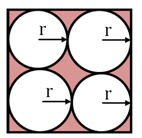
What is area of shaded portion, where r = 7cm.
Explanation
Four circles of radius r fit exactly in a square of side 4r = 28 cm. Area of the square = 28 × 28 = 784 sq.cm.
Area of the four circles = 4 × 227 × 7 × 7 = 616 sq.cm.
Shaded area = 784 - 616 = 168 sq.cm.
Area of the four circles = 4 × 227 × 7 × 7 = 616 sq.cm.
Shaded area = 784 - 616 = 168 sq.cm.
Question 6
Radius of a circle is increased by 6%, determine the increase in area of the circle.
Explanation
The area of a circle is proportional to the square of the radius, so the new area = (1.06)² = 1.1236 times the old area.
The increase in area = 12.36%.
The increase in area = 12.36%.
Question 7
Shyam’s room has dimensions 6m x 5m x 4m. The room also has a door of dimension 2.5m x 1.2m and a window of dimensions 1m x 1m. What will be cost of painting the four walls of his room if rate of painting is Rs. 2 per sq.m.?
Explanation
The area of the four walls = 2(6 + 5) × 4 = 88 sq. m.
The door = 2.5 × 1.2 = 3 sq. m and the window = 1 sq. m.
The area to paint = 88 - 3 - 1 = 84 sq. m, so the cost = 84 × 2 = Rs. 168.
The door = 2.5 × 1.2 = 3 sq. m and the window = 1 sq. m.
The area to paint = 88 - 3 - 1 = 84 sq. m, so the cost = 84 × 2 = Rs. 168.
Question 8
Anil has a rectangular farm and he builds a road along the border of the farm from outside. The road is 5m wide and has an area of 600 m2. What is ratio of breadth and length of the farm?
Explanation
The road is 5 m wide on all sides outside the farm, so the outer rectangle is (l + 10) by (b + 10).
The road area = (l + 10)(b + 10) - lb = 10(l + b) + 100 = 600, so l + b = 50.
Only the sum of the length and the breadth is known, so their ratio cannot be determined.
The road area = (l + 10)(b + 10) - lb = 10(l + b) + 100 = 600, so l + b = 50.
Only the sum of the length and the breadth is known, so their ratio cannot be determined.
Question 9
Original breadth of a rectangular box is 20 cm. The box was then remade in such a way that its length got increased by 30% but the breadth decreased by 20%. This led to an increase in area by 100sq.cm. What is the new area of the box?
Explanation
Let the original length be L. The original area = 20L.
The new length = 1.3L and the new breadth = 16, so the new area = 20.8L.
20.8L - 20L = 100, so L = 125 cm.
The new area = 20.8 × 125 = 2600 sq. cm.
The new length = 1.3L and the new breadth = 16, so the new area = 20.8L.
20.8L - 20L = 100, so L = 125 cm.
The new area = 20.8 × 125 = 2600 sq. cm.
Question 10
A circular wire of radius 21cm is cut and bent to form in the form of a rectangle whose sides are in the ratio of 6:5. Assuming, π = 227, the area enclosed by the rectangle is
Explanation
The length of the wire = 2πr = 2 × 227 × 21 = 132 cm.
The perimeter of the rectangle = 132, so 2(6x + 5x) = 132 and x = 6.
The sides are 36 cm and 30 cm, so the area = 36 × 30 = 1080 sq. cm.
The perimeter of the rectangle = 132, so 2(6x + 5x) = 132 and x = 6.
The sides are 36 cm and 30 cm, so the area = 36 × 30 = 1080 sq. cm.
Question 11
A field with equal sides of 40m is full of grass. One cow is tied to each corner of the field by a rope of 14m. How much grass will not be eaten by those 4 cows?
Explanation
The area of the field = 40 × 40 = 1600 sq. m.
Each cow eats a quarter of a circle of radius 14 m. Four such quarters make one full circle: 227 × 14 × 14 = 616 sq. m.
The grass not eaten = 1600 - 616 = 984 sq. m.
Each cow eats a quarter of a circle of radius 14 m. Four such quarters make one full circle: 227 × 14 × 14 = 616 sq. m.
The grass not eaten = 1600 - 616 = 984 sq. m.
Question 12
Ramesh runs along a circular park every day at a speed of 60m/min. One day he runs along the diameter with same speed and crosses the park. He needed 60 minutes less to cross the park. What is the radius of the park?
Explanation
Running along the circumference takes 2πr60 minutes and along the diameter takes 2r60 minutes.
2πr - 2r60 = 60, so 2r × (227 - 1) = 3600, that is 2r × 157 = 3600.
2r = 1680 m, so r = 840 m.
2πr - 2r60 = 60, so 2r × (227 - 1) = 3600, that is 2r × 157 = 3600.
2r = 1680 m, so r = 840 m.
Question 13
A plot has a concrete path within its borders on all sides having uniform width of 4m. The plot is rectangular with sides 20m and 15m. Charge of removing concrete is Rs. 6 per sq.m. How much is spent in removing all the concrete?
Explanation
The plot is 20 m × 15 m, so its area = 300 sq. m. The path is 4 m wide on all sides inside the plot, so the remaining part is (20 - 8) × (15 - 8) = 12 × 7 = 84 sq. m.
Area of the path = 300 - 84 = 216 sq. m.
Cost = 216 × 6 = Rs. 1296.
Area of the path = 300 - 84 = 216 sq. m.
Cost = 216 × 6 = Rs. 1296.
Question 14
Find perimeter of △LMN, if midpoints of its sides are joined to form △PQR. Also midpoints of △PQR are joined to get △CDE and CD=3, DE=8 and CE=4.
Explanation
Joining the midpoints of the sides of a triangle gives a triangle with half the sides, so the perimeter is halved each time.
The perimeter of ΔCDE = 3 + 8 + 4 = 15.
The perimeter of ΔPQR = 2 × 15 = 30 and the perimeter of ΔLMN = 2 × 30 = 60.
The perimeter of ΔCDE = 3 + 8 + 4 = 15.
The perimeter of ΔPQR = 2 × 15 = 30 and the perimeter of ΔLMN = 2 × 30 = 60.
Question 15
11 equal squares are arranged to form a rectangle. The side of the square is 3 cm. The area of the rectangle?
Explanation
11 equal squares of side 3 cm are arranged to form a rectangle, so the area = 11 × 3 × 3 = 99 sq cm.
Question 16
The breadth of a rectangular hall is three fifth its length. If the area of the hall is 135 sq. m., what is the difference between the length and breadth of the hall in meters?
Explanation
Let the length be l, so the breadth = 35l.
Area = l × 35l = 135, so l² = 225 and l = 15 m, and the breadth = 9 m.
Difference = 15 - 9 = 6 m.
Area = l × 35l = 135, so l² = 225 and l = 15 m, and the breadth = 9 m.
Difference = 15 - 9 = 6 m.
Question 17
A has agreed to mow the lawn, which is a 20m by 40m rectangle. The mower mows a 1m wide strip. If A starts at one corner and mows around the lawn toward the centre, about how many times would he go round before he has mowed half the lawn?
Explanation
Setting 800-(20-2n)(40-2n)=400 and solving n2-30n+100=0 gives n~3.8 (taking the root less than 10).
Question 18
The length and breadth of a rectangle are changed in the ratio 3:5 and 5:6 respectively (old:new for each). What is the ratio of the old area to the new one?
Explanation
New length = 53 × old length and new breadth = 65 × old breadth.
New area = 53 × 65 = 2 × old area, so old : new = 1 : 2.
New area = 53 × 65 = 2 × old area, so old : new = 1 : 2.
Question 19
There are two concentric circles. The radius of the outer circle is 8.5 cm and the length of the longest chord of the outer circle that doesn't cut through the inner circle is 8 cm. What fraction of the bigger circle is not covered by the smaller circle?
Explanation
The tangent chord gives 42+r2=8.52, so r2=56.25. Fraction not covered = 1-(56.2572.25) = 1-225289 = 64/289.
Question 20
An equilateral triangle has area X while a square has an area of Y. The perimeters of both are equal. Which of the following is true?
Explanation
For perimeter P: square area = P2/16 ≈ 0.0625P2; equilateral triangle area = √3P2/36 ≈ 0.0481P2. Since the triangle area is smaller, X < Y.
Question 21
The perimeter of a rectangle and a square are both equal to 80 cm. The difference in their areas is 100 sq. cm. Find the dimensions of the rectangle.
Explanation
Square side=20, area=400. Rectangle: l+w=40, l x w=400-100=300. Solving t2-40t+300=0 gives t=30 or 10.
Question 22
The radius of a circle is 5 cm. The area of the circle is what percentage of its circumference?
Explanation
Area=πr2=25π. Circumference=2πr=10π. Percentage = (25π/10π)x100 = 250%.
Question 23
What will be the perimeter of a semi-circle of radius 7 cm?
Explanation
Perimeter of a semicircle = πr + 2r = 227 × 7 + (2 × 7) = 22 + 14 = 36 cm.
Question 24
If the length is increased by 25%, by what percent the width of a rectangle should be decreased so as to keep the area same.
Explanation
Let the original length be l and width be b, so area = lb. New length = 1.25l. Let the new width be x. Since the area stays the same: 1.25l × x = l × b, giving x = b1.25 = 0.8b. So the width must be decreased by 20%.
Question 25
Each side of a square is increased by 25%. What is the percentage change in the area?
Explanation
New area/old area = (1.25)2 = 1.5625, a 56.25% increase.