Practice questions on laws of indices, simplification of surds, rationalization of denominators, and exponential equations
Question 1
Solve for x: 2x+3 − 2x−1 = 120.
Explanation
Take 2x−1 common: 2x−1 (24 − 1) = 120.
2x−1 × 15 = 120, so 2x−1 = 8 = 23.
x − 1 = 3, so x = 4.
2x−1 × 15 = 120, so 2x−1 = 8 = 23.
x − 1 = 3, so x = 4.
Shortcut Method
2x+3 = 16 × 2x−1
(16 − 1) × 2x−1 = 120 → 2x−1 = 8 = 23
∴ x = 4 ✓
(16 − 1) × 2x−1 = 120 → 2x−1 = 8 = 23
∴ x = 4 ✓
Question 2
Find the value of x if 3x+1 − 3x−1 = 72.
Explanation
Take 3x−1 common: 3x−1 (32 − 1) = 72.
3x−1 × 8 = 72, so 3x−1 = 9 = 32.
x − 1 = 2, so x = 3.
3x−1 × 8 = 72, so 3x−1 = 9 = 32.
x − 1 = 2, so x = 3.
Shortcut Method
3x+1 = 9 × 3x−1
(9 − 1) × 3x−1 = 72 → 3x−1 = 9 = 32
∴ x = 3 ✓
(9 − 1) × 3x−1 = 72 → 3x−1 = 9 = 32
∴ x = 3 ✓
Question 3
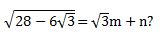
What will be value of (m+n) if we know that
Explanation
Try 28 - 6√3 = (a - b√3)2 = a2 + 3b2 - 2ab√3. So ab = 3 and a2 + 3b2 = 28, which gives a = 1 and b = 3.
So the root = |1 - 3√3| = 3√3 - 1. Comparing with √3 m + n gives m = 3 and n = -1.
m + n = 2.
So the root = |1 - 3√3| = 3√3 - 1. Comparing with √3 m + n gives m = 3 and n = -1.
m + n = 2.
Question 4
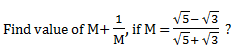
Find the value of M + 1/M (surds).
Explanation
M = (√5 - √3) ÷ (√5 + √3), so 1M = (√5 + √3) ÷ (√5 - √3).
Over the common denominator (√5 + √3)(√5 - √3) = 5 - 3 = 2, the numerator = (√5 - √3)2 + (√5 + √3)2 = (8 - 2√15) + (8 + 2√15) = 16.
M + 1M = 162 = 8.
Over the common denominator (√5 + √3)(√5 - √3) = 5 - 3 = 2, the numerator = (√5 - √3)2 + (√5 + √3)2 = (8 - 2√15) + (8 + 2√15) = 16.
M + 1M = 162 = 8.
Question 5
What is the value of (0.000001)1/3?
Explanation
0.000001 = (0.01)³, so (0.000001)1/3 = 0.01 = 1100.
Question 6
If the value of √28 is approximately 5.2915, then the value of √74 is approximately
Explanation
√28 = 2√7, so √7 = 5.29152 = 2.64575.
√74 = √72 = 2.645752 = 1.3229 (approximately).
√74 = √72 = 2.645752 = 1.3229 (approximately).
Question 7
How many zeroes are there in 200010?
Explanation
200010 = (2 × 10³)10 = 210 × 1030.
210 = 1024 has no trailing zeros, so there are 30 zeros.
210 = 1024 has no trailing zeros, so there are 30 zeros.
Question 8
What is value of M in (p/q)2M+2 = (q/p)9-M
Explanation
qp = (pq)-1, so the right side = (pq)-(9 - M).
Equating the powers: 2M + 2 = M - 9, so M = -11.
Equating the powers: 2M + 2 = M - 9, so M = -11.
Question 9
Find the value of X.
(15)3.5 * (15)x = 158
(15)3.5 * (15)x = 158
Explanation
153.5 × 15x = 153.5 + x = 15⁸, so 3.5 + x = 8.
x = 4.5.
x = 4.5.
Question 10
If 5a = 625, then the value of 5(a – 2) is:
Explanation
5ᵃ = 625 = 5⁴, so a = 4.
5a - 2 = 5² = 25.
5a - 2 = 5² = 25.
Question 11
[ 2 + 2*√6 ] / 2 =
Explanation
(2 + 2√6) ÷ 2 = 2(1 + √6) ÷ 2 = 1 + √6.
Question 12
If m is an integer such that (-2) 2m = 2 9-m then m =
Explanation
(-2)2m = 22m, because the power is even.
22m = 29 - m, so 2m = 9 - m and 3m = 9, so m = 3.
22m = 29 - m, so 2m = 9 - m and 3m = 9, so m = 3.
Question 13
11022 - 11023 =
Explanation
110²² - 110²³ = 10 - 110²³ = 910²³.
Question 14
Find the value of 51/4 × 1251/4.
Explanation
51/4 × 1251/4 = (5 × 125)1/4 = 6251/4 = 5.
Question 15
(√3 + 2)(√3 - 2) = ?
Explanation
Using the difference of squares: (√3)2-22 = 3-4 = -1.
Question 16
32n-1=127n-3. Find n.
Explanation
127n-3 = 3-3(n-3) = 39-3n. So 2n-1=9-3n, giving 5n=10, n=2.
Question 17
(8125)-4/3=?
Explanation
8125=(25)3. [(25)3]-4/3=(25)-4=(52)4=625/16.
Question 18
If xyz=1, find 1/(1+x+y-1)+1/(1+y+z-1)+1/(1+z+x-1)
Explanation
This is a standard cyclic identity that equals 1 whenever xyz=1 (verified with x=2, y=12, z=1: terms are 15 + 25 + 25 = 1).
Question 19
2x=cube root of 64. Find x.
Explanation
Cube root of 64 is 4. 2x=4=22, so x=2.
Question 20
xa=yb=zc and y2=xz. Find b.
Explanation
Let xa=yb=zc=k. Then y2=xz gives k2/b=k1/a+1/c, so 2/b=(a+c)/(ac), giving b=2ac/(a+c).
Question 21
25x+3=253x-4. Find x.
Explanation
Same base, so exponents are equal: x+3=3x-4, giving 7=2x, x=72=14/4.
Question 22
1/(1+xa-b)+1/(1+xb-a)=?
Explanation
Let y=xa-b, so xb-a=1/y. Expression = 1/(1+y) + y/(y+1) = (1+y)/(1+y) = 1.
Question 23
√2n=128. Find n.
Explanation
2n/2=128=27, so n/2=7, n=14.
Question 24
The value of (27216)-2/3 is:
Explanation
27216 = (36)3 = (12)3. [(12)3]-2/3 = (12)-2 = 4.
Question 25
The value of (729)1/3 is
Explanation
93 = 729.