Practice Verbal Reasoning questions on Cube and Cuboid, covering painted cubes, visible and hidden faces, opposite and adjacent faces, cube nets, cutting and counting smaller cubes, and spatial orientation. Takes about 20-25 minutes and is useful for placement, TCS NQT, SSC, banking and MBA entrance exams.
Question 1
The following questions are based on the information given below:
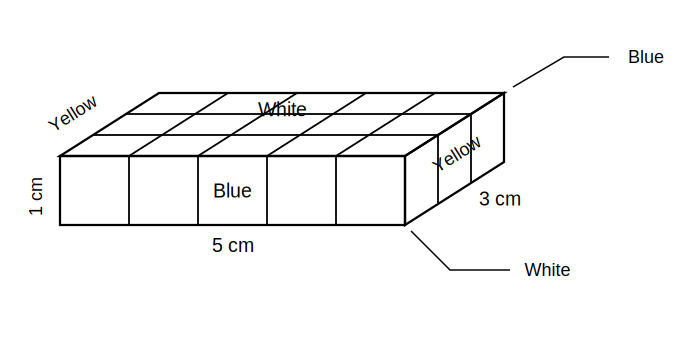
1. A cuboid shaped wooden block has 5 cm length, 3 cm breadth and 1 cm height.
2. Two faces measuring 3 cm × 1 cm are coloured in yellow.
3. Two faces measuring 5 cm × 1 cm are coloured in blue.
4. Two faces measuring 5 cm × 3 cm are coloured in white.
5. The block is divided into 5 equal cubes of side 1 cm (from 5 cm side) and 3 equal cubes of side 1 cm (from 3 cm side).
How many cubes having yellow, blue and white colours on at least one side of the cube will be formed?
1. A cuboid shaped wooden block has 5 cm length, 3 cm breadth and 1 cm height.
2. Two faces measuring 3 cm × 1 cm are coloured in yellow.
3. Two faces measuring 5 cm × 1 cm are coloured in blue.
4. Two faces measuring 5 cm × 3 cm are coloured in white.
5. The block is divided into 5 equal cubes of side 1 cm (from 5 cm side) and 3 equal cubes of side 1 cm (from 3 cm side).
How many cubes having yellow, blue and white colours on at least one side of the cube will be formed?
Explanation
Such cubes are related to the corners of the cuboid. Since the cuboid has 4 corners, the number of such small cubes is 4.
Question 2
The following questions are based on the information given below:
1. A cuboid shaped wooden block has 5 cm length, 3 cm breadth and 1 cm height.
2. Two faces measuring 3 cm × 1 cm are coloured in yellow.
3. Two faces measuring 5 cm × 1 cm are coloured in blue.
4. Two faces measuring 5 cm × 3 cm are coloured in white.
5. The block is divided into 5 equal cubes of side 1 cm (from 5 cm side) and 3 equal cubes of side 1 cm (from 3 cm side).
How many cubes will have only blue and white colours on their faces?
1. A cuboid shaped wooden block has 5 cm length, 3 cm breadth and 1 cm height.
2. Two faces measuring 3 cm × 1 cm are coloured in yellow.
3. Two faces measuring 5 cm × 1 cm are coloured in blue.
4. Two faces measuring 5 cm × 3 cm are coloured in white.
5. The block is divided into 5 equal cubes of side 1 cm (from 5 cm side) and 3 equal cubes of side 1 cm (from 3 cm side).
How many cubes will have only blue and white colours on their faces?
Explanation
These cubes lie along the two blue faces, leaving out the corner cubes. Each blue face has 5 - 2 = 3 of them, so the number is 2 × 3 = 6.
Question 3
The following questions are based on the information given below:
1. A cuboid shaped wooden block has 5 cm length, 3 cm breadth and 1 cm height.
2. Two faces measuring 3 cm × 1 cm are coloured in yellow.
3. Two faces measuring 5 cm × 1 cm are coloured in blue.
4. Two faces measuring 5 cm × 3 cm are coloured in white.
5. The block is divided into 5 equal cubes of side 1 cm (from 5 cm side) and 3 equal cubes of side 1 cm (from 3 cm side).
How many cubes will have only yellow and white colours on their faces?
1. A cuboid shaped wooden block has 5 cm length, 3 cm breadth and 1 cm height.
2. Two faces measuring 3 cm × 1 cm are coloured in yellow.
3. Two faces measuring 5 cm × 1 cm are coloured in blue.
4. Two faces measuring 5 cm × 3 cm are coloured in white.
5. The block is divided into 5 equal cubes of side 1 cm (from 5 cm side) and 3 equal cubes of side 1 cm (from 3 cm side).
How many cubes will have only yellow and white colours on their faces?
Explanation
These cubes lie along the two yellow faces, leaving out the corner cubes. Each yellow face has 3 - 2 = 1 of them, so the number is 2 × 1 = 2.
Question 4
The following questions are based on the information given below:
1. A cuboid shaped wooden block has 5 cm length, 3 cm breadth and 1 cm height.
2. Two faces measuring 3 cm × 1 cm are coloured in yellow.
3. Two faces measuring 5 cm × 1 cm are coloured in blue.
4. Two faces measuring 5 cm × 3 cm are coloured in white.
5. The block is divided into 5 equal cubes of side 1 cm (from 5 cm side) and 3 equal cubes of side 1 cm (from 3 cm side).
How many cubes will have only white colour on them?
1. A cuboid shaped wooden block has 5 cm length, 3 cm breadth and 1 cm height.
2. Two faces measuring 3 cm × 1 cm are coloured in yellow.
3. Two faces measuring 5 cm × 1 cm are coloured in blue.
4. Two faces measuring 5 cm × 3 cm are coloured in white.
5. The block is divided into 5 equal cubes of side 1 cm (from 5 cm side) and 3 equal cubes of side 1 cm (from 3 cm side).
How many cubes will have only white colour on them?
Explanation
These are the middle cubes, which touch neither a yellow nor a blue face. Their number is (5 - 2) × (3 - 2) = 3.
Question 5
The following questions are based on the information given below:
1. A cuboid shaped wooden block has 5 cm length, 3 cm breadth and 1 cm height.
2. Two faces measuring 3 cm × 1 cm are coloured in yellow.
3. Two faces measuring 5 cm × 1 cm are coloured in blue.
4. Two faces measuring 5 cm × 3 cm are coloured in white.
5. The block is divided into 5 equal cubes of side 1 cm (from 5 cm side) and 3 equal cubes of side 1 cm (from 3 cm side).
How many cubes will be formed in all?
1. A cuboid shaped wooden block has 5 cm length, 3 cm breadth and 1 cm height.
2. Two faces measuring 3 cm × 1 cm are coloured in yellow.
3. Two faces measuring 5 cm × 1 cm are coloured in blue.
4. Two faces measuring 5 cm × 3 cm are coloured in white.
5. The block is divided into 5 equal cubes of side 1 cm (from 5 cm side) and 3 equal cubes of side 1 cm (from 3 cm side).
How many cubes will be formed in all?
Explanation
The block is cut into 5 cubes along its length and 3 along its breadth, so there are 5 × 3 × 1 = 15 cubes.