Practice Non Verbal Reasoning questions on Cubes and Dice, covering dice-view opposite-face puzzles, cube nets, painted-cube and cuboid counting, and corner-face reasoning, each with a full explanation and a quick shortcut trick. Each question shows one or more positions of a dice, a cube net or a cut cube, and asks about faces, numbers or painted faces. Study the figure carefully and select the correct answer from the alternatives.
Question 1
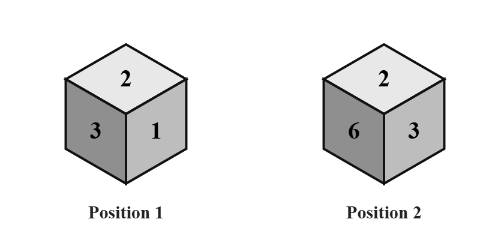
Two different positions of the same dice, with numbers 1 to 6 on its faces, are shown in the figure below. Find the number on the face opposite to the one showing 6.
Explanation
The top face (2) is common to both positions.
In Position 1, Right = 1 and Front = 3, so the hidden Left face is unknown from this view alone.
In Position 2 (the die turned, top still 2), Front = 6 -- this is the value that was on the hidden Left face in Position 1.
Right and Left are always opposite faces on a cube, so the face opposite 1 is 6, which means the face opposite 6 is 1.
In Position 1, Right = 1 and Front = 3, so the hidden Left face is unknown from this view alone.
In Position 2 (the die turned, top still 2), Front = 6 -- this is the value that was on the hidden Left face in Position 1.
Right and Left are always opposite faces on a cube, so the face opposite 1 is 6, which means the face opposite 6 is 1.
Shortcut Method
Right(1) & Left are always opposite
Position 2 Front(6) = Position 1's hidden Left
∴ Left = 6, so opposite of 1 is 6
∴ Opposite of 6 = 1 ✓
Position 2 Front(6) = Position 1's hidden Left
∴ Left = 6, so opposite of 1 is 6
∴ Opposite of 6 = 1 ✓
Question 2
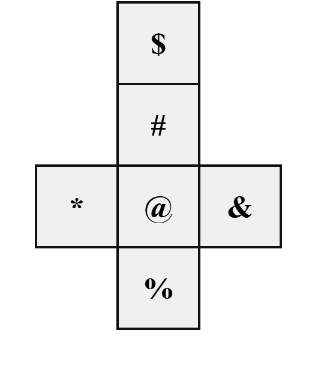
The sheet of paper shown in the figure below is folded to form a cube. Which symbol will be on the face opposite to the one showing @?
Explanation
In this net, the four squares attached directly to the centre square (#, %, &, *) fold up to become the four side faces running around the centre.
The square that extends one step further out beyond one of those side squares (here, $, attached beyond #) always folds around to land on the face directly behind the centre -- that is, opposite to it.
So the face opposite @ is $.
The square that extends one step further out beyond one of those side squares (here, $, attached beyond #) always folds around to land on the face directly behind the centre -- that is, opposite to it.
So the face opposite @ is $.
Shortcut Method
Centre & the far extension square are always opposite
@ is centre, $ extends beyond #
∴ Opposite of @ = $ ✓
@ is centre, $ extends beyond #
∴ Opposite of @ = $ ✓
Question 3
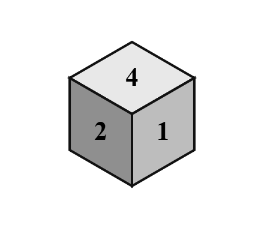
In an ordinary dice, the numbers on any two opposite faces always add up to 7. Using this rule, find the number on the face opposite to the one showing 4, in the dice shown in the figure below.
Explanation
An ordinary (standard) dice always has its opposite faces adding up to 7 -- this is a fixed property, unlike the two- and three-view puzzles where the number arrangement is custom and must be worked out from the given views.
Here the face shown is 4, so the face opposite it is 7 - 4 = 3.
Here the face shown is 4, so the face opposite it is 7 - 4 = 3.
Shortcut Method
Standard dice: opposite faces always sum to 7
Opposite of 4 = 7 - 4
∴ Opposite of 4 = 3 ✓
Opposite of 4 = 7 - 4
∴ Opposite of 4 = 3 ✓
Question 4
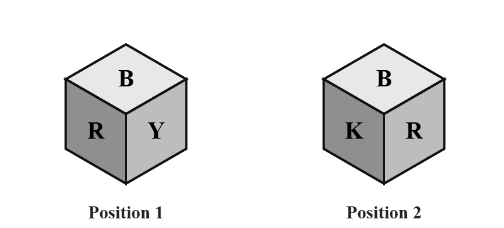
Two different positions of the same dice are shown in the figure below, with the six colours Red (R), Blue (B), Green (G), Yellow (Y), White (W) and Black (K) on its faces. Find the colour on the face opposite to the one showing Black (K).
Explanation
The top face (Blue) is common to both positions.
In Position 1, Right = Yellow and Front = Red, so the hidden Left face is unknown from this view alone.
In Position 2 (top still Blue), Front = Black -- this is the colour that was on the hidden Left face in Position 1.
Right and Left are always opposite faces on a cube, so the face opposite Yellow is Black, which means the face opposite Black is Yellow.
In Position 1, Right = Yellow and Front = Red, so the hidden Left face is unknown from this view alone.
In Position 2 (top still Blue), Front = Black -- this is the colour that was on the hidden Left face in Position 1.
Right and Left are always opposite faces on a cube, so the face opposite Yellow is Black, which means the face opposite Black is Yellow.
Shortcut Method
Right(Yellow) & Left are always opposite
Position 2 Front(Black) = Position 1's hidden Left
∴ Opposite of Black = Yellow ✓
Position 2 Front(Black) = Position 1's hidden Left
∴ Opposite of Black = Yellow ✓
Question 5
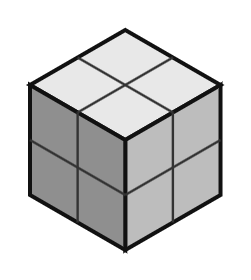
A cube is painted on all of its outer surfaces and then cut into 8 identical smaller cubes, as shown in the figure below. How many of the smaller cubes have exactly 3 painted faces?
Explanation
When a cube is cut into just 2 equal parts along each edge (2 × 2 × 2 = 8 smaller cubes), every single piece is a corner piece -- there is no room left for an edge, face-centre, or interior piece, since those categories only appear once the cube is cut into 3 or more parts per edge.
A corner piece always touches 3 outer faces, so all 8 of the smaller cubes have exactly 3 painted faces.
A corner piece always touches 3 outer faces, so all 8 of the smaller cubes have exactly 3 painted faces.
Shortcut Method
n = 2 → no edge/face-centre/interior pieces exist, only corners
Corners = 8 (all of them)
∴ Cubes with 3 painted faces = 8 ✓
Corners = 8 (all of them)
∴ Cubes with 3 painted faces = 8 ✓
Question 6
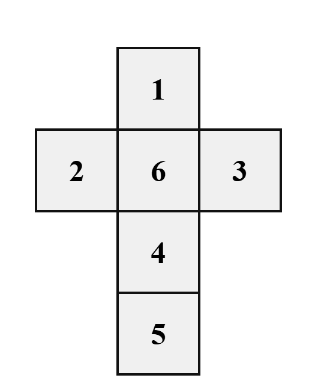
The sheet of paper shown in the figure below is folded to form a cube. Find the number that will be on the face opposite to the one showing 6.
Explanation
The square that extends one step further out beyond one of the side arms (here, 5, attached beyond 4) always folds around to land on the face directly behind the centre square -- that is, opposite to it, no matter which arm carries the extension.
So the face opposite the centre (6) is 5.
So the face opposite the centre (6) is 5.
Shortcut Method
Centre & the far extension square are always opposite
Centre = 6, extension = 5
∴ Opposite of 6 = 5 ✓
Centre = 6, extension = 5
∴ Opposite of 6 = 5 ✓
Question 7
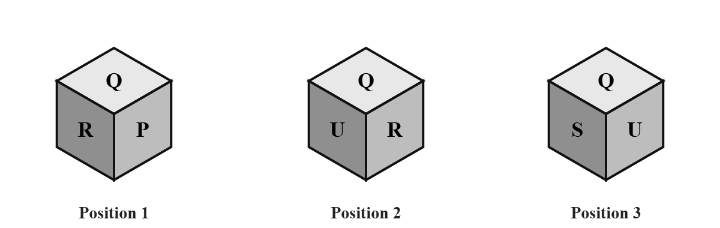
Three different positions of the same dice, with letters P, Q, R, S, T and U on its faces, are shown in the figure below. Find the letter on the face opposite to the one showing R.
Explanation
The top face (Q) is common to all three positions.
Position 1 shows Front = R, Right = P.
Turning the die 90 degrees (top still Q) brings the hidden Left face to the front: Position 2 shows Front = U, so Position 1's hidden Left face was U.
Turning another 90 degrees -- a full 180-degree turn from Position 1 -- brings the hidden Back face to the front: Position 3 shows Front = S, so Position 1's hidden Back face was S.
Front and Back are always opposite faces, so the face opposite R is S.
Position 1 shows Front = R, Right = P.
Turning the die 90 degrees (top still Q) brings the hidden Left face to the front: Position 2 shows Front = U, so Position 1's hidden Left face was U.
Turning another 90 degrees -- a full 180-degree turn from Position 1 -- brings the hidden Back face to the front: Position 3 shows Front = S, so Position 1's hidden Back face was S.
Front and Back are always opposite faces, so the face opposite R is S.
Shortcut Method
Front & Back are always opposite
Position 1 Front = R
Position 3 is a 180° turn, so its Front(S) = Position 1's hidden Back
∴ Opposite of R = S ✓
Position 1 Front = R
Position 3 is a 180° turn, so its Front(S) = Position 1's hidden Back
∴ Opposite of R = S ✓
Question 8
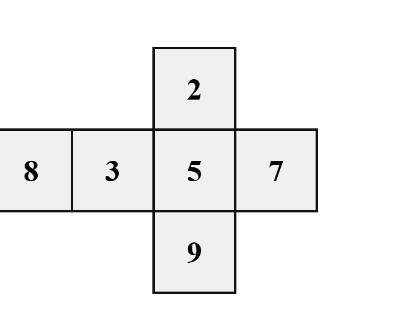
The sheet of paper shown in the figure below is folded to form a cube. Find the number that will be on the face opposite to the one showing 7.
Explanation
The centre square (5) has four squares attached directly to its four sides: 2 (above), 9 (below), 7 (right) and 3 (left), plus one more square (8) extending further out beyond 3.
When folded, the two squares attached directly above and below the centre (2 and 9) become opposite faces of the cube, and the two squares attached directly left and right of the centre (3 and 7) also become opposite faces of the cube -- regardless of where the extra extension square is.
So the face opposite 7 is 3.
When folded, the two squares attached directly above and below the centre (2 and 9) become opposite faces of the cube, and the two squares attached directly left and right of the centre (3 and 7) also become opposite faces of the cube -- regardless of where the extra extension square is.
So the face opposite 7 is 3.
Shortcut Method
Arms on opposite sides of the centre are opposite faces
East = 7, West = 3 (the extension 8 beyond West does not affect this pair)
∴ Opposite of 7 = 3 ✓
East = 7, West = 3 (the extension 8 beyond West does not affect this pair)
∴ Opposite of 7 = 3 ✓
Question 9
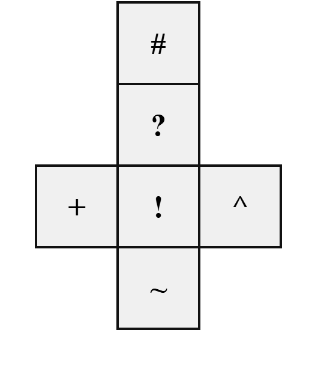
The sheet of paper shown in the figure below is folded to form a cube. Which symbol will be on the face opposite to the one showing '?'
Explanation
The four squares attached directly to the centre square (!) -- ?, ~, ^ and + -- fold up to become the four side faces running around the centre. The squares attached directly above and below the centre on the same arm (? and ~) always fold to become opposite faces of the cube, whichever arm carries the extra extension square.
So the face opposite ? is ~.
So the face opposite ? is ~.
Shortcut Method
Arms directly above & below the centre are opposite faces
North = ?, South = ~
∴ Opposite of ? = ~ ✓
North = ?, South = ~
∴ Opposite of ? = ~ ✓
Question 10
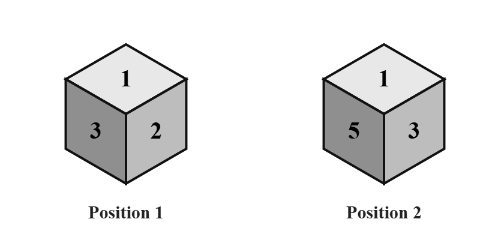
Two different positions of a dice, with numbers 1 to 6 on its faces, are shown in the figure below. Every face of a dice is adjacent to every other face except the one directly opposite it. Using the two positions shown, find the number that is NOT adjacent to the face showing 2.
Explanation
A face is adjacent to every other face except its own opposite, so "not adjacent to 2" simply means "opposite to 2".
The top face (1) is common to both positions.
In Position 1, Right = 2 and Front = 3, so the hidden Left face is unknown from this view alone.
In Position 2 (top still 1), Front = 5 -- this is the value that was on the hidden Left face in Position 1.
Right and Left are always opposite faces on a cube, so the face opposite 2 is 5 -- and that is the one face NOT adjacent to 2.
The top face (1) is common to both positions.
In Position 1, Right = 2 and Front = 3, so the hidden Left face is unknown from this view alone.
In Position 2 (top still 1), Front = 5 -- this is the value that was on the hidden Left face in Position 1.
Right and Left are always opposite faces on a cube, so the face opposite 2 is 5 -- and that is the one face NOT adjacent to 2.
Shortcut Method
"Not adjacent to X" = "opposite of X"
Right(2) & Left are always opposite
Position 2 Front(5) = Position 1's hidden Left
∴ Face not adjacent to 2 = 5 ✓
Right(2) & Left are always opposite
Position 2 Front(5) = Position 1's hidden Left
∴ Face not adjacent to 2 = 5 ✓
Question 11
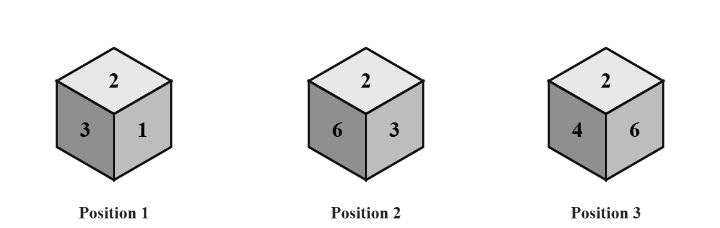
Three different positions of a dice, with numbers 1 to 6 on its faces, are shown in the figure below. Find the number on the face opposite to the one showing 3.
Explanation
The top face (2) is common to all three positions. Position 1 shows Front = 3, Right = 1.
Turning the die 90 degrees (top still 2) brings the hidden Left face to the front: Position 2 shows Front = 6, so Position 1's hidden Left face was 6.
Turning another 90 degrees -- a full 180-degree turn from Position 1 -- brings the hidden Back face to the front: Position 3 shows Front = 4, so Position 1's hidden Back face was 4.
Front and Back are always opposite faces, so the face opposite 3 is 4.
Turning the die 90 degrees (top still 2) brings the hidden Left face to the front: Position 2 shows Front = 6, so Position 1's hidden Left face was 6.
Turning another 90 degrees -- a full 180-degree turn from Position 1 -- brings the hidden Back face to the front: Position 3 shows Front = 4, so Position 1's hidden Back face was 4.
Front and Back are always opposite faces, so the face opposite 3 is 4.
Shortcut Method
Front & Back are always opposite
Position 1 Front = 3
Position 3 is a 180° turn, so its Front(4) = Position 1's hidden Back
∴ Opposite of 3 = 4 ✓
Position 1 Front = 3
Position 3 is a 180° turn, so its Front(4) = Position 1's hidden Back
∴ Opposite of 3 = 4 ✓
Question 12
The sheet of paper shown in the figure below is folded to form a cube. Find the letter that will be on the face opposite to the one showing M.
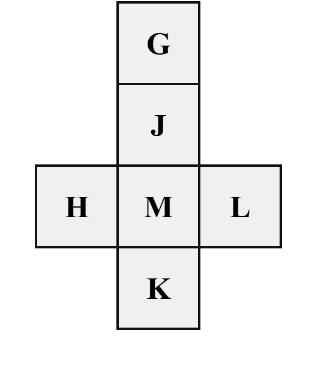
Explanation
The square that extends one step further out beyond one of the side arms (here, G, attached beyond J) always folds around to land on the face directly behind the centre square -- that is, opposite to it.
So the face opposite M is G.
So the face opposite M is G.
Shortcut Method
Centre & the far extension square are always opposite
Centre = M, extension = G
∴ Opposite of M = G ✓
Centre = M, extension = G
∴ Opposite of M = G ✓
Question 13
Three standard dice, where the numbers on opposite faces always add up to 7, are shown below with only their top faces visible. If the top faces of Die 1, Die 2 and Die 3 show 2, 5 and 3 respectively, find the sum of the numbers on the bottom faces of the three dice.
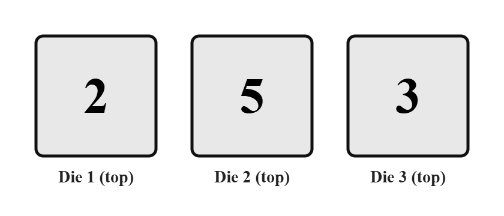
Explanation
On a standard dice, the bottom face is always 7 minus the top face.
Die 1: bottom = 7 - 2 = 5.
Die 2: bottom = 7 - 5 = 2.
Die 3: bottom = 7 - 3 = 4.
Sum of the three bottom faces = 5 + 2 + 4 = 11.
Die 1: bottom = 7 - 2 = 5.
Die 2: bottom = 7 - 5 = 2.
Die 3: bottom = 7 - 3 = 4.
Sum of the three bottom faces = 5 + 2 + 4 = 11.
Shortcut Method
Bottom = 7 - top, for each die
7-2=5, 7-5=2, 7-3=4
∴ Sum of bottoms = 5+2+4 = 11 ✓
7-2=5, 7-5=2, 7-3=4
∴ Sum of bottoms = 5+2+4 = 11 ✓
Question 14
Three different positions of the same dice, with letters D, E, F, G, H and I on its faces, are shown in the figure below. Find the letter on the face opposite to the one showing F.
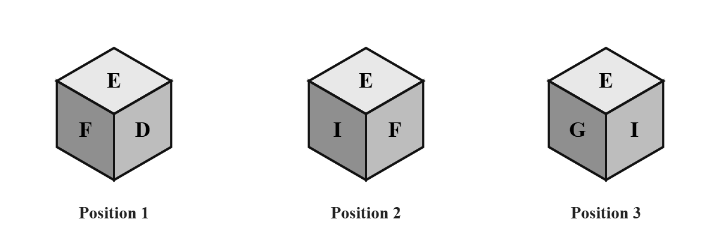
Explanation
The top face (E) is common to all three positions. Position 1 shows Front = F, Right = D.
Turning the die 90 degrees (top still E) brings the hidden Left face to the front: Position 2 shows Front = I, so Position 1's hidden Left face was I.
Turning another 90 degrees -- a full 180-degree turn from Position 1 -- brings the hidden Back face to the front: Position 3 shows Front = G, so Position 1's hidden Back face was G.
Front and Back are always opposite faces, so the face opposite F is G.
Turning the die 90 degrees (top still E) brings the hidden Left face to the front: Position 2 shows Front = I, so Position 1's hidden Left face was I.
Turning another 90 degrees -- a full 180-degree turn from Position 1 -- brings the hidden Back face to the front: Position 3 shows Front = G, so Position 1's hidden Back face was G.
Front and Back are always opposite faces, so the face opposite F is G.
Shortcut Method
Front & Back are always opposite
Position 1 Front = F
Position 3 is a 180° turn, so its Front(G) = Position 1's hidden Back
∴ Opposite of F = G ✓
Position 1 Front = F
Position 3 is a 180° turn, so its Front(G) = Position 1's hidden Back
∴ Opposite of F = G ✓
Question 15
A cube is painted on all of its outer surfaces and then cut into 64 identical smaller cubes, as shown in the figure below. How many of the smaller cubes have exactly 1 painted face?
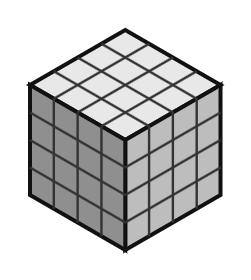
Explanation
Cutting a painted cube into 4 equal parts along each edge (4 × 4 × 4 = 64 smaller cubes): the cubes with exactly 1 painted face are the ones sitting at the centre of each outer face, away from every edge.
On each face of the big cube, the face-centre cubes form a (4-2) × (4-2) = 2 × 2 = 4 square.
There are 6 faces, so the total is 6 × 4 = 24.
On each face of the big cube, the face-centre cubes form a (4-2) × (4-2) = 2 × 2 = 4 square.
There are 6 faces, so the total is 6 × 4 = 24.
Shortcut Method
Face-centre cubes per face = (n-2)²
n = 4 → (4-2)² = 4 per face
6 faces × 4 = 24
∴ Cubes with exactly 1 painted face = 24 ✓
n = 4 → (4-2)² = 4 per face
6 faces × 4 = 24
∴ Cubes with exactly 1 painted face = 24 ✓
Question 16
The sheet of paper shown in the figure below is folded to form a cube. Which symbol will be on the face opposite to the one showing '}'?
![a plus-shaped net of six squares showing the symbols {, }, [, ] and ;, with an extra square marked : attached beyond the ] square](/QuestionImages/non-verbal-reasoning/cubes-and-dice/q18.png)
Explanation
The centre square ({) has four squares attached directly to its sides: } (above), [ (below), ] (right) and ; (left), plus one more square (:) extending further out beyond ].
The two squares attached directly above and below the centre (} and [) always become opposite faces of the cube when folded, regardless of where the extension square is.
So the face opposite } is [.
The two squares attached directly above and below the centre (} and [) always become opposite faces of the cube when folded, regardless of where the extension square is.
So the face opposite } is [.
Shortcut Method
Arms directly above & below the centre are opposite faces
North = }, South = [
∴ Opposite of } = [ ✓
North = }, South = [
∴ Opposite of } = [ ✓
Question 17
A box of dimensions 4 x 3 x 2 units is painted on all of its outer surfaces and then cut into 24 unit cubes, as shown in the figure below. How many of the unit cubes have exactly 1 painted face?
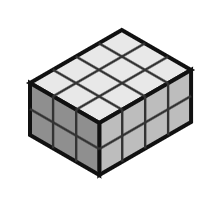
Explanation
For a box of size a × b × c painted on all outer faces and cut into unit cubes, the number of pieces with exactly 1 painted face is 2[(a-2)(b-2) + (b-2)(c-2) + (c-2)(a-2)].
Here a = 4, b = 3, c = 2, so (a-2) = 2, (b-2) = 1, (c-2) = 0.
2[(2 × 1) + (1 × 0) + (0 × 2)] = 2[2 + 0 + 0] = 4.
So the number of unit cubes with exactly 1 painted face is 4.
Here a = 4, b = 3, c = 2, so (a-2) = 2, (b-2) = 1, (c-2) = 0.
2[(2 × 1) + (1 × 0) + (0 × 2)] = 2[2 + 0 + 0] = 4.
So the number of unit cubes with exactly 1 painted face is 4.
Shortcut Method
1-face count = 2[(a-2)(b-2)+(b-2)(c-2)+(c-2)(a-2)]
a=4,b=3,c=2 → (a-2,b-2,c-2)=(2,1,0)
2[(2×1)+(1×0)+(0×2)] = 2×2
∴ Cubes with exactly 1 painted face = 4 ✓
a=4,b=3,c=2 → (a-2,b-2,c-2)=(2,1,0)
2[(2×1)+(1×0)+(0×2)] = 2×2
∴ Cubes with exactly 1 painted face = 4 ✓
Question 18
A box of dimensions 5 x 4 x 3 units is painted on all of its outer surfaces and then cut into 60 unit cubes, as shown in the figure below. How many of the unit cubes have exactly 2 painted faces?
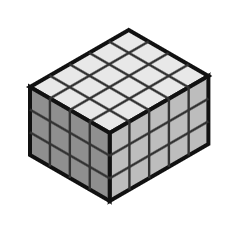
Explanation
For a box of size a × b × c painted on all outer faces and cut into unit cubes, the number of pieces with exactly 2 painted faces (lying along an edge, but not at a corner) is 4[(a-2) + (b-2) + (c-2)].
Here a = 5, b = 4, c = 3, so (a-2) = 3, (b-2) = 2, (c-2) = 1.
4[3 + 2 + 1] = 4 × 6 = 24.
So the number of unit cubes with exactly 2 painted faces is 24.
Here a = 5, b = 4, c = 3, so (a-2) = 3, (b-2) = 2, (c-2) = 1.
4[3 + 2 + 1] = 4 × 6 = 24.
So the number of unit cubes with exactly 2 painted faces is 24.
Shortcut Method
2-face (edge) count = 4[(a-2)+(b-2)+(c-2)]
a=5,b=4,c=3 → (a-2,b-2,c-2)=(3,2,1)
4[3+2+1] = 4×6
∴ Cubes with exactly 2 painted faces = 24 ✓
a=5,b=4,c=3 → (a-2,b-2,c-2)=(3,2,1)
4[3+2+1] = 4×6
∴ Cubes with exactly 2 painted faces = 24 ✓
Question 19
A cube is painted on all of its outer surfaces and then cut into 27 identical smaller cubes, as shown in the figure below. How many of the smaller cubes have exactly 2 painted faces?
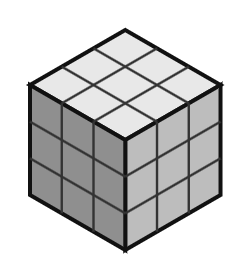
Explanation
Cutting a painted cube into 3 equal parts along each edge (3 × 3 × 3 = 27 smaller cubes) always produces 4 types of pieces:
the 8 corner cubes, each touching 3 outer faces, have 3 painted faces;
the cubes lying along an edge but not at a corner have exactly 2 painted faces -- there are 12 edges, and 1 such cube per edge (3 - 2 = 1), giving 12 cubes;
the cubes at the centre of each face have exactly 1 painted face -- 6 faces × 1 = 6 cubes;
the 1 cube right at the centre of the whole cube is not painted at all.
Check: 8 + 12 + 6 + 1 = 27.
So the number of smaller cubes with exactly 2 painted faces is 12.
the 8 corner cubes, each touching 3 outer faces, have 3 painted faces;
the cubes lying along an edge but not at a corner have exactly 2 painted faces -- there are 12 edges, and 1 such cube per edge (3 - 2 = 1), giving 12 cubes;
the cubes at the centre of each face have exactly 1 painted face -- 6 faces × 1 = 6 cubes;
the 1 cube right at the centre of the whole cube is not painted at all.
Check: 8 + 12 + 6 + 1 = 27.
So the number of smaller cubes with exactly 2 painted faces is 12.
Shortcut Method
For an n×n×n painted cube cut into n³ pieces:
corners (3 faces) = 8, edges (2 faces) = 12(n-2), face-centres (1 face) = 6(n-2)², core (0 faces) = (n-2)³
n = 3 → edges = 12 × 1 = 12
∴ Cubes with exactly 2 painted faces = 12 ✓
corners (3 faces) = 8, edges (2 faces) = 12(n-2), face-centres (1 face) = 6(n-2)², core (0 faces) = (n-2)³
n = 3 → edges = 12 × 1 = 12
∴ Cubes with exactly 2 painted faces = 12 ✓
Question 20
A cube is painted on all of its outer surfaces and then cut into 125 identical smaller cubes, as shown in the figure below. How many of the smaller cubes have exactly 2 painted faces?
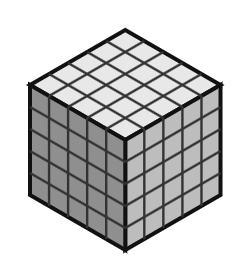
Explanation
For an n × n × n cube painted on all outer faces and cut into n³ unit cubes, the number of pieces with exactly 2 painted faces (lying along an edge but not at a corner) is 12(n-2), since there are 12 edges and (n-2) such cubes along each edge.
Here n = 5, so 12(5-2) = 12 × 3 = 36.
So the number of unit cubes with exactly 2 painted faces is 36.
Here n = 5, so 12(5-2) = 12 × 3 = 36.
So the number of unit cubes with exactly 2 painted faces is 36.
Shortcut Method
Edge cubes (2 faces) = 12(n-2)
n = 5 → 12 × 3
∴ Cubes with exactly 2 painted faces = 36 ✓
n = 5 → 12 × 3
∴ Cubes with exactly 2 painted faces = 36 ✓
Question 21
The numbers on all six faces of an ordinary dice (1 to 6) add up to 21. The figure below shows the three faces meeting at one corner of the dice, displaying 1, 2 and 3. Find the sum of the numbers on the three faces that meet at the corner diagonally opposite to it.
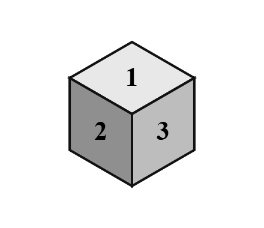
Explanation
The three faces meeting at the corner diagonally opposite a given corner are simply the individual opposites of the three faces at the given corner -- reaching the far corner means crossing to the opposite face along all three directions at once.
Using the standard rule that opposite faces add up to 7: opposite of 1 is 6, opposite of 2 is 5, and opposite of 3 is 4.
Sum at the opposite corner = 6 + 5 + 4 = 15.
Using the standard rule that opposite faces add up to 7: opposite of 1 is 6, opposite of 2 is 5, and opposite of 3 is 4.
Sum at the opposite corner = 6 + 5 + 4 = 15.
Shortcut Method
Opposite corner faces = 7 minus each given face
(7-1)+(7-2)+(7-3) = 6+5+4
∴ Sum at opposite corner = 15 ✓
(7-1)+(7-2)+(7-3) = 6+5+4
∴ Sum at opposite corner = 15 ✓
Question 22
A cube is painted on only its 4 side faces (the top and bottom faces are left unpainted) and then cut into 27 identical smaller cubes, as shown in the figure below. How many of the smaller cubes have exactly 1 painted face?
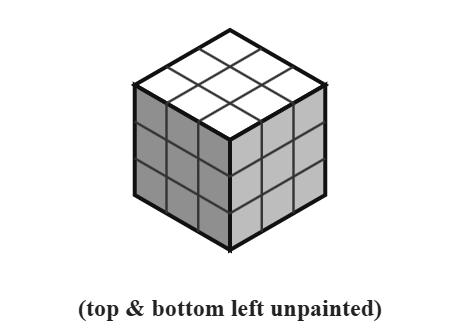
Explanation
Only the 4 side faces are painted here -- the top and bottom are left unpainted. A unit cube's painted-face count depends only on whether it lies on the outer boundary along the two painted horizontal directions; its position along the unpainted vertical direction never adds a painted face.
A unit cube has exactly 1 painted face when it sits on the boundary in exactly one of the two painted horizontal directions and in the middle position in the other direction. There are 4 such combinations (2 with the first direction on the boundary and the second in the middle, and 2 the other way round), and each combination can occur at any of the 3 positions along the unpainted vertical direction.
So the count is 4 × 3 = 12.
A unit cube has exactly 1 painted face when it sits on the boundary in exactly one of the two painted horizontal directions and in the middle position in the other direction. There are 4 such combinations (2 with the first direction on the boundary and the second in the middle, and 2 the other way round), and each combination can occur at any of the 3 positions along the unpainted vertical direction.
So the count is 4 × 3 = 12.
Shortcut Method
Only 4 side faces painted (top/bottom left plain)
Exactly-1-face combos (horizontal) = 4, free vertical positions = 3
4 × 3 = 12
∴ Cubes with exactly 1 painted face = 12 ✓
Exactly-1-face combos (horizontal) = 4, free vertical positions = 3
4 × 3 = 12
∴ Cubes with exactly 1 painted face = 12 ✓
Question 23
A solid is built by stacking 3 layers of identical unit cubes as shown in the figure below: the bottom layer is a 3 x 3 arrangement, the middle layer is a 2 x 2 arrangement placed on top of it, and the top layer is a single cube. Find the total number of unit cubes used.
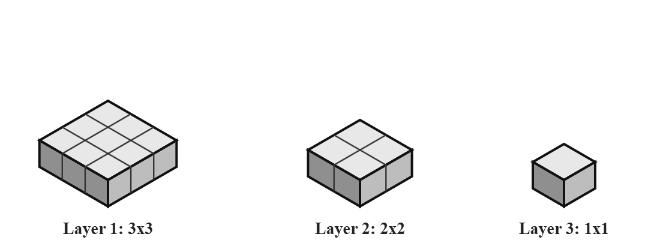
Explanation
The solid is built from 3 stacked layers: the bottom layer is a 3 × 3 arrangement (9 cubes), the middle layer is a 2 × 2 arrangement (4 cubes), and the top layer is a single cube (1 cube).
Total number of cubes = 9 + 4 + 1 = 14.
Total number of cubes = 9 + 4 + 1 = 14.
Shortcut Method
Layer 1 = 3×3 = 9
Layer 2 = 2×2 = 4
Layer 3 = 1×1 = 1
∴ Total cubes = 9+4+1 = 14 ✓
Layer 2 = 2×2 = 4
Layer 3 = 1×1 = 1
∴ Total cubes = 9+4+1 = 14 ✓
Question 24
A cube is painted on all of its outer surfaces and then cut into 64 identical smaller cubes, as shown in the figure below. If all the smaller cubes with no painted faces are removed, how many smaller cubes remain?
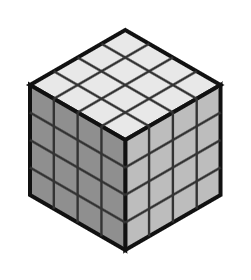
Explanation
The cube is cut into 4 × 4 × 4 = 64 smaller cubes. The unit cubes with 0 painted faces are the ones completely inside, away from every outer face -- they form a smaller (4-2) × (4-2) × (4-2) = 2 × 2 × 2 = 8 cube right at the centre.
Removing these 8 unpainted cubes leaves 64 - 8 = 56 smaller cubes.
Removing these 8 unpainted cubes leaves 64 - 8 = 56 smaller cubes.
Shortcut Method
Interior (0-face) cubes = (n-2)³
n = 4 → (4-2)³ = 8
Remaining = 64 - 8
∴ Cubes remaining = 56 ✓
n = 4 → (4-2)³ = 8
Remaining = 64 - 8
∴ Cubes remaining = 56 ✓
Question 25
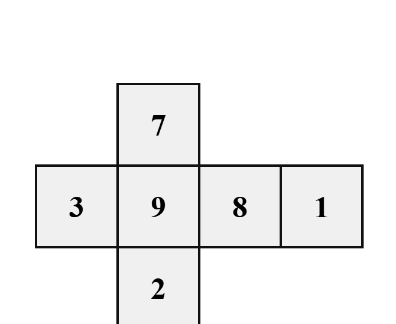
The sheet of paper shown in the figure below is folded to form a cube. Find the number that will be on the face opposite to the one showing 7, given that the numbers 9, 7, 2, 8, 3 and 1 are on its six faces.
Explanation
The centre square (9) has four squares attached directly to its sides: 7 (above), 2 (below), 8 (right) and 3 (left), plus one more square (1) extending further out beyond 8.
The two squares attached directly above and below the centre (7 and 2) always become opposite faces of the cube when folded, regardless of where the extension square is.
So the face opposite 7 is 2.
The two squares attached directly above and below the centre (7 and 2) always become opposite faces of the cube when folded, regardless of where the extension square is.
So the face opposite 7 is 2.
Shortcut Method
Arms directly above & below the centre are opposite faces
North = 7, South = 2
∴ Opposite of 7 = 2 ✓
North = 7, South = 2
∴ Opposite of 7 = 2 ✓
Question 26
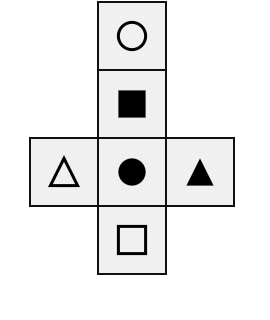
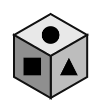
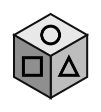
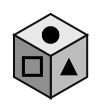
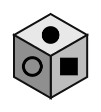
The sheet of paper shown in the figure below is folded to form a cube. Which of the following cubes CANNOT be formed by folding it?
A
 ✓✗
✓✗B
 ✓✗
✓✗C
 ✓✗
✓✗D
 ✓✗
✓✗Explanation
In the net, the centre square (filled circle) and the extension square (outline circle) are attached two steps apart along the same arm, so when folded they always land on opposite faces of the cube -- they can never be seen together on the same view.
Option 4 shows both the filled circle and the outline circle at once, so it cannot be formed by folding this sheet.
Options 1, 2 and 3 each show three faces that are mutually non-opposite (one face from each of the three opposite pairs), so all three are valid.
Option 4 shows both the filled circle and the outline circle at once, so it cannot be formed by folding this sheet.
Options 1, 2 and 3 each show three faces that are mutually non-opposite (one face from each of the three opposite pairs), so all three are valid.
Shortcut Method
Centre & extension square are always opposite -- can never appear together
Option 4 shows both the filled circle (centre) & outline circle (extension)
∴ Option 4 cannot be formed ✓
Option 4 shows both the filled circle (centre) & outline circle (extension)
∴ Option 4 cannot be formed ✓
Question 27
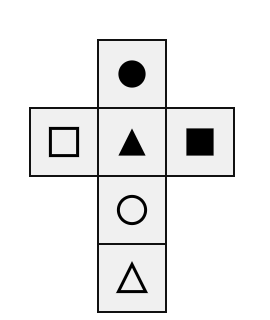
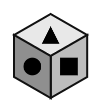
Study the net shown in the figure below, which is to be folded into a cube. Select the cube that CANNOT result from folding this sheet.
A
 ✓✗
✓✗B
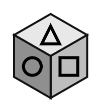 ✓✗
✓✗C
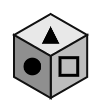 ✓✗
✓✗D
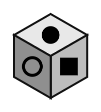 ✓✗
✓✗Explanation
In the net, the two arms attached directly above and below the centre (filled circle and outline circle) sit on opposite sides of the centre square, so when folded they always land on opposite faces of the cube.
Option 4 shows both the filled circle and the outline circle at once, so it cannot be formed by folding this sheet.
Options 1, 2 and 3 each show three mutually non-opposite faces, so all three are valid.
Option 4 shows both the filled circle and the outline circle at once, so it cannot be formed by folding this sheet.
Options 1, 2 and 3 each show three mutually non-opposite faces, so all three are valid.
Shortcut Method
Arms directly above & below the centre are always opposite -- can never appear together
Option 4 shows both the filled circle & outline circle
∴ Option 4 cannot be formed ✓
Option 4 shows both the filled circle & outline circle
∴ Option 4 cannot be formed ✓
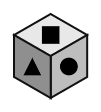
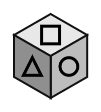
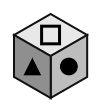
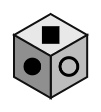
Question 28
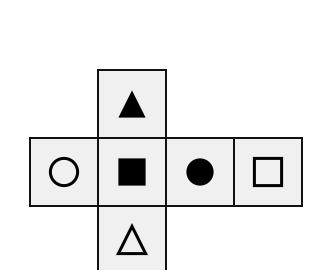
If the sheet of paper shown in the figure below is folded along the lines to form a cube, which of the given four cubes is NOT a possible result?
A
 ✓✗
✓✗B
 ✓✗
✓✗C
 ✓✗
✓✗D
 ✓✗
✓✗Explanation
In the net, the two arms attached directly left and right of the centre (filled circle and outline circle) sit on opposite sides of the centre square, so when folded they always land on opposite faces of the cube.
Option 4 shows both the filled circle and the outline circle at once, so it cannot be formed by folding this sheet.
Options 1, 2 and 3 each show three mutually non-opposite faces, so all three are valid.
Option 4 shows both the filled circle and the outline circle at once, so it cannot be formed by folding this sheet.
Options 1, 2 and 3 each show three mutually non-opposite faces, so all three are valid.
Shortcut Method
Arms directly left & right of the centre are always opposite -- can never appear together
Option 4 shows both the filled circle & outline circle
∴ Option 4 cannot be formed ✓
Option 4 shows both the filled circle & outline circle
∴ Option 4 cannot be formed ✓
Question 29
The given sheet of paper is folded to form a cube, as shown in the figure below. Identify the one cube among the options that CANNOT be obtained by folding it.
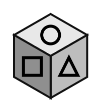
A
 ✓✗
✓✗B
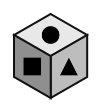 ✓✗
✓✗C
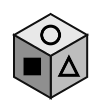 ✓✗
✓✗D
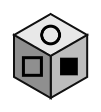 ✓✗
✓✗Explanation
In the net, the two arms attached directly above and below the centre (outline square and filled square) sit on opposite sides of the centre square, so when folded they always land on opposite faces of the cube.
Option 4 shows both the outline square and the filled square at once, so it cannot be formed by folding this sheet.
Options 1, 2 and 3 each show three mutually non-opposite faces, so all three are valid.
Option 4 shows both the outline square and the filled square at once, so it cannot be formed by folding this sheet.
Options 1, 2 and 3 each show three mutually non-opposite faces, so all three are valid.
Shortcut Method
Arms directly above & below the centre are always opposite -- can never appear together
Option 4 shows both the outline square & filled square
∴ Option 4 cannot be formed ✓
Option 4 shows both the outline square & filled square
∴ Option 4 cannot be formed ✓
Question 30
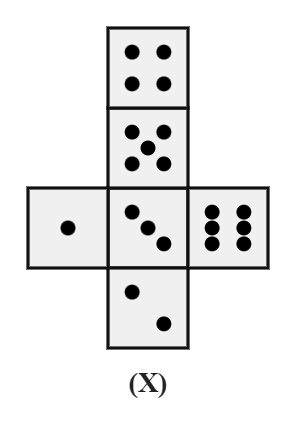
The sheet of paper shown in the figure below has dots marked on its six faces. When it is folded to form a cube, how many dots will lie on the face opposite to the one having 5 dots?
Explanation
The arms attached directly above and below the centre square (5 dots and 2 dots) sit on opposite sides of the centre, so when folded they always land on opposite faces of the cube, regardless of where the extension square is.
So the face opposite the 5-dot face has 2 dots.
So the face opposite the 5-dot face has 2 dots.
Shortcut Method
Arms directly above & below the centre are opposite faces
North = 5 dots, South = 2 dots
∴ Opposite of 5 dots = 2 dots ✓
North = 5 dots, South = 2 dots
∴ Opposite of 5 dots = 2 dots ✓
Question 31
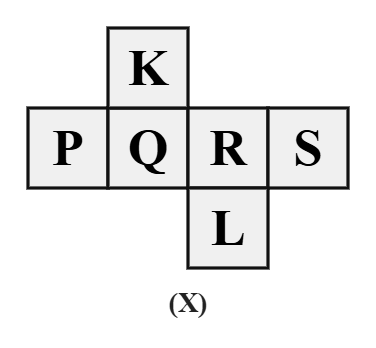
A sheet of paper with letters marked on its six faces is shown in the figure below. If it is folded to form a cube, which letter will be on the face opposite to the one showing K?
Explanation
When a row of four squares is rolled into a tube to form four sides of a cube, each square keeps its own up/down edge pointing the same way throughout the fold. So the square attached above Q (K) always folds onto the top face, and the square attached below R (L) always folds onto the bottom face -- and top and bottom are always opposite each other.
So the face opposite K is L.
So the face opposite K is L.
Shortcut Method
Tab above a row-square → top face; tab below a row-square → bottom face
Top & bottom are always opposite
∴ Opposite of K = L ✓
Top & bottom are always opposite
∴ Opposite of K = L ✓
Question 32
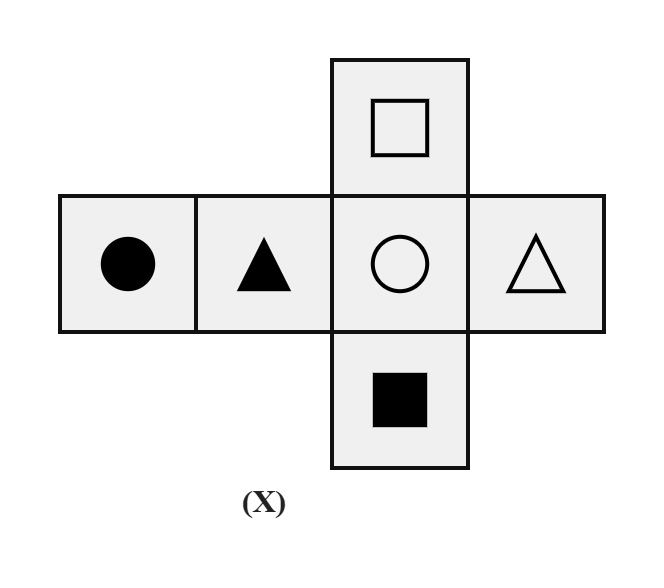
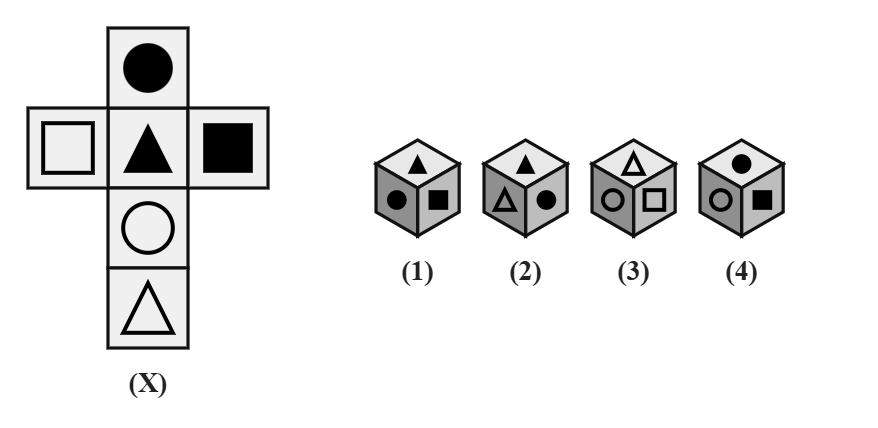
The sheet of paper shown in figure (X) is folded to form a cube. Choose the box(es) among (1), (2), (3) and (4) that can be formed by folding it.
Explanation
The three opposite pairs on this net are: filled/outline triangle (centre/extension), filled/outline circle (North/South arms), and filled/outline square (East/West arms).
Cube (1) shows a filled triangle, filled circle and filled square -- one face from each pair -- so it is valid.
Cube (2) shows both the filled and outline triangle together, which is impossible.
Cube (3) shows an outline triangle, outline circle and outline square -- one face from each pair -- so it is also valid.
Cube (4) shows both the filled and outline circle together, which is impossible.
So cubes (1) and (3) can be formed.
Cube (1) shows a filled triangle, filled circle and filled square -- one face from each pair -- so it is valid.
Cube (2) shows both the filled and outline triangle together, which is impossible.
Cube (3) shows an outline triangle, outline circle and outline square -- one face from each pair -- so it is also valid.
Cube (4) shows both the filled and outline circle together, which is impossible.
So cubes (1) and (3) can be formed.
Shortcut Method
(1) and (3) = one face from each opposite pair ✓
(2) shows both triangles, (4) shows both circles → impossible
∴ Only (1) and (3) can be formed ✓
(2) shows both triangles, (4) shows both circles → impossible
∴ Only (1) and (3) can be formed ✓
Question 33
Figure (X) below shows a sheet of paper that is folded along the lines to form a cube. From the four cubes (1) to (4) shown, select the one(s) that match the cube so formed.
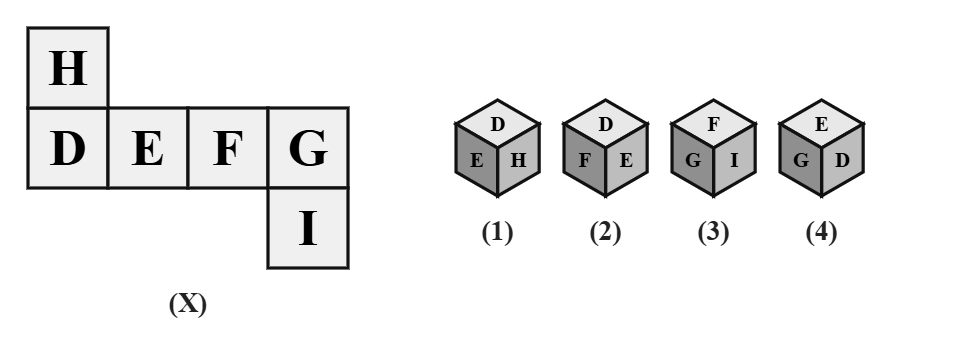
Explanation
On this net, D and F are opposite (they are the 1st and 3rd squares of the row), E and G are opposite (2nd and 4th squares), and H and I are opposite (the tab above D and the tab below G).
Cube (1) shows D, E and H -- one face from each opposite pair -- so it is valid.
Cube (2) shows both D and F together, which is impossible.
Cube (3) shows F, G and I -- one face from each opposite pair -- so it is also valid.
Cube (4) shows both E and G together, which is impossible.
So cubes (1) and (3) can be formed.
Cube (1) shows D, E and H -- one face from each opposite pair -- so it is valid.
Cube (2) shows both D and F together, which is impossible.
Cube (3) shows F, G and I -- one face from each opposite pair -- so it is also valid.
Cube (4) shows both E and G together, which is impossible.
So cubes (1) and (3) can be formed.
Shortcut Method
Row squares 1 & 3 opposite, 2 & 4 opposite; top tab & bottom tab opposite
(1) and (3) = one face from each pair ✓
(2) shows D & F, (4) shows E & G → impossible
∴ Only (1) and (3) can be formed ✓
(1) and (3) = one face from each pair ✓
(2) shows D & F, (4) shows E & G → impossible
∴ Only (1) and (3) can be formed ✓
Question 34
A sheet of paper with dots on its six faces is shown in the figure below. When folded to form a cube, how many dots lie opposite to the face having 6 dots?
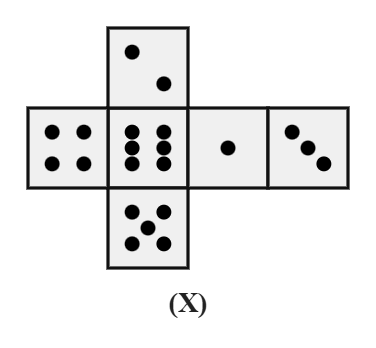
Explanation
The square that extends one step further out beyond a side arm (here, the 3-dot square, attached beyond the 1-dot arm) always folds around to land on the face directly behind the centre square -- that is, opposite to it, no matter which arm carries the extension.
So the face opposite the centre (6 dots) has 3 dots.
So the face opposite the centre (6 dots) has 3 dots.
Shortcut Method
Centre & the far extension square are always opposite
Centre = 6 dots, extension = 3 dots
∴ Opposite of 6 dots = 3 dots ✓
Centre = 6 dots, extension = 3 dots
∴ Opposite of 6 dots = 3 dots ✓
Question 35
Study the sheet of paper shown below, which has dots marked on its six faces. When folded to form a cube, how many dots will lie opposite to the face having 4 dots?
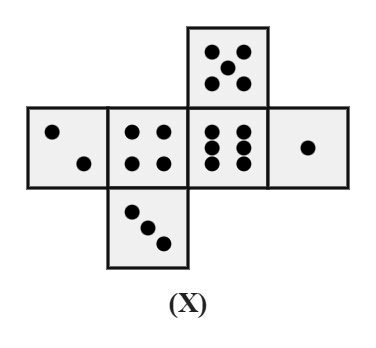
Explanation
On this net, the 2-dot and 6-dot squares are opposite (1st and 3rd squares of the row), the 4-dot and 1-dot squares are opposite (2nd and 4th squares), and the 5-dot and 3-dot tabs are opposite each other.
So the face opposite the 4-dot face has 1 dot.
So the face opposite the 4-dot face has 1 dot.
Shortcut Method
Row squares 1 & 3 opposite, 2 & 4 opposite
4-dot square is the 2nd square, 1-dot square is the 4th square
∴ Opposite of 4 dots = 1 dot ✓
4-dot square is the 2nd square, 1-dot square is the 4th square
∴ Opposite of 4 dots = 1 dot ✓
Question 36
When the sheet of paper shown as figure (X) is folded to make a cube, which of the boxes (1), (2), (3) and (4) shown alongside represent the resulting cube?
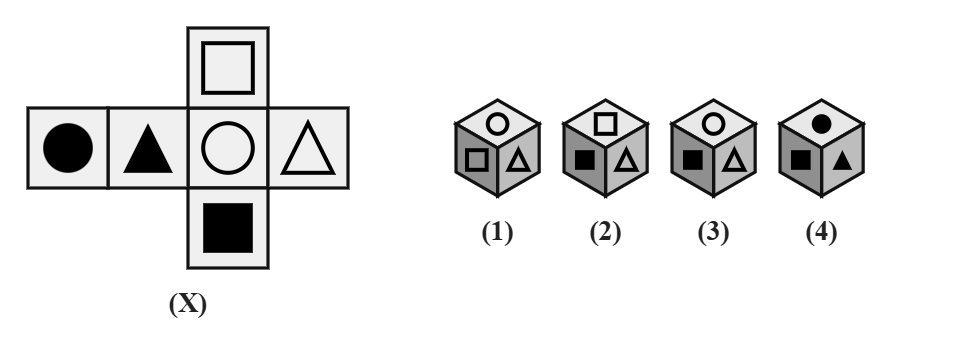
Explanation
Cubes (1), (3) and (4) each show one face from every opposite pair (outline/filled circle, outline/filled square, outline/filled triangle), so all three are valid.
Cube (2) shows both the outline and filled square together (the opposite North/South arms), which is impossible.
So cubes (1), (3) and (4) can be formed.
Cube (2) shows both the outline and filled square together (the opposite North/South arms), which is impossible.
So cubes (1), (3) and (4) can be formed.
Shortcut Method
(1),(3),(4) = one face from each opposite pair ✓
(2) shows both squares together → impossible
∴ (1), (3) and (4) can be formed ✓
(2) shows both squares together → impossible
∴ (1), (3) and (4) can be formed ✓
Question 37
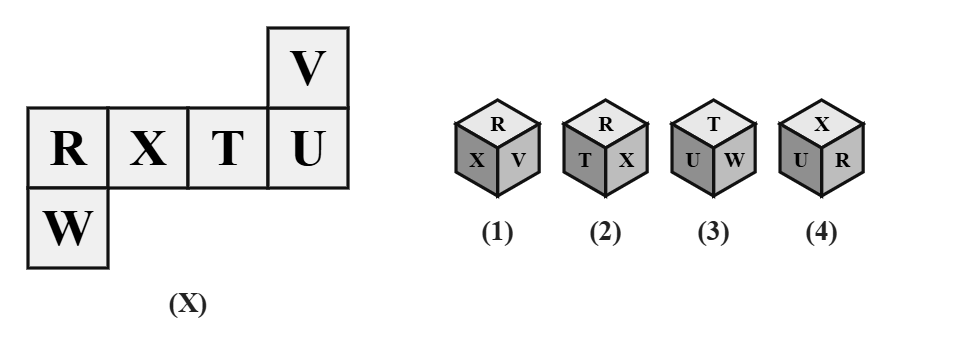
Observe the sheet of paper marked (X) in the figure below. If it is folded to form a cube, identify which of the four given boxes could be the result.
Explanation
On this net, R and T are opposite (1st and 3rd squares), X and U are opposite (2nd and 4th squares), and V and W are opposite (the tab above U and the tab below R).
Cube (1) shows R, X and V -- one face from each opposite pair -- so it is valid.
Cube (2) shows both R and T together, which is impossible.
Cube (3) shows T, U and W -- one face from each opposite pair -- so it is also valid.
Cube (4) shows both X and U together, which is impossible.
So cubes (1) and (3) can be formed.
Cube (1) shows R, X and V -- one face from each opposite pair -- so it is valid.
Cube (2) shows both R and T together, which is impossible.
Cube (3) shows T, U and W -- one face from each opposite pair -- so it is also valid.
Cube (4) shows both X and U together, which is impossible.
So cubes (1) and (3) can be formed.
Shortcut Method
Row squares 1 & 3 opposite, 2 & 4 opposite; top tab & bottom tab opposite
(1) and (3) = one face from each pair ✓
(2) shows R & T, (4) shows X & U → impossible
∴ Only (1) and (3) can be formed ✓
(1) and (3) = one face from each pair ✓
(2) shows R & T, (4) shows X & U → impossible
∴ Only (1) and (3) can be formed ✓
Question 38
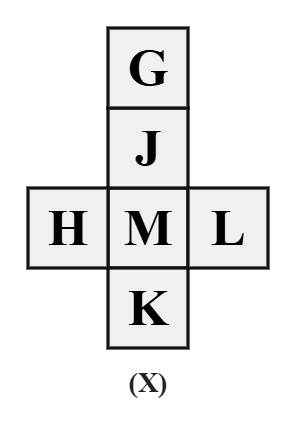
The given sheet of paper (X) is folded along its lines to form a cube. Which letter will be on the face opposite to the one showing J?
Explanation
The arms attached directly above and below the centre square (J and K) sit on opposite sides of the centre, so when folded they always land on opposite faces of the cube, regardless of where the extension square is.
So the face opposite J is K.
So the face opposite J is K.
Shortcut Method
Arms directly above & below the centre are opposite faces
North = J, South = K
∴ Opposite of J = K ✓
North = J, South = K
∴ Opposite of J = K ✓
Question 39
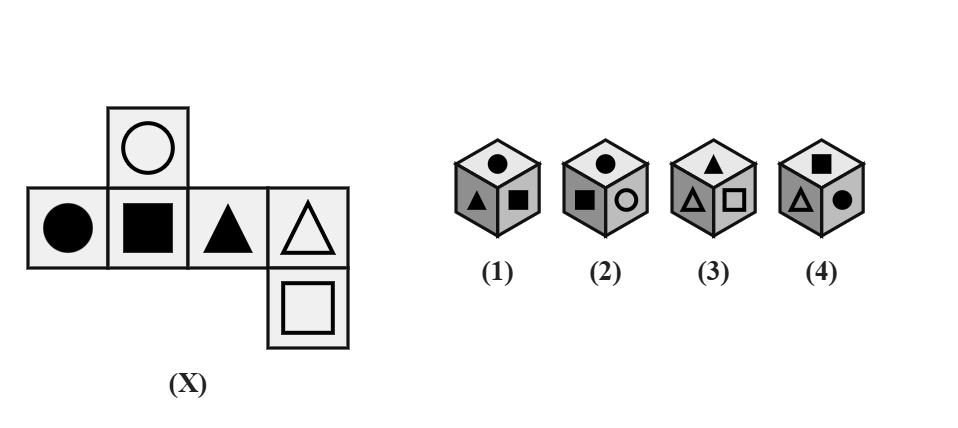
The figure below shows a sheet of paper (X) that will be folded to form a cube. Identify which of the four boxes (1), (2), (3) and (4) are valid results.
Explanation
On this net, the filled circle and the filled triangle are the 1st and 3rd squares of the row, so they are opposite; the filled square and the outline triangle are the 2nd and 4th squares, so they are opposite; and the outline circle and outline square tabs are opposite each other.
Cube (1) shows the filled circle and filled triangle together, which is impossible.
Cube (2) shows the filled circle, filled square and outline circle -- one face from each opposite pair -- so it is valid.
Cube (3) shows the filled triangle, outline triangle and outline square -- one face from each opposite pair -- so it is also valid.
Cube (4) shows the filled square and outline triangle together, which is impossible.
So cubes (2) and (3) can be formed.
Cube (1) shows the filled circle and filled triangle together, which is impossible.
Cube (2) shows the filled circle, filled square and outline circle -- one face from each opposite pair -- so it is valid.
Cube (3) shows the filled triangle, outline triangle and outline square -- one face from each opposite pair -- so it is also valid.
Cube (4) shows the filled square and outline triangle together, which is impossible.
So cubes (2) and (3) can be formed.
Shortcut Method
Row squares 1 & 3 opposite, 2 & 4 opposite; top tab & bottom tab opposite
(2) and (3) = one face from each pair ✓
(1) shows both S1 & S3, (4) shows both S2 & S4 → impossible
∴ Only (2) and (3) can be formed ✓
(2) and (3) = one face from each pair ✓
(1) shows both S1 & S3, (4) shows both S2 & S4 → impossible
∴ Only (2) and (3) can be formed ✓
Question 40
A dice is numbered from 1 to 6 in different ways. If 1 is opposite to 3 and adjacent to 5 and 6, then which of the following statements is necessarily true?
Explanation
Every face of a cube is adjacent to every other face except the one directly opposite it. Since 1 and 3 are already confirmed as a fully opposite pair, neither of them can be opposite to any other number.
That means every one of the remaining numbers -- 2, 4, 5 and 6 -- must be adjacent to BOTH 1 and 3.
In particular, 4 is necessarily adjacent to both 1 and 3, regardless of how 2, 4, 5 and 6 happen to pair up among themselves. The other options each claim a specific opposite pairing among 2, 4, 5 and 6, which the given information does not fix.
That means every one of the remaining numbers -- 2, 4, 5 and 6 -- must be adjacent to BOTH 1 and 3.
In particular, 4 is necessarily adjacent to both 1 and 3, regardless of how 2, 4, 5 and 6 happen to pair up among themselves. The other options each claim a specific opposite pairing among 2, 4, 5 and 6, which the given information does not fix.
Shortcut Method
1-3 already a full opposite pair → every other face (2,4,5,6) MUST be adjacent to both 1 and 3
∴ "4 is adjacent to 1 and 3" is necessarily true ✓
∴ "4 is adjacent to 1 and 3" is necessarily true ✓
Question 41
A dice is numbered from 1 to 6 in different ways. If 4 is opposite to 6 and adjacent to 2 and 5, then which of the following statements is necessarily true?
Explanation
Every face of a cube is adjacent to every other face except the one directly opposite it. Since 4 and 6 are already confirmed as a fully opposite pair, neither of them can be opposite to any other number.
That means every one of the remaining numbers -- 1, 2, 3 and 5 -- must be adjacent to BOTH 4 and 6.
In particular, 1 is necessarily adjacent to both 4 and 6, regardless of how 1, 2, 3 and 5 happen to pair up among themselves. The other options each claim a specific opposite pairing among 1, 2, 3 and 5, which the given information does not fix.
That means every one of the remaining numbers -- 1, 2, 3 and 5 -- must be adjacent to BOTH 4 and 6.
In particular, 1 is necessarily adjacent to both 4 and 6, regardless of how 1, 2, 3 and 5 happen to pair up among themselves. The other options each claim a specific opposite pairing among 1, 2, 3 and 5, which the given information does not fix.
Shortcut Method
4-6 already a full opposite pair → every other face (1,2,3,5) MUST be adjacent to both 4 and 6
∴ "1 is adjacent to 4 and 6" is necessarily true ✓
∴ "1 is adjacent to 4 and 6" is necessarily true ✓
Question 42
A dice is numbered from 1 to 6 in different ways. If 2 is opposite to 5 and adjacent to 1 and 3, then which of the following statements is necessarily true?
Explanation
Every face of a cube is adjacent to every other face except the one directly opposite it. Since 2 and 5 are already confirmed as a fully opposite pair, no other number can be opposite to either 2 or 5.
That means every one of the remaining numbers -- 1, 3, 4 and 6 -- must be adjacent to BOTH 2 and 5, since none of them can be the one face that is opposite.
In particular, 6 is necessarily adjacent to both 2 and 5. This holds no matter how 1, 3, 4 and 6 happen to pair up with each other on the remaining faces, so it is the only statement that is necessarily (not just possibly) true. The other options each claim a SPECIFIC opposite pairing among 1, 3, 4 and 6, which is not fixed by the given information.
That means every one of the remaining numbers -- 1, 3, 4 and 6 -- must be adjacent to BOTH 2 and 5, since none of them can be the one face that is opposite.
In particular, 6 is necessarily adjacent to both 2 and 5. This holds no matter how 1, 3, 4 and 6 happen to pair up with each other on the remaining faces, so it is the only statement that is necessarily (not just possibly) true. The other options each claim a SPECIFIC opposite pairing among 1, 3, 4 and 6, which is not fixed by the given information.
Shortcut Method
2-5 already a full opposite pair → every other face (1,3,4,6) MUST be adjacent to both 2 and 5
∴ "6 is adjacent to 2 and 5" is necessarily true ✓
∴ "6 is adjacent to 2 and 5" is necessarily true ✓
Question 43
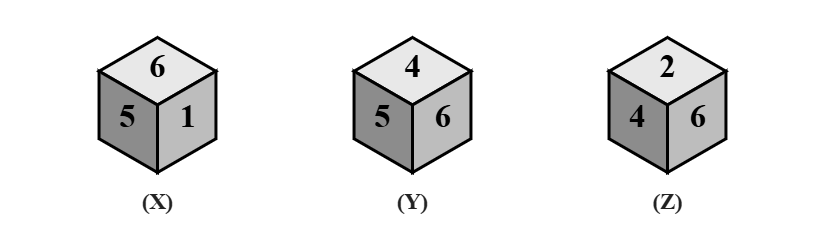
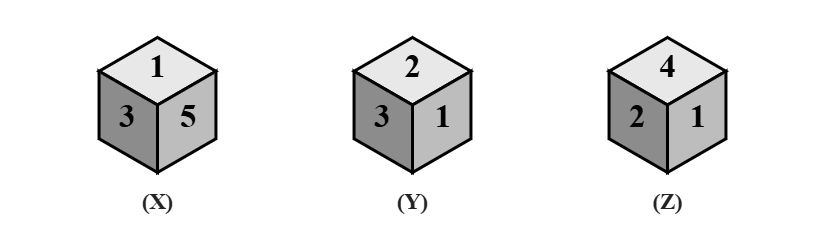
The figure below shows three different positions X, Y and Z of the same dice. Identify the number that lies on the bottom face in position X.
Explanation
In position X, the top face shows 6, so we need the face opposite 6.
From X, the faces 5 and 1 are adjacent to 6 (its Front and Right faces).
From Y (top 4, front 5, right 6), the number 6 is seen together with 4 and 5, so 4 is also adjacent to 6.
From Z (top 2, front 4, right 6), the number 6 is seen together with 2 and 4, so 2 is also adjacent to 6.
Altogether, 5, 1, 4 and 2 are confirmed adjacent to 6 -- all four faces a cube face can be adjacent to. The one remaining number, 3, must be the face opposite 6. Since 6 is on top in position X, the number 3 lies on the bottom face.
From X, the faces 5 and 1 are adjacent to 6 (its Front and Right faces).
From Y (top 4, front 5, right 6), the number 6 is seen together with 4 and 5, so 4 is also adjacent to 6.
From Z (top 2, front 4, right 6), the number 6 is seen together with 2 and 4, so 2 is also adjacent to 6.
Altogether, 5, 1, 4 and 2 are confirmed adjacent to 6 -- all four faces a cube face can be adjacent to. The one remaining number, 3, must be the face opposite 6. Since 6 is on top in position X, the number 3 lies on the bottom face.
Shortcut Method
X, Y, Z together show 5, 1, 4 and 2 all adjacent to 6 → 3 is the only number left, so 3 is opposite 6
∴ bottom of X (top=6) = 3 ✓
∴ bottom of X (top=6) = 3 ✓
Question 44
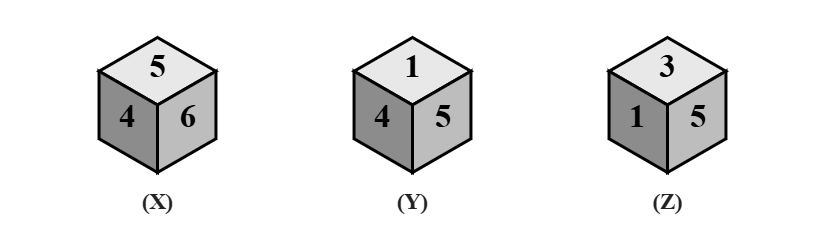
Three different positions X, Y and Z of a dice, with numbers 1 to 6 on its faces, are shown in the figure below. Which number lies on the bottom face in position X?
Explanation
In position X, the top face shows 1, so we need the face opposite 1.
From X, the faces 3 and 5 are adjacent to 1 (its Front and Right faces).
From Y (top 2, front 3, right 1), the number 1 is seen together with 2 and 3, so 2 is also adjacent to 1.
From Z (top 4, front 2, right 1), the number 1 is seen together with 4 and 2, so 4 is also adjacent to 1.
Altogether, 3, 5, 2 and 4 are confirmed adjacent to 1 -- all four faces a cube face can be adjacent to. The one remaining number, 6, must be the face opposite 1. Since 1 is on top in position X, the number 6 lies on the bottom face.
From X, the faces 3 and 5 are adjacent to 1 (its Front and Right faces).
From Y (top 2, front 3, right 1), the number 1 is seen together with 2 and 3, so 2 is also adjacent to 1.
From Z (top 4, front 2, right 1), the number 1 is seen together with 4 and 2, so 4 is also adjacent to 1.
Altogether, 3, 5, 2 and 4 are confirmed adjacent to 1 -- all four faces a cube face can be adjacent to. The one remaining number, 6, must be the face opposite 1. Since 1 is on top in position X, the number 6 lies on the bottom face.
Shortcut Method
X, Y, Z together show 3, 5, 2 and 4 all adjacent to 1 → 6 is the only number left, so 6 is opposite 1
∴ bottom of X (top=1) = 6 ✓
∴ bottom of X (top=1) = 6 ✓
Question 45
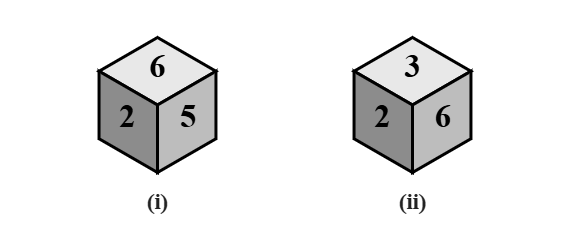
Three different positions X, Y and Z of the same dice are shown in the figure below. Which number lies on the bottom face in position X?
Explanation
In position X, the top face shows 5, so we need the face opposite 5.
From X, the faces 4 and 6 are adjacent to 5 (they are the Front and Right faces shown alongside it).
From Y (top 1, front 4, right 5), the number 5 is seen together with 1 and 4, so 1 is also adjacent to 5.
From Z (top 3, front 1, right 5), the number 5 is seen together with 3 and 1, so 3 is also adjacent to 5.
Altogether, 4, 6, 1 and 3 are confirmed adjacent to 5 -- that is four different faces, which is every face a cube face can be adjacent to. The one remaining number, 2, cannot be adjacent to 5, so it must be the face opposite 5. Since 5 is on top in position X, the number 2 lies on the bottom face.
From X, the faces 4 and 6 are adjacent to 5 (they are the Front and Right faces shown alongside it).
From Y (top 1, front 4, right 5), the number 5 is seen together with 1 and 4, so 1 is also adjacent to 5.
From Z (top 3, front 1, right 5), the number 5 is seen together with 3 and 1, so 3 is also adjacent to 5.
Altogether, 4, 6, 1 and 3 are confirmed adjacent to 5 -- that is four different faces, which is every face a cube face can be adjacent to. The one remaining number, 2, cannot be adjacent to 5, so it must be the face opposite 5. Since 5 is on top in position X, the number 2 lies on the bottom face.
Shortcut Method
A face is adjacent to exactly 4 others and opposite to exactly 1
X, Y, Z together show 4, 6, 1 and 3 all adjacent to 5 → 2 is the only number left, so 2 is opposite 5
∴ bottom of X (top=5) = 2 ✓
X, Y, Z together show 4, 6, 1 and 3 all adjacent to 5 → 2 is the only number left, so 2 is opposite 5
∴ bottom of X (top=5) = 2 ✓
Question 46
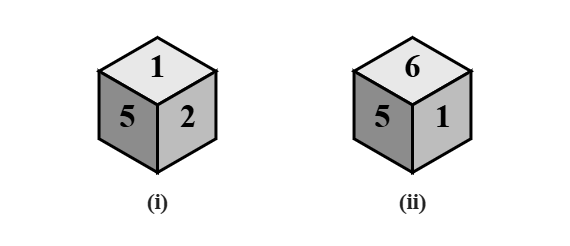
Two different positions of a dice, with numbers 1 to 6 on its faces, are shown below. Find the number on the face opposite to the one showing 5.
Explanation
The front face (2) is common to both positions.
In Position (i), Right = 5, so the hidden Left face is unknown from this view alone.
In Position (ii) (front still 2), Top = 3 -- this is the value that was on the hidden Left face in Position (i).
Right and Left are always opposite faces, so the face opposite 5 is 3.
In Position (i), Right = 5, so the hidden Left face is unknown from this view alone.
In Position (ii) (front still 2), Top = 3 -- this is the value that was on the hidden Left face in Position (i).
Right and Left are always opposite faces, so the face opposite 5 is 3.
Shortcut Method
Front(2) stays common → Position (ii) Top(3) = Position (i)'s hidden Left
∴ opposite of 5 = 3 ✓
∴ opposite of 5 = 3 ✓
Question 47
Two different positions of the same dice are shown in the figure below. Find the number on the face opposite to the one showing 2.
Explanation
The front face (5) is common to both positions.
In Position (i), Right = 2, so the hidden Left face is unknown from this view alone.
In Position (ii) (front still 5), Top = 6 -- this is the value that was on the hidden Left face in Position (i).
Right and Left are always opposite faces, so the face opposite 2 is 6.
In Position (i), Right = 2, so the hidden Left face is unknown from this view alone.
In Position (ii) (front still 5), Top = 6 -- this is the value that was on the hidden Left face in Position (i).
Right and Left are always opposite faces, so the face opposite 2 is 6.
Shortcut Method
Front(5) stays common → Position (ii) Top(6) = Position (i)'s hidden Left
∴ opposite of 2 = 6 ✓
∴ opposite of 2 = 6 ✓
Question 48
Two different positions of a dice are shown in the figure below. Find the number on the face opposite to the one showing 3.
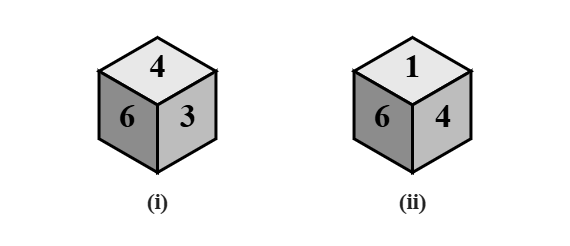
Explanation
The front face (6) is common to both positions.
In Position (i), Right = 3, so the hidden Left face is unknown from this view alone.
In Position (ii) (front still 6), Top = 1 -- this is the value that was on the hidden Left face in Position (i).
Right and Left are always opposite faces, so the face opposite 3 is 1.
In Position (i), Right = 3, so the hidden Left face is unknown from this view alone.
In Position (ii) (front still 6), Top = 1 -- this is the value that was on the hidden Left face in Position (i).
Right and Left are always opposite faces, so the face opposite 3 is 1.
Shortcut Method
Front(6) stays common → Position (ii) Top(1) = Position (i)'s hidden Left
∴ opposite of 3 = 1 ✓
∴ opposite of 3 = 1 ✓
Question 49
Two different positions of the same dice, with numbers 1 to 6 on its faces, are shown below. Find the number on the face opposite to the one showing 4.
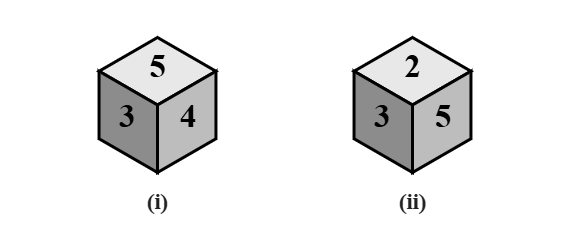
Explanation
The front face (3) is common to both positions.
In Position (i), Right = 4, so the hidden Left face is unknown from this view alone.
In Position (ii) (front still 3), Top = 2 -- this is the value that was on the hidden Left face in Position (i).
Right and Left are always opposite faces, so the face opposite 4 is 2.
In Position (i), Right = 4, so the hidden Left face is unknown from this view alone.
In Position (ii) (front still 3), Top = 2 -- this is the value that was on the hidden Left face in Position (i).
Right and Left are always opposite faces, so the face opposite 4 is 2.
Shortcut Method
Front(3) stays common → Position (ii) Top(2) = Position (i)'s hidden Left
∴ opposite of 4 = 2 ✓
∴ opposite of 4 = 2 ✓
Question 50
Two different positions of a dice are shown in the figure below. Find the number on the face opposite to the one showing 1.
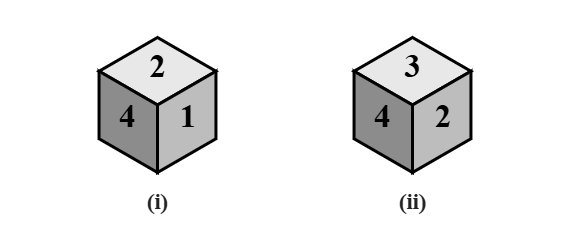
Explanation
The front face (4) is common to both positions.
In Position (i), Right = 1, so the hidden Left face is unknown from this view alone.
In Position (ii) (front still 4), Top = 3 -- this is the value that was on the hidden Left face in Position (i).
Right and Left are always opposite faces, so the face opposite 1 is 3.
In Position (i), Right = 1, so the hidden Left face is unknown from this view alone.
In Position (ii) (front still 4), Top = 3 -- this is the value that was on the hidden Left face in Position (i).
Right and Left are always opposite faces, so the face opposite 1 is 3.
Shortcut Method
Front(4) stays common → Position (ii) Top(3) = Position (i)'s hidden Left
∴ opposite of 1 = 3 ✓
∴ opposite of 1 = 3 ✓
Question 51
Two different positions of the same dice are shown in the figure below. Find the number on the face opposite to the one showing 4.
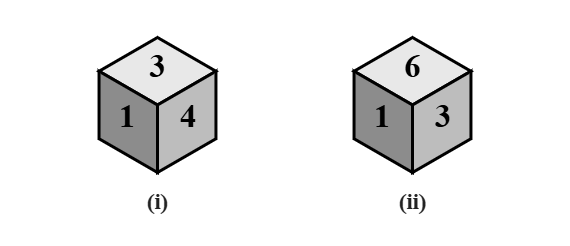
Explanation
The front face (1) is common to both positions.
In Position (i), Right = 4, so the hidden Left face is unknown from this view alone.
In Position (ii) (front still 1), Top = 6 -- this is the value that was on the hidden Left face in Position (i).
Right and Left are always opposite faces, so the face opposite 4 is 6.
In Position (i), Right = 4, so the hidden Left face is unknown from this view alone.
In Position (ii) (front still 1), Top = 6 -- this is the value that was on the hidden Left face in Position (i).
Right and Left are always opposite faces, so the face opposite 4 is 6.
Shortcut Method
Front(1) stays common → Position (ii) Top(6) = Position (i)'s hidden Left
∴ opposite of 4 = 6 ✓
∴ opposite of 4 = 6 ✓
Question 52
The numbers on any two opposite faces of a cubical die always add up to 7. Using this rule, find the figure below that is correctly drawn.
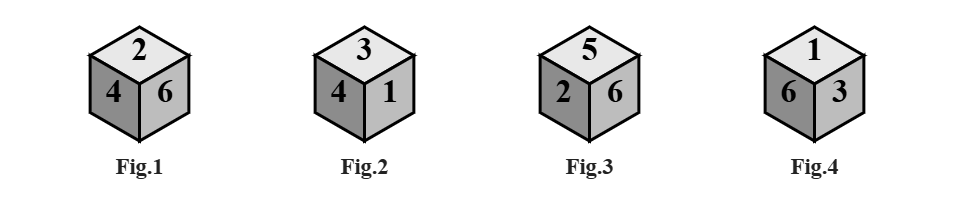
Explanation
The three opposite pairs under the sum-to-7 rule are (1,6), (2,5) and (3,4); a real die can never show both members of a pair in the same view.
Fig.2 shows 3 and 4 together -- impossible.
Fig.3 shows 5 and 2 together -- impossible.
Fig.4 shows 1 and 6 together -- impossible.
Fig.1 shows 2, 4 and 6, one value from each of the three opposite pairs, with no conflict -- this is the only figure that is actually possible.
Fig.2 shows 3 and 4 together -- impossible.
Fig.3 shows 5 and 2 together -- impossible.
Fig.4 shows 1 and 6 together -- impossible.
Fig.1 shows 2, 4 and 6, one value from each of the three opposite pairs, with no conflict -- this is the only figure that is actually possible.
Shortcut Method
Opposite pairs (sum 7): (1,6) (2,5) (3,4) → a valid figure never shows two faces from the same pair together
Only Fig.1 (2,4,6) has no such conflict ✓
Only Fig.1 (2,4,6) has no such conflict ✓
Question 53
Given that the numbers on opposite faces of a die always add up to 7, identify the figure below that could actually be a genuine view of the die.
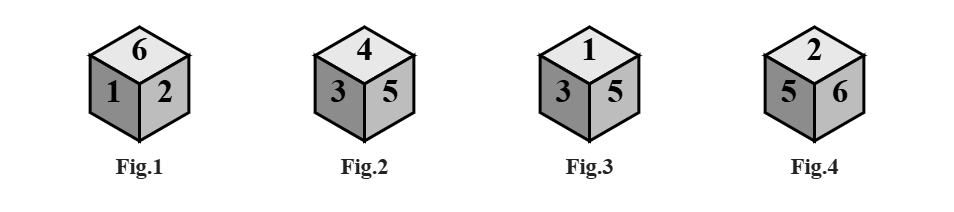
Explanation
The three opposite pairs under the sum-to-7 rule are (1,6), (2,5) and (3,4); no single view can ever show both faces of the same pair together.
Fig.1 shows 6 and 1 together -- impossible.
Fig.2 shows 4 and 3 together -- impossible.
Fig.4 shows 2 and 5 together -- impossible.
Fig.3 shows 1, 3 and 5, one value from each of the three opposite pairs, with no conflict -- this is the only figure that is actually possible.
Fig.1 shows 6 and 1 together -- impossible.
Fig.2 shows 4 and 3 together -- impossible.
Fig.4 shows 2 and 5 together -- impossible.
Fig.3 shows 1, 3 and 5, one value from each of the three opposite pairs, with no conflict -- this is the only figure that is actually possible.
Shortcut Method
Opposite pairs (sum 7): (1,6) (2,5) (3,4) → a valid figure never shows two faces from the same pair together
Only Fig.3 (1,3,5) has no such conflict ✓
Only Fig.3 (1,3,5) has no such conflict ✓
Question 54
If the total number of dots on opposite faces of a cubical die is always 7, find the figure which is correct.
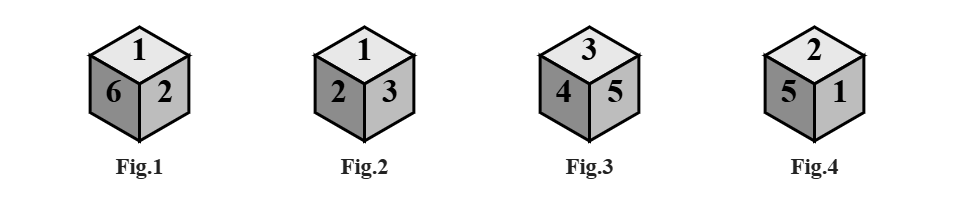
Explanation
Under the sum-to-7 rule, the three opposite pairs are (1,6), (2,5) and (3,4). A single view of a real die can never show both members of an opposite pair at once, since opposite faces never face the viewer at the same time.
Fig.1 shows 1 and 6 together -- impossible, since 1 and 6 are opposite.
Fig.3 shows 3 and 4 together -- impossible, since 3 and 4 are opposite.
Fig.4 shows 2 and 5 together -- impossible, since 2 and 5 are opposite.
Fig.2 shows 1, 2 and 3 together, one value from each of the three opposite pairs, with no conflict -- this is the only figure that could actually be a single view of a real die.
Fig.1 shows 1 and 6 together -- impossible, since 1 and 6 are opposite.
Fig.3 shows 3 and 4 together -- impossible, since 3 and 4 are opposite.
Fig.4 shows 2 and 5 together -- impossible, since 2 and 5 are opposite.
Fig.2 shows 1, 2 and 3 together, one value from each of the three opposite pairs, with no conflict -- this is the only figure that could actually be a single view of a real die.
Shortcut Method
Opposite pairs (sum 7): (1,6) (2,5) (3,4) → a valid figure never shows two faces from the same pair together
Only Fig.2 (1,2,3) has no such conflict ✓
Only Fig.2 (1,2,3) has no such conflict ✓
Question 55
Two positions of a cuboid-shaped block are shown in the figure below. When the number 5 will be on the top face, then which number will be at the bottom?
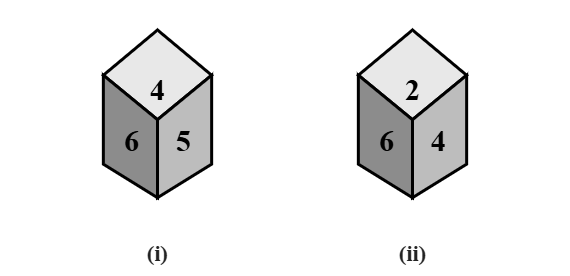
Explanation
The front face (6) is common to both positions.
In Position (i), Right = 5, so the hidden Left face is unknown from this view alone.
In Position (ii) (front still 6), Top = 2 -- this is the value that was on the hidden Left face in Position (i).
Left and Right are always opposite faces, so the face opposite 5 is 2. Therefore, whenever 5 is turned to the top, 2 will be at the bottom.
In Position (i), Right = 5, so the hidden Left face is unknown from this view alone.
In Position (ii) (front still 6), Top = 2 -- this is the value that was on the hidden Left face in Position (i).
Left and Right are always opposite faces, so the face opposite 5 is 2. Therefore, whenever 5 is turned to the top, 2 will be at the bottom.
Shortcut Method
Front(6) stays common → Position (ii) Top(2) = Position (i)'s hidden Left
Left & Right are opposite → opposite of 5 = 2 ✓
Left & Right are opposite → opposite of 5 = 2 ✓
Question 56
Two positions of a cuboid-shaped block are shown in the figure below. When the number 4 will be on the top face, then which number will be at the bottom?
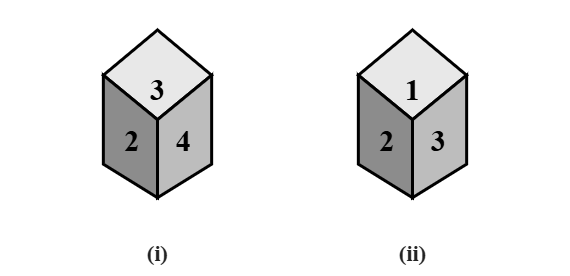
Explanation
The front face (2) is common to both positions.
In Position (i), Right = 4, so the hidden Left face is unknown from this view alone.
In Position (ii) (front still 2), Top = 1 -- this is the value that was on the hidden Left face in Position (i).
Left and Right are always opposite faces, so the face opposite 4 is 1. Therefore, whenever 4 is turned to the top, 1 will be at the bottom.
In Position (i), Right = 4, so the hidden Left face is unknown from this view alone.
In Position (ii) (front still 2), Top = 1 -- this is the value that was on the hidden Left face in Position (i).
Left and Right are always opposite faces, so the face opposite 4 is 1. Therefore, whenever 4 is turned to the top, 1 will be at the bottom.
Shortcut Method
Front(2) stays common → Position (ii) Top(1) = Position (i)'s hidden Left
Left & Right are opposite → opposite of 4 = 1 ✓
Left & Right are opposite → opposite of 4 = 1 ✓
Question 57
Two positions of a cuboid-shaped block are shown in the figure below. When the number 3 will be on the top face, then which number will be at the bottom?
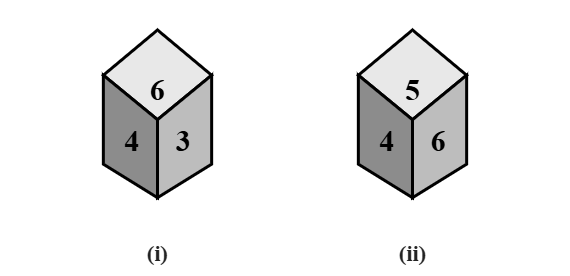
Explanation
The front face (4) is common to both positions.
In Position (i), Right = 3, so the hidden Left face is unknown from this view alone.
In Position (ii) (front still 4), Top = 5 -- this is the value that was on the hidden Left face in Position (i).
Left and Right are always opposite faces on the block, so the face opposite 3 is 5. Therefore, whenever 3 is turned to the top, 5 will be at the bottom.
In Position (i), Right = 3, so the hidden Left face is unknown from this view alone.
In Position (ii) (front still 4), Top = 5 -- this is the value that was on the hidden Left face in Position (i).
Left and Right are always opposite faces on the block, so the face opposite 3 is 5. Therefore, whenever 3 is turned to the top, 5 will be at the bottom.
Shortcut Method
Front(4) stays common → Position (ii) Top(5) = Position (i)'s hidden Left
Left & Right are opposite → opposite of 3 = 5 ✓
Left & Right are opposite → opposite of 3 = 5 ✓
Question 58
Below are depicted three different positions of the same dice. Find the number of dots that lie on the face opposite to the face with 5 dots.
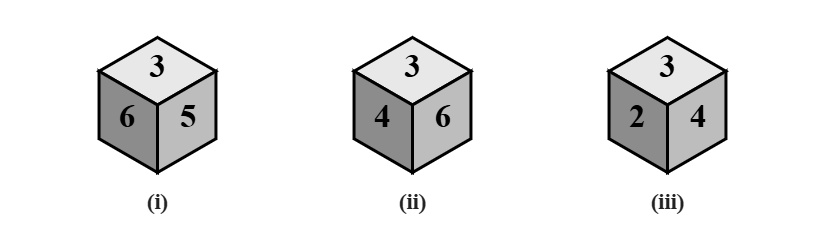
Explanation
The top face (3 dots) is common to all three positions, so the die only turns about the vertical axis.
In Position (i), Right = 5 dots and Front = 6 dots, so the hidden Left face is unknown from this view alone.
Turning once more (Position (ii), top still 3 dots) brings that hidden Left face to the Front -- and Position (ii) shows Front = 4 dots. So the hidden Left face of Position (i) had 4 dots.
Right and Left are always opposite faces, so the face opposite the 5-dot face has 4 dots. Position (iii) continues the same pattern.
In Position (i), Right = 5 dots and Front = 6 dots, so the hidden Left face is unknown from this view alone.
Turning once more (Position (ii), top still 3 dots) brings that hidden Left face to the Front -- and Position (ii) shows Front = 4 dots. So the hidden Left face of Position (i) had 4 dots.
Right and Left are always opposite faces, so the face opposite the 5-dot face has 4 dots. Position (iii) continues the same pattern.
Shortcut Method
Top(3) stays common → vertical-axis turns only
Position (ii) Front(4) = Position (i)'s hidden Left
∴ opposite of 5 dots = 4 dots ✓
Position (ii) Front(4) = Position (i)'s hidden Left
∴ opposite of 5 dots = 4 dots ✓
Question 59
Below are depicted three different positions of a dice. Find the number of dots on the face opposite to the face showing 2 dots.
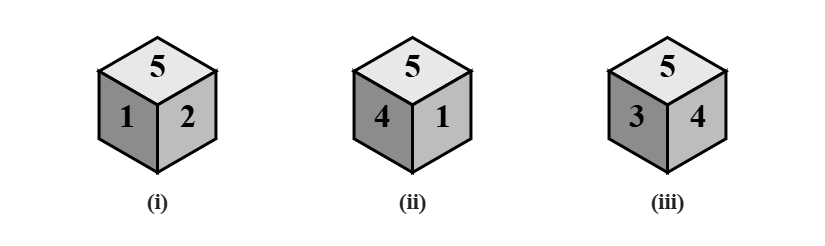
Explanation
The top face (5 dots) is common to all three positions, so the die only turns about the vertical axis.
In Position (i), Right = 2 dots and Front = 1 dot, so the hidden Left face is unknown from this view alone.
Turning once more (Position (ii), top still 5 dots) brings that hidden Left face to the Front -- and Position (ii) shows Front = 4 dots. So the hidden Left face of Position (i) had 4 dots.
Right and Left are always opposite faces, so the face opposite the 2-dot face has 4 dots. Position (iii) continues the same pattern.
In Position (i), Right = 2 dots and Front = 1 dot, so the hidden Left face is unknown from this view alone.
Turning once more (Position (ii), top still 5 dots) brings that hidden Left face to the Front -- and Position (ii) shows Front = 4 dots. So the hidden Left face of Position (i) had 4 dots.
Right and Left are always opposite faces, so the face opposite the 2-dot face has 4 dots. Position (iii) continues the same pattern.
Shortcut Method
Top(5) stays common → vertical-axis turns only
Position (ii) Front(4) = Position (i)'s hidden Left
∴ opposite of 2 dots = 4 dots ✓
Position (ii) Front(4) = Position (i)'s hidden Left
∴ opposite of 2 dots = 4 dots ✓
Question 60
Below are depicted three different positions of the same dice. Find the number of dots on the face opposite to the face with 3 dots.
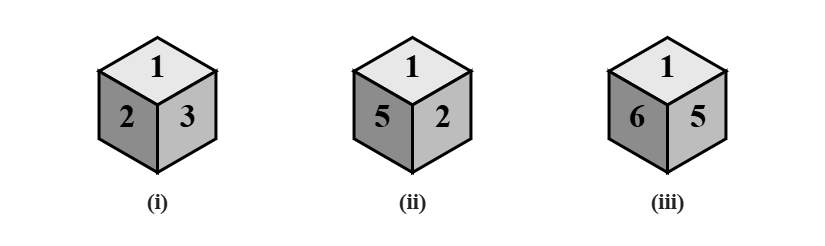
Explanation
The top face (1 dot) is common to all three positions, so the die only turns about the vertical axis.
In Position (i), Right = 3 dots and Front = 2 dots, so the hidden Left face is unknown from this view alone.
Turning once more (Position (ii), top still 1 dot) brings that hidden Left face to the Front -- and Position (ii) shows Front = 5 dots. So the hidden Left face of Position (i) had 5 dots.
Right and Left are always opposite faces, so the face opposite the 3-dot face has 5 dots. Position (iii) continues the same pattern.
In Position (i), Right = 3 dots and Front = 2 dots, so the hidden Left face is unknown from this view alone.
Turning once more (Position (ii), top still 1 dot) brings that hidden Left face to the Front -- and Position (ii) shows Front = 5 dots. So the hidden Left face of Position (i) had 5 dots.
Right and Left are always opposite faces, so the face opposite the 3-dot face has 5 dots. Position (iii) continues the same pattern.
Shortcut Method
Top(1) stays common → vertical-axis turns only
Position (ii) Front(5) = Position (i)'s hidden Left
∴ opposite of 3 dots = 5 dots ✓
Position (ii) Front(5) = Position (i)'s hidden Left
∴ opposite of 3 dots = 5 dots ✓
Question 61
A dice is thrown four times and its four different positions are shown in the figure below. Find the number on the face opposite to the one showing 5.
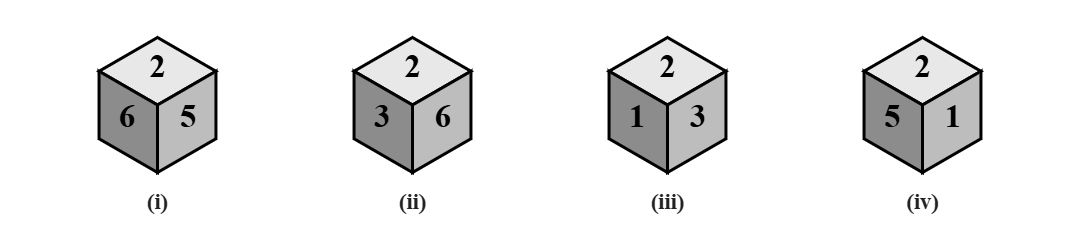
Explanation
The top face (2) is common to all four positions, so the die only turns about the vertical axis.
In Position (i), Right = 5 and Front = 6, so the hidden Left face is unknown from this view alone.
Turning once more (Position (ii), top still 2) brings that hidden Left face to the Front -- and Position (ii) shows Front = 3. So the hidden Left face of Position (i) was 3.
Right and Left are always opposite faces, so the face opposite 5 is 3. Positions (iii) and (iv) continue the same pattern.
In Position (i), Right = 5 and Front = 6, so the hidden Left face is unknown from this view alone.
Turning once more (Position (ii), top still 2) brings that hidden Left face to the Front -- and Position (ii) shows Front = 3. So the hidden Left face of Position (i) was 3.
Right and Left are always opposite faces, so the face opposite 5 is 3. Positions (iii) and (iv) continue the same pattern.
Shortcut Method
Top(2) stays common across all four → vertical-axis turns only
Position (ii) Front(3) = Position (i)'s hidden Left
∴ opposite of 5 = 3 ✓
Position (ii) Front(3) = Position (i)'s hidden Left
∴ opposite of 5 = 3 ✓
Question 62
A dice is thrown four times and its four different positions are shown in the figure below. Find the number on the face opposite to the one showing 3.
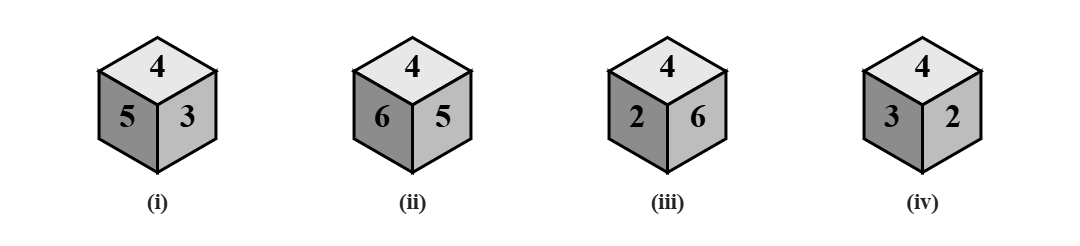
Explanation
The top face (4) is common to all four positions, so the die only turns about the vertical axis.
In Position (i), Right = 3 and Front = 5, so the hidden Left face is unknown from this view alone.
Turning once more (Position (ii), top still 4) brings that hidden Left face to the Front -- and Position (ii) shows Front = 6. So the hidden Left face of Position (i) was 6.
Right and Left are always opposite faces, so the face opposite 3 is 6. Positions (iii) and (iv) continue the same pattern.
In Position (i), Right = 3 and Front = 5, so the hidden Left face is unknown from this view alone.
Turning once more (Position (ii), top still 4) brings that hidden Left face to the Front -- and Position (ii) shows Front = 6. So the hidden Left face of Position (i) was 6.
Right and Left are always opposite faces, so the face opposite 3 is 6. Positions (iii) and (iv) continue the same pattern.
Shortcut Method
Top(4) stays common across all four → vertical-axis turns only
Position (ii) Front(6) = Position (i)'s hidden Left
∴ opposite of 3 = 6 ✓
Position (ii) Front(6) = Position (i)'s hidden Left
∴ opposite of 3 = 6 ✓
Question 63
A dice is thrown four times and its four different positions are shown in the figure below. Find the number on the face opposite to the one showing 2.
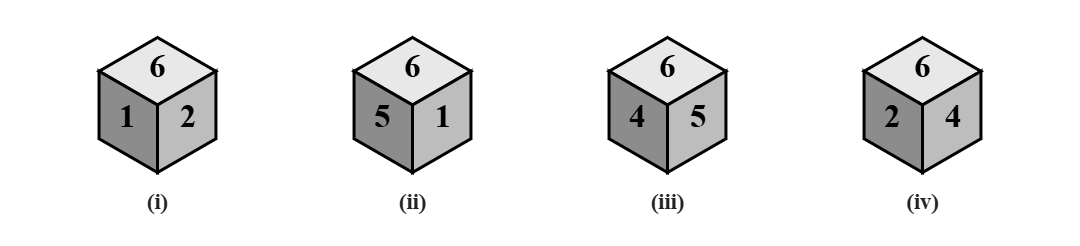
Explanation
The top face (6) is common to all four positions, so the die is only being turned about the vertical axis.
In Position (i), Right = 2 and Front = 1, so the hidden Left face is unknown from this view alone.
Turning once more (Position (ii), top still 6) brings that hidden Left face to the Front -- and Position (ii) shows Front = 5. So the hidden Left face of Position (i) was 5.
Right and Left are always opposite faces, so the face opposite 2 is 5. Positions (iii) and (iv) continue the same turning pattern and are consistent with this.
In Position (i), Right = 2 and Front = 1, so the hidden Left face is unknown from this view alone.
Turning once more (Position (ii), top still 6) brings that hidden Left face to the Front -- and Position (ii) shows Front = 5. So the hidden Left face of Position (i) was 5.
Right and Left are always opposite faces, so the face opposite 2 is 5. Positions (iii) and (iv) continue the same turning pattern and are consistent with this.
Shortcut Method
Top(6) stays common across all four → vertical-axis turns only
Position (ii) Front(5) = Position (i)'s hidden Left
∴ opposite of 2 = 5 ✓
Position (ii) Front(5) = Position (i)'s hidden Left
∴ opposite of 2 = 5 ✓
Question 64
A dice is rolled along the same straight line three times, and its three positions are shown in the figure below. Find the number on the face opposite to the one showing 6.
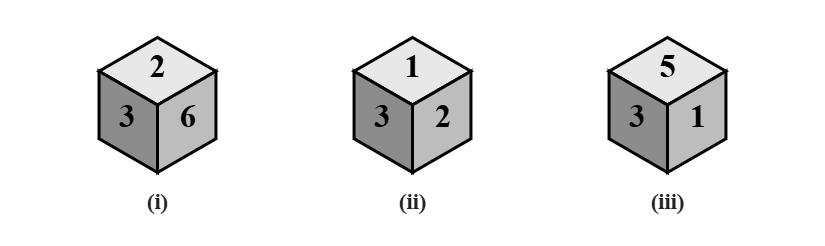
Explanation
The front face (3) is common to all three positions, since rolling along one straight line keeps the front-back axis fixed.
In Position (i), Right = 6 and Top = 2, so the hidden Left face is not yet known.
Rolling once more (Position (ii), front still 3) brings that hidden Left face to the Top -- and Position (ii) shows Top = 1. So the hidden Left face of Position (i) was 1.
Right and Left are always opposite faces, so the face opposite 6 is 1. Position (iii) continues the same rolling pattern.
In Position (i), Right = 6 and Top = 2, so the hidden Left face is not yet known.
Rolling once more (Position (ii), front still 3) brings that hidden Left face to the Top -- and Position (ii) shows Top = 1. So the hidden Left face of Position (i) was 1.
Right and Left are always opposite faces, so the face opposite 6 is 1. Position (iii) continues the same rolling pattern.
Shortcut Method
Front(3) stays common while rolling → top/right/bottom/left cycle
Position (ii) Top(1) = Position (i)'s hidden Left
∴ opposite of 6 = 1 ✓
Position (ii) Top(1) = Position (i)'s hidden Left
∴ opposite of 6 = 1 ✓
Question 65
A dice is rolled down along the same edge three times, and its three positions are shown in the figure below. Find the number on the face opposite to the one showing 2.
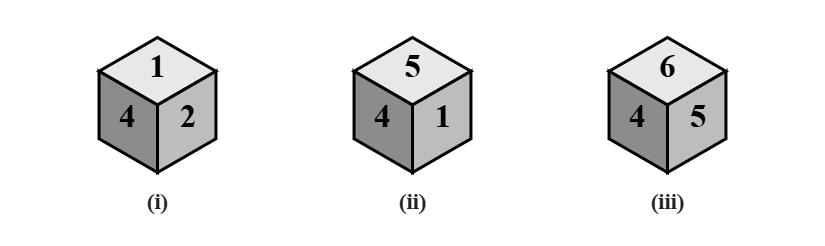
Explanation
The front face (4) is common to all three positions, since the die is rolled along the same edge each time, keeping the front-back axis fixed.
In Position (i), Right = 2 and Top = 1, so the hidden Left face is unknown from this view alone.
Rolling once more (Position (ii), front still 4) brings that hidden Left face to the Top -- and Position (ii) shows Top = 5. So the hidden Left face of Position (i) was 5.
Right and Left are always opposite faces, so the face opposite 2 is 5. Position (iii) continues the same rolling pattern.
In Position (i), Right = 2 and Top = 1, so the hidden Left face is unknown from this view alone.
Rolling once more (Position (ii), front still 4) brings that hidden Left face to the Top -- and Position (ii) shows Top = 5. So the hidden Left face of Position (i) was 5.
Right and Left are always opposite faces, so the face opposite 2 is 5. Position (iii) continues the same rolling pattern.
Shortcut Method
Front(4) stays common while rolling → top/right/bottom/left cycle
Position (ii) Top(5) = Position (i)'s hidden Left
∴ opposite of 2 = 5 ✓
Position (ii) Top(5) = Position (i)'s hidden Left
∴ opposite of 2 = 5 ✓
Question 66
A dice is rolled along the same straight line three times, and its three positions are shown in the figure below. Find the number on the face opposite to the one showing 4.
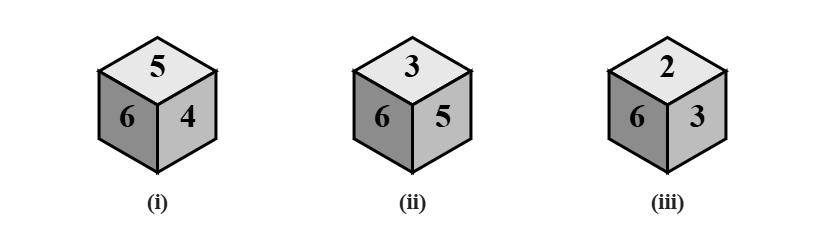
Explanation
The front face (6) is common to all three positions, since rolling the die along one straight line keeps the front-back axis fixed while the top, right, bottom and left faces cycle round.
In Position (i), Right = 4 and Top = 5, so the hidden Left face is not yet known.
Rolling once more (Position (ii), front still 6) brings that hidden Left face up to the Top -- and Position (ii) shows Top = 3. So the hidden Left face of Position (i) was 3.
Right and Left are always opposite faces, so the face opposite 4 is 3. Position (iii) continues the same rolling pattern.
In Position (i), Right = 4 and Top = 5, so the hidden Left face is not yet known.
Rolling once more (Position (ii), front still 6) brings that hidden Left face up to the Top -- and Position (ii) shows Top = 3. So the hidden Left face of Position (i) was 3.
Right and Left are always opposite faces, so the face opposite 4 is 3. Position (iii) continues the same rolling pattern.
Shortcut Method
Front(6) stays common while rolling → top/right/bottom/left cycle
Position (ii) Top(3) = Position (i)'s hidden Left
∴ opposite of 4 = 3 ✓
Position (ii) Top(3) = Position (i)'s hidden Left
∴ opposite of 4 = 3 ✓
Question 67
Three different positions of a dice, with numbers 1 to 6 on its faces, are shown in the figure below. Find the number on the face opposite to the one showing 5.
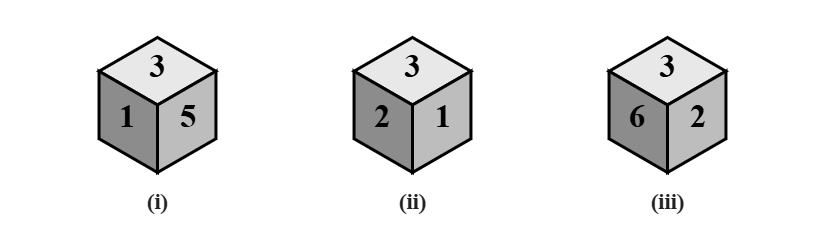
Explanation
The top face (3) is common to all three positions, so only the vertical axis is being turned.
In Position (i), Right = 5 and Front = 1, so the hidden Left face is unknown from this view alone.
In Position (ii) (top still 3), Front = 2 -- this must be the value that was hidden on the Left face in Position (i).
Since Right and Left are always opposite faces, the face opposite 5 is 2. Position (iii) continues the same turning pattern.
In Position (i), Right = 5 and Front = 1, so the hidden Left face is unknown from this view alone.
In Position (ii) (top still 3), Front = 2 -- this must be the value that was hidden on the Left face in Position (i).
Since Right and Left are always opposite faces, the face opposite 5 is 2. Position (iii) continues the same turning pattern.
Shortcut Method
Top(3) stays common → vertical-axis turn only
Position (ii) Front(2) = Position (i)'s hidden Left
∴ opposite of 5 = 2 ✓
Position (ii) Front(2) = Position (i)'s hidden Left
∴ opposite of 5 = 2 ✓
Question 68
Three different positions of a dice, with numbers 1 to 6 on its faces, are shown in the figure below. Find the number on the face opposite to the one showing 4.
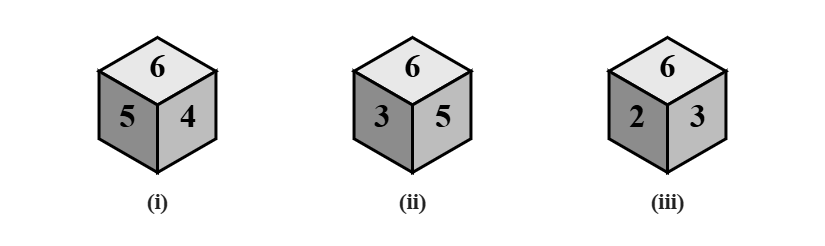
Explanation
The top face (6) is common to all three positions, so the die is being turned about the vertical axis only.
In Position (i), Right = 4 and Front = 5, so the hidden Left face is unknown from this view alone.
In Position (ii) (top still 6), Front = 3 -- this is the value that was on the hidden Left face in Position (i).
Right and Left are always opposite faces, so the face opposite 4 is 3. Position (iii) continues the same pattern and is consistent with this.
In Position (i), Right = 4 and Front = 5, so the hidden Left face is unknown from this view alone.
In Position (ii) (top still 6), Front = 3 -- this is the value that was on the hidden Left face in Position (i).
Right and Left are always opposite faces, so the face opposite 4 is 3. Position (iii) continues the same pattern and is consistent with this.
Shortcut Method
Top(6) stays common → vertical-axis turn only
Position (ii) Front(3) = Position (i)'s hidden Left
∴ opposite of 4 = 3 ✓
Position (ii) Front(3) = Position (i)'s hidden Left
∴ opposite of 4 = 3 ✓
Question 69
Three different positions of the same dice, with numbers 1 to 6 on its faces, are shown in the figure below. Find the number on the face opposite to the one showing 1.
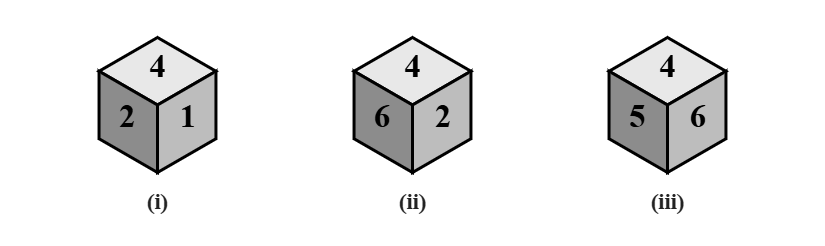
Explanation
The top face (4) is common to all three positions, so the die is simply being turned about the vertical axis each time.
In Position (i), Right = 1 and Front = 2, so the hidden Left face is not yet known.
Turning the die once (Position (ii), top still 4) brings that hidden Left face to the Front -- and Position (ii) shows Front = 6. So the hidden Left face of Position (i) is 6.
Right and Left are always opposite faces on a cube, so the face opposite 1 is 6. (Position (iii) continues the same turning pattern, confirming it.)
In Position (i), Right = 1 and Front = 2, so the hidden Left face is not yet known.
Turning the die once (Position (ii), top still 4) brings that hidden Left face to the Front -- and Position (ii) shows Front = 6. So the hidden Left face of Position (i) is 6.
Right and Left are always opposite faces on a cube, so the face opposite 1 is 6. (Position (iii) continues the same turning pattern, confirming it.)
Shortcut Method
Top(4) stays common → die only turns about the vertical axis
Position (ii) Front(6) = Position (i)'s hidden Left
Right & Left are always opposite → opposite of 1 = 6 ✓
Position (ii) Front(6) = Position (i)'s hidden Left
Right & Left are always opposite → opposite of 1 = 6 ✓