Practice Non Verbal Reasoning questions on Classification, covering figure classification, odd-one-out figures, shapes, patterns, symbols, and visual relationships. Takes about 20-25 minutes and is useful for placement, TCS NQT, SSC, banking and MBA entrance exams. Each question shows five figures marked (1), (2), (3), (4) and (5). Four of them are alike in a certain way, and one is different. Choose the figure that is different from the rest.
Question 1
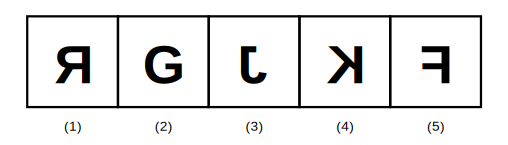
Four of the five boxes below show a capital letter as its mirror image; one does not. Choose the figure which is different from the rest.
Explanation
Figures 1, 3, 4 and 5 each show a capital letter as its mirror image (lateral inversion), so every one of them reads backwards. Figure 2 shows the letter G written the normal, correct way round.
Option 2 is the only figure that is not a mirror image, so it is the odd one out.
Option 2 is the only figure that is not a mirror image, so it is the odd one out.
Shortcut Method
Check whether each letter reads backwards (mirrored) or normally: mirrored (4 figures) vs normal (1 figure) → Option 2 is different ✓
Question 2
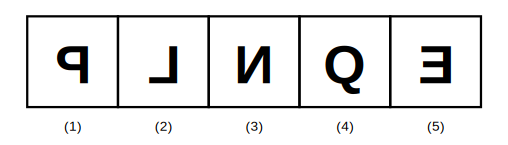
Each of the five boxes below shows a capital letter. Select the figure which is different from the rest.
Explanation
Figures 1, 2, 3 and 5 each show a capital letter as its mirror image (lateral inversion), so every one of them reads backwards. Figure 4 shows the letter Q written the normal, correct way round.
Option 4 is the only figure that is not a mirror image, so it is the odd one out.
Option 4 is the only figure that is not a mirror image, so it is the odd one out.
Shortcut Method
Check whether each letter reads backwards (mirrored) or normally: mirrored (4 figures) vs normal (1 figure) → Option 4 is different ✓
Question 3
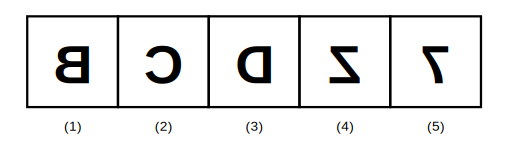
Look carefully at what each of the five mirrored-looking figures below actually represents, then choose the figure which is different from the rest.
Explanation
Figures 1, 2, 3 and 4 are each the mirror image of a capital letter. Figure 5 is the mirror image of a number, not a letter.
Option 5 is the only figure that mirrors a number rather than a letter, so it is the odd one out.
Option 5 is the only figure that mirrors a number rather than a letter, so it is the odd one out.
Shortcut Method
Check whether each mirrored character is a letter or a number: letter (4 figures) vs number (1 figure) → Option 5 is different ✓
Question 4
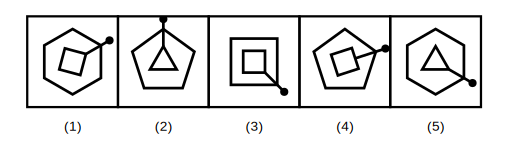
Each figure below has an outer polygon, a smaller inner shape, and a pin (a short line ending in a dot) joining them. Choose the figure which is different from the rest.
Explanation
In figures 1, 2, 3 and 5, the pin passes through a corner of the outer shape and also meets a corner of the inner shape. In figure 4, the pin meets the inner shape in the middle of one of its sides instead of at a corner.
Option 4 is the only figure where the pin does not meet a corner of both shapes, so it is the odd one out.
Option 4 is the only figure where the pin does not meet a corner of both shapes, so it is the odd one out.
Shortcut Method
Check where the pin meets the inner shape: at a corner (4 figures) vs the middle of a side (1 figure) → Option 4 is different ✓
Question 5
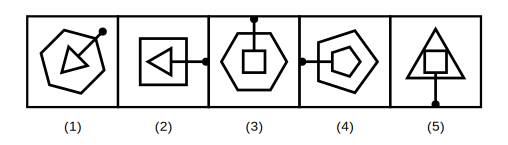
The five figures below each show an outer shape, an inner shape and a connecting pin. Select the figure which is different from the rest.
Explanation
In figures 2, 3, 4 and 5, the pin meets both the outer and inner shape in the middle of a side. In figure 1, the pin instead passes through a corner of the outer shape.
Option 1 is the only figure where the pin meets a corner rather than a side-midpoint, so it is the odd one out.
Option 1 is the only figure where the pin meets a corner rather than a side-midpoint, so it is the odd one out.
Shortcut Method
Check where the pin meets the outer shape: middle of a side (4 figures) vs a corner (1 figure) → Option 1 is different ✓
Question 6
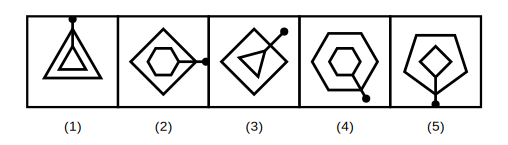
Study where the connecting pin meets the two shapes in each figure below, then choose the figure which is different from the rest.
Explanation
In figures 1, 2, 4 and 5, the pin passes through a corner of both the outer and inner shape. In figure 3, the pin meets the middle of a side of the outer shape instead of a corner.
Option 3 is the only figure where the pin does not meet a corner of both shapes, so it is the odd one out.
Option 3 is the only figure where the pin does not meet a corner of both shapes, so it is the odd one out.
Shortcut Method
Check where the pin meets the outer shape: at a corner (4 figures) vs the middle of a side (1 figure) → Option 3 is different ✓
Question 7
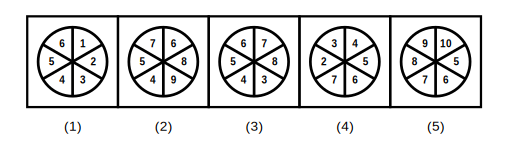
Each circle below is divided into six parts, and each part holds a number. Choose the figure which is different from the rest.
Explanation
In figures 1, 3, 4 and 5, the six numbers increase by 1 at each step when read clockwise around the circle. In figure 2, two of the numbers are out of their proper order.
Option 2 is the only figure where the clockwise counting sequence is broken, so it is the odd one out.
Option 2 is the only figure where the clockwise counting sequence is broken, so it is the odd one out.
Shortcut Method
Read the numbers clockwise and check they go up by 1 each time: in order (4 figures) vs two swapped (1 figure) → Option 2 is different ✓
Question 8
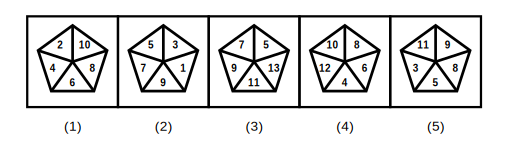
The five pentagons below each have five numbers arranged around them. Select the figure which is different from the rest.
Explanation
In figures 1, 2, 3 and 4, the numbers increase by 2 at each step when read anticlockwise around the pentagon. In figure 5, the numbers do not follow this increasing-by-2 pattern.
Option 5 is the only figure that breaks the anticlockwise counting rule, so it is the odd one out.
Option 5 is the only figure that breaks the anticlockwise counting rule, so it is the odd one out.
Shortcut Method
Read the numbers anticlockwise and check they go up by 2 each time: in order (4 figures) vs broken (1 figure) → Option 5 is different ✓
Question 9
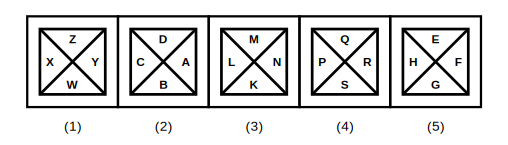
Each square below has four letters arranged around it. Choose the figure which is different from the rest.
Explanation
In figures 2, 3, 4 and 5, the four letters are in alphabetical order when read clockwise around the square. In figure 1, two of the letters are swapped, breaking the alphabetical order.
Option 1 is the only figure where the clockwise letters are not in alphabetical order, so it is the odd one out.
Option 1 is the only figure where the clockwise letters are not in alphabetical order, so it is the odd one out.
Shortcut Method
Read the letters clockwise and check they are in alphabetical order: in order (4 figures) vs two swapped (1 figure) → Option 1 is different ✓
Question 10
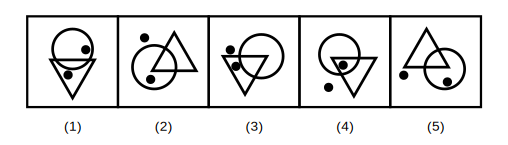
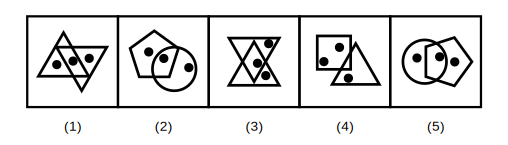
Each figure below has two overlapping shapes with dots scattered among them. Choose the figure which is different from the rest.
Explanation
In figures 2, 3, 4 and 5, one of the dots lies outside both the circle and the triangle. In figure 1, every dot lies inside at least one of the two shapes.
Option 1 is the only figure with no dot lying outside both shapes, so it is the odd one out.
Option 1 is the only figure with no dot lying outside both shapes, so it is the odd one out.
Shortcut Method
Check whether any dot lies outside both shapes: one dot outside both (4 figures) vs none (1 figure) → Option 1 is different ✓
Question 11
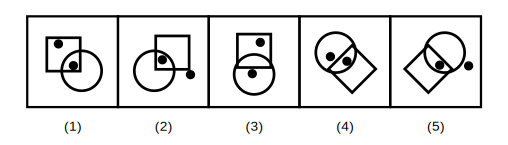
The five figures below each show two overlapping shapes with dots among them. Select the figure which is different from the rest.
Explanation
In figures 1, 2, 4 and 5, one dot lies in the region shared by both the square and the circle. In figure 3, no dot falls in that shared region.
Option 3 is the only figure with no dot in the overlap of the two shapes, so it is the odd one out.
Option 3 is the only figure with no dot in the overlap of the two shapes, so it is the odd one out.
Shortcut Method
Check whether a dot lies in the overlap of the two shapes: one dot in the overlap (4 figures) vs none (1 figure) → Option 3 is different ✓
Question 12
Look at how the dots are distributed between the two overlapping shapes in each figure below, then choose the figure which is different from the rest.
Explanation
In figures 1, 2, 3 and 5, there is one dot inside only the first shape, one dot inside only the second shape, and one dot inside both shapes. In figure 4, no dot is inside both shapes.
Option 4 is the only figure where the "one in each, one shared" pattern is broken, so it is the odd one out.
Option 4 is the only figure where the "one in each, one shared" pattern is broken, so it is the odd one out.
Shortcut Method
Check for a dot inside both shapes at once: present (4 figures) vs absent (1 figure) → Option 4 is different ✓
Question 13
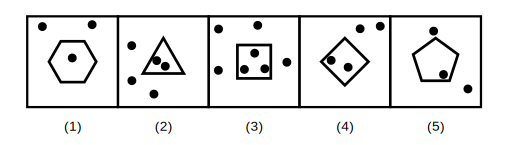
Each shape below has dots inside it and dots outside it. Choose the figure which is different from the rest.
Explanation
In figures 1, 2, 3 and 5, the number of dots outside the shape is exactly one more than the number of dots inside it. Figure 4 has the same number of dots inside and outside.
Option 4 is the only figure that breaks the "outside = inside + 1" rule, so it is the odd one out.
Option 4 is the only figure that breaks the "outside = inside + 1" rule, so it is the odd one out.
Shortcut Method
Count dots inside and outside: outside = inside + 1 (4 figures) vs outside = inside (1 figure) → Option 4 is different ✓
Question 14
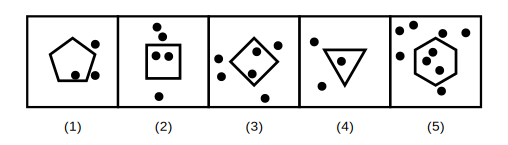
The five shapes below each have some dots inside and some outside. Select the figure which is different from the rest.
Explanation
In figures 1, 3, 4 and 5, there are exactly twice as many dots outside the shape as inside it. Figure 2 does not follow this doubling rule.
Option 2 is the only figure that breaks the "outside = 2 x inside" rule, so it is the odd one out.
Option 2 is the only figure that breaks the "outside = 2 x inside" rule, so it is the odd one out.
Shortcut Method
Count dots inside and outside: outside = 2 x inside (4 figures) vs broken (1 figure) → Option 2 is different ✓
Question 15
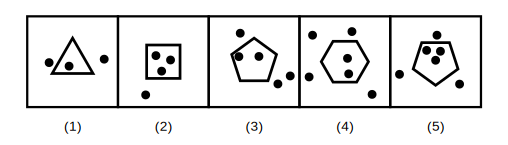
Count the total number of dots (inside plus outside) in each figure below and compare it with the number of sides of the shape, then choose the figure which is different from the rest.
Explanation
In figures 1, 2, 3 and 4, the total number of dots (inside plus outside) equals the number of sides of the shape. Figure 5 has one dot more than its number of sides.
Option 5 is the only figure where the total dot count does not match the side count, so it is the odd one out.
Option 5 is the only figure where the total dot count does not match the side count, so it is the odd one out.
Shortcut Method
Count total dots and compare to the number of sides: equal (4 figures) vs one extra dot (1 figure) → Option 5 is different ✓
Question 16
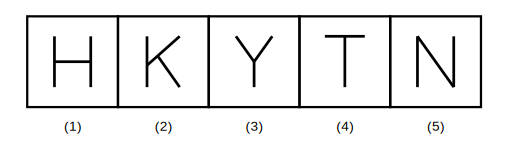
Each figure below is a capital letter made of a small number of straight lines. Choose the figure which is different from the rest.
Explanation
The letters H, K, Y and N are each drawn with exactly three straight strokes. The letter T is drawn with only two straight strokes (one horizontal, one vertical).
Option 4 is the only letter with a different stroke count, so it is the odd one out.
Option 4 is the only letter with a different stroke count, so it is the odd one out.
Shortcut Method
Count the straight strokes making up each letter: three strokes (4 figures) vs two strokes (1 figure) → Option 4 is different ✓
Question 17
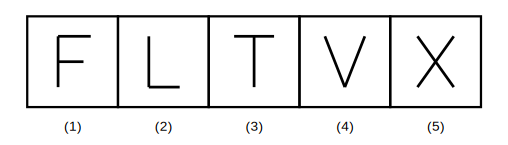
The five capital letters below are each made of a small number of straight strokes. Select the figure which is different from the rest.
Explanation
The letters L, T, V and X are each drawn with exactly two straight strokes. The letter F is drawn with three straight strokes (one vertical and two horizontal).
Option 1 is the only letter with a different stroke count, so it is the odd one out.
Option 1 is the only letter with a different stroke count, so it is the odd one out.
Shortcut Method
Count the straight strokes making up each letter: two strokes (4 figures) vs three strokes (1 figure) → Option 1 is different ✓
Question 18
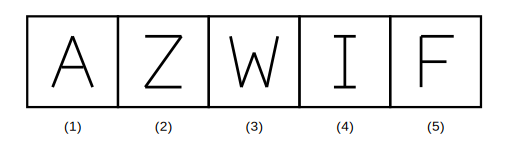
Count the straight lines making up each capital letter below, then choose the figure which is different from the rest.
Explanation
The letters A, Z, I and F are each drawn with exactly three straight strokes. The letter W is drawn with four straight strokes (its characteristic up-down-up-down shape).
Option 3 is the only letter with a different stroke count, so it is the odd one out.
Option 3 is the only letter with a different stroke count, so it is the odd one out.
Shortcut Method
Count the straight strokes making up each letter: three strokes (4 figures) vs four strokes (1 figure) → Option 3 is different ✓
Question 19
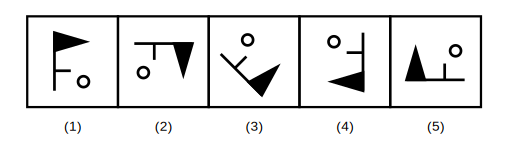
Four of the five arrow-and-dot figures below are the same figure simply turned to different positions; one is not. Choose the figure which is different from the rest.
Explanation
Figures 1, 2, 4 and 5 are the same asymmetric figure, simply turned to different positions. Figure 3 is a mirror image of this figure, so no amount of turning (without flipping it over) can make it match the others.
Option 3 is the only figure that is a reflection rather than a rotation, so it is the odd one out.
Option 3 is the only figure that is a reflection rather than a rotation, so it is the odd one out.
Shortcut Method
Check handedness, not just orientation: rotations of one figure (4 figures) vs a mirror image (1 figure) → Option 3 is different ✓
Question 20
The five figures below each show an arrow shape with a dot. Select the figure which is different from the rest.
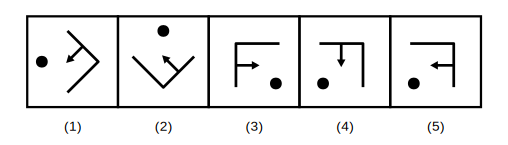
Explanation
Figures 1, 2, 3 and 4 are the same asymmetric figure, simply turned to different positions. Figure 5 is a mirror image of this figure, so no amount of turning can make it match the others.
Option 5 is the only figure that is a reflection rather than a rotation, so it is the odd one out.
Option 5 is the only figure that is a reflection rather than a rotation, so it is the odd one out.
Shortcut Method
Check handedness, not just orientation: rotations of one figure (4 figures) vs a mirror image (1 figure) → Option 5 is different ✓
Question 21
One of the five arrow-and-dot figures below cannot be produced by turning the others. Choose the figure which is different from the rest.
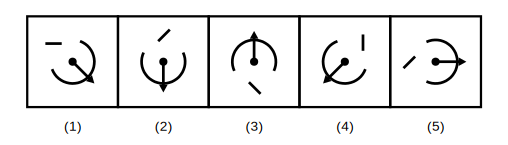
Explanation
Figures 1, 3, 4 and 5 are the same asymmetric figure, simply turned to different positions. Figure 2 is a mirror image of this figure, so no amount of turning can make it match the others.
Option 2 is the only figure that is a reflection rather than a rotation, so it is the odd one out.
Option 2 is the only figure that is a reflection rather than a rotation, so it is the odd one out.
Shortcut Method
Check handedness, not just orientation: rotations of one figure (4 figures) vs a mirror image (1 figure) → Option 2 is different ✓
Question 22
Each figure below has an arrow, a pin (a line ending in a small ball) and a dot. Choose the figure which is different from the rest.
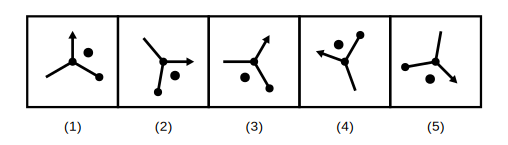
Explanation
In figures 1, 2, 4 and 5, the dot sits in the angle between the arrow and the pin (the line ending in a small ball). In figure 3, the dot sits somewhere else.
Option 3 is the only figure where the dot is not between the arrow and the pin, so it is the odd one out.
Option 3 is the only figure where the dot is not between the arrow and the pin, so it is the odd one out.
Shortcut Method
Check whether the dot sits in the angle between the arrow and the pin: yes (4 figures) vs no (1 figure) → Option 3 is different ✓
Question 23
The five figures below each have a forked line, a plain line and a small circle. Select the figure which is different from the rest.
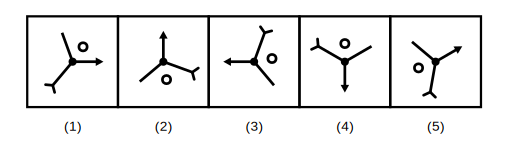
Explanation
In figures 2, 3, 4 and 5, the small circle sits in the angle between the forked line and the plain line. In figure 1, the circle sits somewhere else.
Option 1 is the only figure where the circle is not between the forked line and the plain line, so it is the odd one out.
Option 1 is the only figure where the circle is not between the forked line and the plain line, so it is the odd one out.
Shortcut Method
Check whether the circle sits in the angle between the forked line and the plain line: yes (4 figures) vs no (1 figure) → Option 1 is different ✓
Question 24
Each figure below has two arrows and a dot. Choose the figure which is different from the rest.
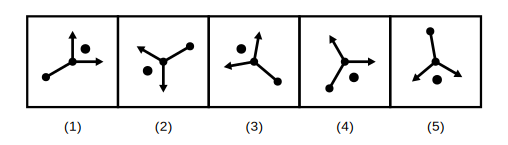
Explanation
In figures 1, 2, 3 and 5, the dot sits in the angle between the two arrows. In figure 4, the dot sits somewhere else.
Option 4 is the only figure where the dot is not between the two arrows, so it is the odd one out.
Option 4 is the only figure where the dot is not between the two arrows, so it is the odd one out.
Shortcut Method
Check whether the dot sits in the angle between the two arrows: yes (4 figures) vs no (1 figure) → Option 4 is different ✓
Question 25
Each figure below has three nested squares, each with a small gap. Choose the figure which is different from the rest.
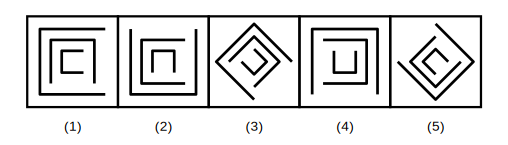
Explanation
In figures 2, 3, 4 and 5, the middle square is the outer square turned 90 degrees clockwise, and the inner square is the middle square turned another 90 degrees clockwise -- the same rotation step is used twice. In figure 1, the inner square is turned the opposite way instead of continuing clockwise.
Option 1 is the only figure where the rotation step is not repeated consistently, so it is the odd one out.
Option 1 is the only figure where the rotation step is not repeated consistently, so it is the odd one out.
Shortcut Method
Check that both rotation steps (outer-to-middle, middle-to-inner) turn the same way: both clockwise (4 figures) vs one reversed (1 figure) → Option 1 is different ✓
Question 26
The five figures below each have several nested circles, each with a small gap. Select the figure which is different from the rest.
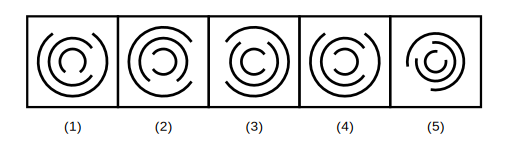
Explanation
In figures 1, 2, 3 and 5, each circle's gap is rotated 90 degrees clockwise from the gap of the circle enclosing it -- the same rotation step carries all the way to the centre. In figure 4, the innermost gap does not follow this 90-degree clockwise step.
Option 4 is the only figure where the innermost circle breaks the pattern, so it is the odd one out.
Option 4 is the only figure where the innermost circle breaks the pattern, so it is the odd one out.
Shortcut Method
Check that each gap is rotated 90° clockwise from the one around it, all the way to the centre: consistent (4 figures) vs broken at the centre (1 figure) → Option 4 is different ✓
Question 27
Each figure below has nested hexagons, each with an opening on one side. Choose the figure which is different from the rest.
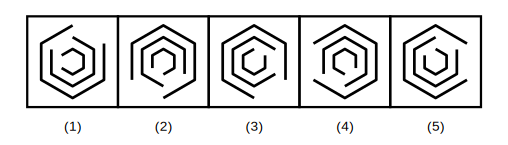
Explanation
In figures 1, 3, 4 and 5, each hexagon's opening is one side further anticlockwise than the opening of the hexagon enclosing it, all the way to the centre. In figure 2, the innermost hexagon's opening turns the other way instead of continuing anticlockwise.
Option 2 is the only figure where the innermost hexagon breaks the pattern, so it is the odd one out.
Option 2 is the only figure where the innermost hexagon breaks the pattern, so it is the odd one out.
Shortcut Method
Check that each opening steps one side anticlockwise from the one around it, all the way to the centre: consistent (4 figures) vs broken at the centre (1 figure) → Option 2 is different ✓
Question 28
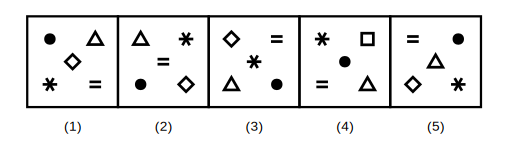
Each figure below shows the same five symbols (a star, a diamond, a dot, an equals sign and a triangle) arranged in different positions. Choose the figure which is different from the rest.
Explanation
Figures 1, 2, 3 and 5 all contain the same five symbols -- a star, a diamond, a dot, an equals sign and a triangle -- simply arranged in different positions. In figure 4, the diamond has been replaced by a square.
Option 4 is the only figure with a substituted symbol, so it is the odd one out.
Option 4 is the only figure with a substituted symbol, so it is the odd one out.
Shortcut Method
Check that all five original symbols are present: all five present (4 figures) vs diamond replaced by a square (1 figure) → Option 4 is different ✓
Question 29
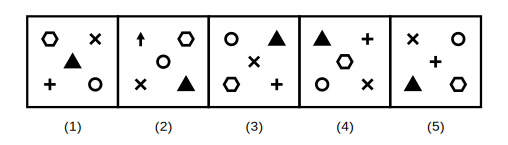
The five figures below each contain the same five symbols (a cross, a circle, a plus sign, a black triangle and a hexagon). Select the figure which is different from the rest.
Explanation
Figures 1, 3, 4 and 5 all contain the same five symbols -- a cross, a circle, a plus sign, a black triangle and a hexagon -- just rearranged. In figure 2, the plus sign has been replaced by an arrow.
Option 2 is the only figure with a substituted symbol, so it is the odd one out.
Option 2 is the only figure with a substituted symbol, so it is the odd one out.
Shortcut Method
Check that all five original symbols are present: all five present (4 figures) vs plus replaced by an arrow (1 figure) → Option 2 is different ✓
Question 30
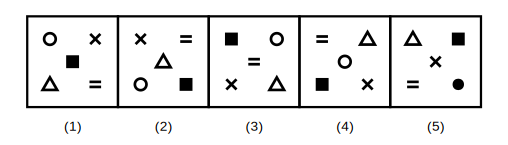
Check the five symbols in each figure below (a black square, a circle, an equals sign, a cross and a triangle), then choose the figure which is different from the rest.
Explanation
Figures 1, 2, 3 and 4 all contain the same five symbols -- a black square, a circle, an equals sign, a cross and a triangle -- just rearranged. In figure 5, the (white, hollow) circle has been replaced by a solid black dot.
Option 5 is the only figure with a substituted symbol, so it is the odd one out.
Option 5 is the only figure with a substituted symbol, so it is the odd one out.
Shortcut Method
Check that all five original symbols are present: all five present (4 figures) vs circle replaced by a black dot (1 figure) → Option 5 is different ✓
Question 31
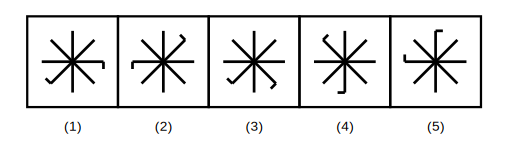
Among the five abstract figures below, two pairs can each be turned to match each other, leaving one figure with no match. Choose the figure which is different from the rest.
Explanation
Figures 1 and 4 can be turned to match each other exactly, and figures 3 and 5 can also be turned to match each other exactly. Figure 2 cannot be turned to match any of the other four figures.
Option 2 is the only figure with no rotation-equivalent partner, so it is the odd one out.
Option 2 is the only figure with no rotation-equivalent partner, so it is the odd one out.
Shortcut Method
Look for a figure with no rotation-equivalent partner: figures 1&4 and 3&5 pair up, leaving figure 2 unmatched → Option 2 is different ✓
Question 32
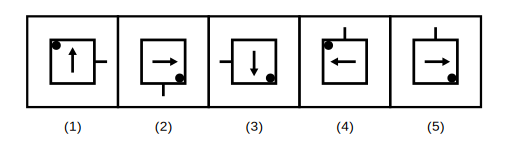
Four of the five figures below pair up into two rotation-equivalent pairs; one figure has no match. Select the figure which is different from the rest.
Explanation
Figures 1 and 3 can be turned to match each other exactly, and figures 2 and 4 can also be turned to match each other exactly. Figure 5 cannot be turned to match any of the other four figures.
Option 5 is the only figure with no rotation-equivalent partner, so it is the odd one out.
Option 5 is the only figure with no rotation-equivalent partner, so it is the odd one out.
Shortcut Method
Look for a figure with no rotation-equivalent partner: figures 1&3 and 2&4 pair up, leaving figure 5 unmatched → Option 5 is different ✓
Question 33
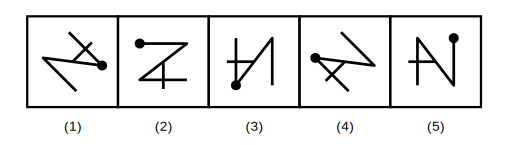
Two of the pairs among the five figures below are rotations of each other; one figure stands alone. Choose the figure which is different from the rest.
Explanation
Figures 1 and 4 can be turned to match each other exactly, and figures 2 and 5 can also be turned to match each other exactly. Figure 3 cannot be turned to match any of the other four figures.
Option 3 is the only figure with no rotation-equivalent partner, so it is the odd one out.
Option 3 is the only figure with no rotation-equivalent partner, so it is the odd one out.
Shortcut Method
Look for a figure with no rotation-equivalent partner: figures 1&4 and 2&5 pair up, leaving figure 3 unmatched → Option 3 is different ✓
Question 34
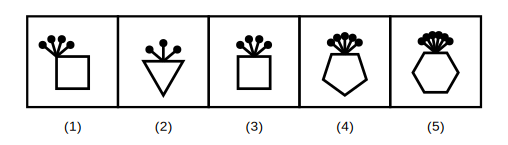
Each figure below has a polygon topped with a small cluster of pins. Choose the figure which is different from the rest.
Explanation
Every figure has as many pins in its cluster as the polygon has sides. In figures 2, 3, 4 and 5, the pin cluster grows from the middle of one of the polygon's sides. In figure 1, the cluster grows from a corner instead.
Option 1 is the only figure where the pins grow from a corner rather than a side-midpoint, so it is the odd one out.
Option 1 is the only figure where the pins grow from a corner rather than a side-midpoint, so it is the odd one out.
Shortcut Method
Check where the pin cluster grows from: side-midpoint (4 figures) vs a corner (1 figure) → Option 1 is different ✓
Question 35
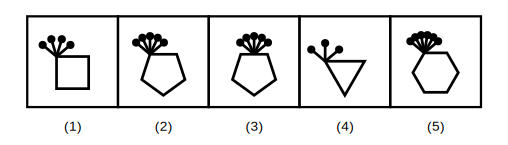
The five figures below each have a polygon with a cluster of pins on top. Select the figure which is different from the rest.
Explanation
Every figure has as many pins in its cluster as the polygon has sides. In figures 1, 2, 4 and 5, the pin cluster grows from a corner of the polygon. In figure 3, the cluster grows from the middle of a side instead.
Option 3 is the only figure where the pins grow from a side-midpoint rather than a corner, so it is the odd one out.
Option 3 is the only figure where the pins grow from a side-midpoint rather than a corner, so it is the odd one out.
Shortcut Method
Check where the pin cluster grows from: a corner (4 figures) vs side-midpoint (1 figure) → Option 3 is different ✓
Question 36
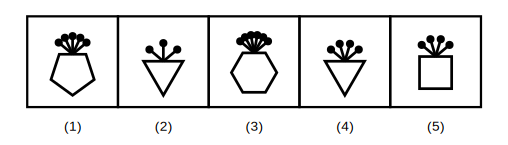
Count the pins in the cluster on top of each polygon below and compare it with the number of sides, then choose the figure which is different from the rest.
Explanation
In figures 1, 2, 3 and 5, the number of pins in the cluster equals the number of sides of the polygon. Figure 4 has one pin more than its number of sides.
Option 4 is the only figure where the pin count does not match the side count, so it is the odd one out.
Option 4 is the only figure where the pin count does not match the side count, so it is the odd one out.
Shortcut Method
Count the pins and compare to the number of sides: equal (4 figures) vs one extra pin (1 figure) → Option 4 is different ✓