Practice Non Verbal Reasoning questions on Grouping of Images, covering classification of figures into related groups based on shapes, patterns, symbols, positions, and visual properties. Takes about 20-25 minutes and is useful for placement, TCS NQT, SSC, banking and MBA entrance exams. Each question shows nine numbered figures. Group them into three classes, using each figure only once, and select the alternative that gives the correct grouping.
Question 1
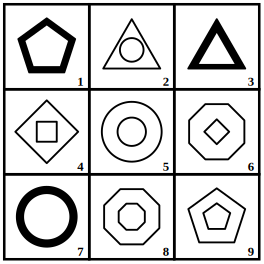
Identify the option that forms three correct classes from the nine figures shown, using each figure only once.
Explanation
5, 8, 9 have two similar elements, one inside the other. 1, 3, 7 have two similar elements, one inside the other, and the area between the two elements is shaded. 2, 4, 6 have one element placed inside a different element.
Question 2
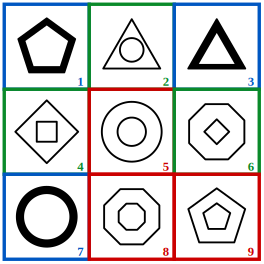
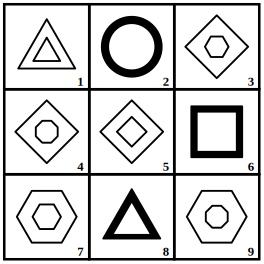
Choose the correct grouping of the nine figures below into three classes, using each figure exactly once.
Explanation
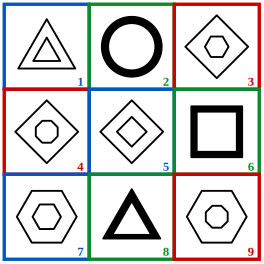
3, 4, 9 have one element placed inside a different element. 1, 5, 7 have two similar elements, one inside the other. 2, 6, 8 have two similar elements, one inside the other, and the area between the two elements is shaded.
Question 3
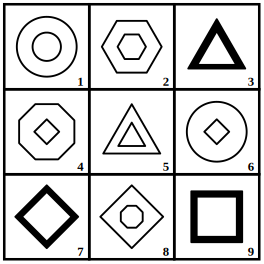
Determine which option correctly sorts the nine figures in the grid into three classes of three.
Explanation
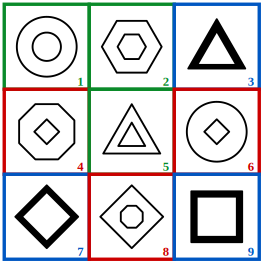
4, 6, 8 have one element placed inside a different element. 3, 7, 9 have two similar elements, one inside the other, and the area between the two elements is shaded. 1, 2, 5 have two similar elements, one inside the other.
Question 4
Observe the nine figures and select the option that places them correctly in three classes, each figure used once.
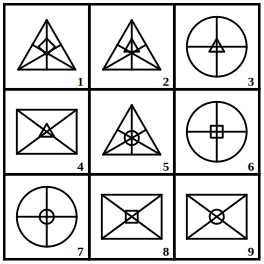
Explanation
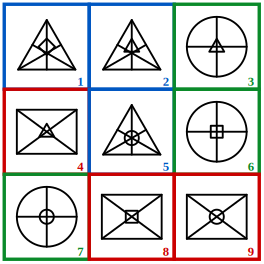
4, 8, 9 contain a rectangle with its two diagonals as the outer element and another element placed inside it. 1, 2, 5 contain a triangle with its three medians as the outer element and another element placed inside it. 3, 6, 7 contain a circle with its two mutually perpendicular diameters as the outer element and another element placed inside it.
Question 5
Pick the option that divides the figures 1 to 9 below into three correct classes without using any figure twice.
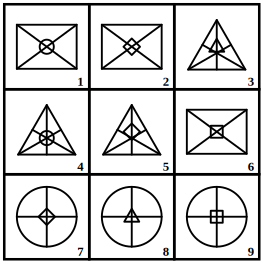
Explanation
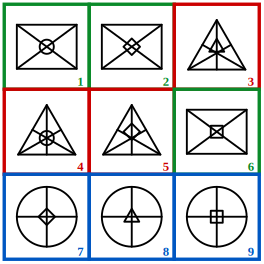
3, 4, 5 contain a triangle with its three medians as the outer element and another element placed inside it. 7, 8, 9 contain a circle with its two mutually perpendicular diameters as the outer element and another element placed inside it. 1, 2, 6 contain a rectangle with its two diagonals as the outer element and another element placed inside it.
Question 6
Which grouping of the nine numbered figures into three classes is correct, if each figure is to be used only once?
Explanation
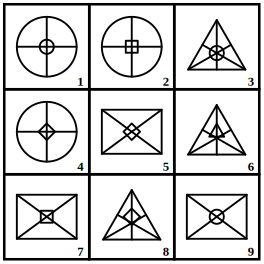
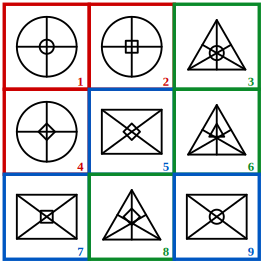
1, 2, 4 contain a circle with its two mutually perpendicular diameters as the outer element and another element placed inside it. 5, 7, 9 contain a rectangle with its two diagonals as the outer element and another element placed inside it. 3, 6, 8 contain a triangle with its three medians as the outer element and another element placed inside it.
Question 7
Find the correct way to group the nine figures shown into three classes, with every figure used once.
Explanation
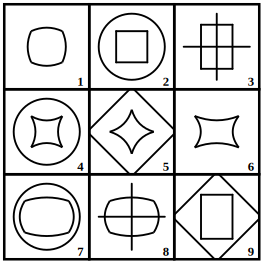
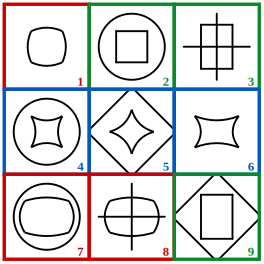
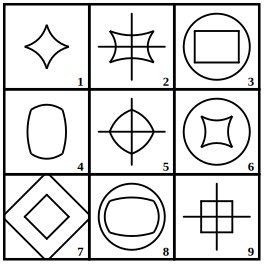
1, 7, 8 have patterns formed from four lines curved outwards (convex). 4, 5, 6 have patterns formed from four lines curved inwards (concave). 2, 3, 9 have patterns formed from four straight lines.
Question 8
Using each figure only once, identify the option that correctly groups the nine figures below into three classes.
Explanation
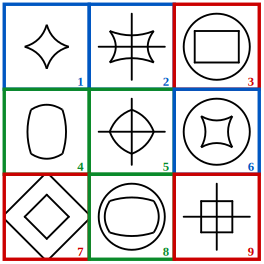
3, 7, 9 have patterns formed from four straight lines. 1, 2, 6 have patterns formed from four lines curved inwards (concave). 4, 5, 8 have patterns formed from four lines curved outwards (convex).
Question 9
The nine figures in the grid can be arranged into three classes. Which option shows the correct arrangement?
Explanation
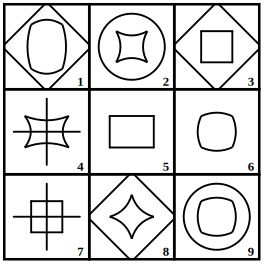
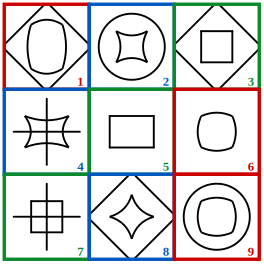
1, 6, 9 have patterns formed from four lines curved outwards (convex). 2, 4, 8 have patterns formed from four lines curved inwards (concave). 3, 5, 7 have patterns formed from four straight lines.
Question 10
Choose the option that correctly groups the nine figures below into three sets of three, each figure used exactly once.
Explanation
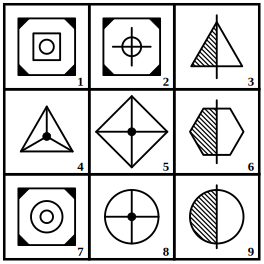
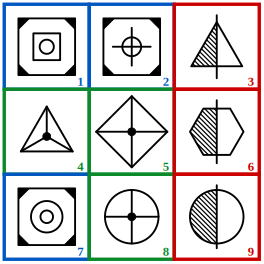
3, 6, 9 are figures which are half shaded by slanting lines. 1, 2, 7 have their four corners shaded black. 4, 5, 8 are divided into equal parts by straight lines and have a black circle at the centre.
Question 11
Separate the figures numbered 1 to 9 into three classes, using each only once. Which option is correct?
Explanation
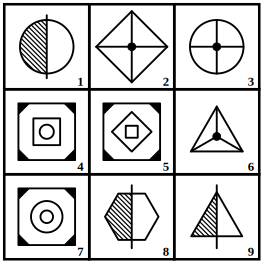
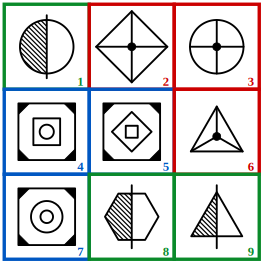
2, 3, 6 are divided into equal parts by straight lines and have a black circle at the centre. 4, 5, 7 have their four corners shaded black. 1, 8, 9 are figures which are half shaded by slanting lines.
Question 12
Select the option in which the nine figures of the grid are correctly arranged into three classes, using each figure once only.
Explanation
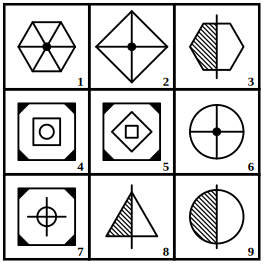
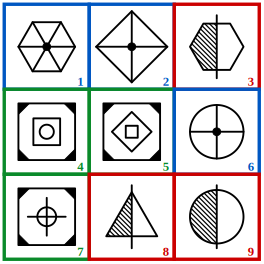
3, 8, 9 are figures which are half shaded by slanting lines. 1, 2, 6 are divided into equal parts by straight lines and have a black circle at the centre. 4, 5, 7 have their four corners shaded black.
Question 13
Which option gives the correct division of the nine figures below into three classes of similar figures?
Explanation
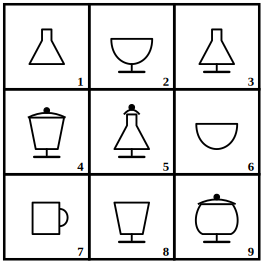
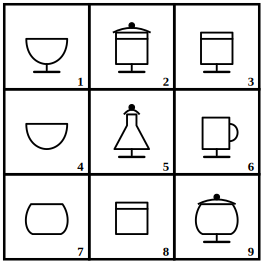
1, 6, 7 are objects which have neither a base nor an upper lid. 2, 3, 8 are objects having a base but no upper lid. 4, 5, 9 are objects having both a base and an upper lid.
Question 14
Examine the grid of nine figures and decide which option arranges them into three classes, each figure being used only once.
Explanation
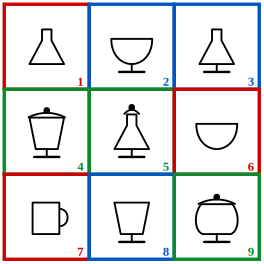
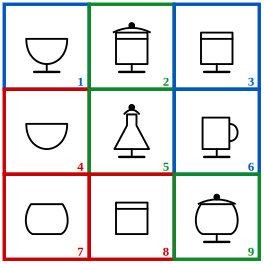
4, 7, 8 are objects which have neither a base nor an upper lid. 1, 3, 6 are objects having a base but no upper lid. 2, 5, 9 are objects having both a base and an upper lid.
Question 15
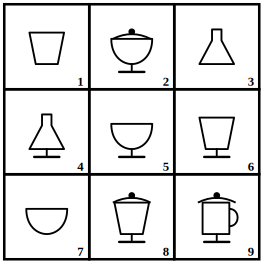
From the options, choose the grouping that sorts all nine figures below into three proper classes.
Explanation
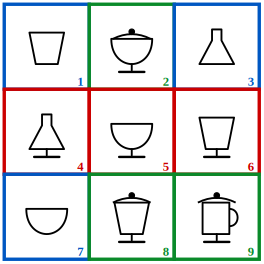
4, 5, 6 are objects having a base but no upper lid. 1, 3, 7 are objects which have neither a base nor an upper lid. 2, 8, 9 are objects having both a base and an upper lid.
Question 16
Group the nine figures shown below into three classes so that each figure is used exactly once. Pick the right option.
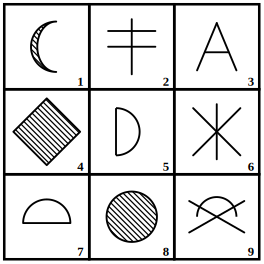
Explanation
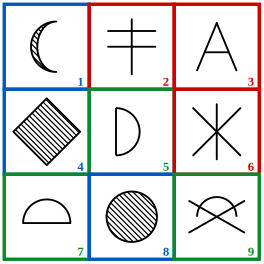
2, 3, 6 are figures composed of straight lines only. 1, 4, 8 are closed figures shaded by oblique line segments. 5, 7, 9 are figures composed of straight as well as curved lines.
Question 17
Find the option that correctly separates the nine given figures into three classes, with no figure repeated.
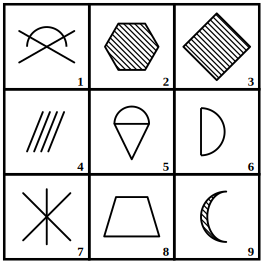
Explanation
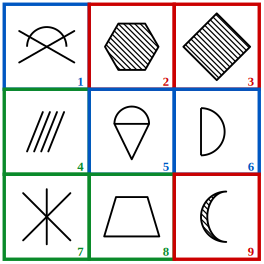
2, 3, 9 are closed figures shaded by oblique line segments. 1, 5, 6 are figures composed of straight as well as curved lines. 4, 7, 8 are figures composed of straight lines only.
Question 18
Look at the figures numbered 1 to 9 and select the option that splits them into three correct classes, using each figure once.
Explanation
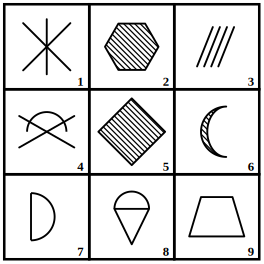
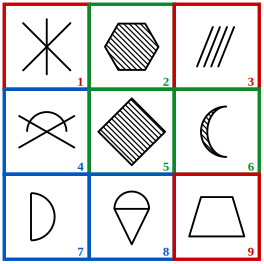
1, 3, 9 are figures composed of straight lines only. 4, 7, 8 are figures composed of straight as well as curved lines. 2, 5, 6 are closed figures shaded by oblique line segments.
Question 19
Classify the nine numbered figures into three groups of three on the basis of a common property. Choose the correct grouping.
Explanation
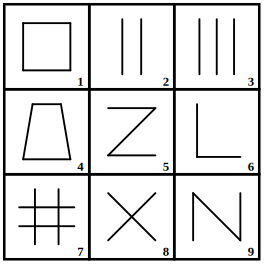
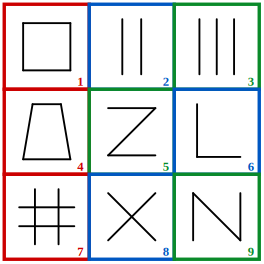
1, 4, 7 are figures composed of four straight lines. 2, 6, 8 are figures composed of two straight lines. 3, 5, 9 are figures composed of three straight lines.
Question 20
Which of the following groupings correctly places the nine figures into three classes, using each figure only once?
Explanation
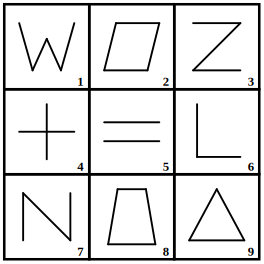
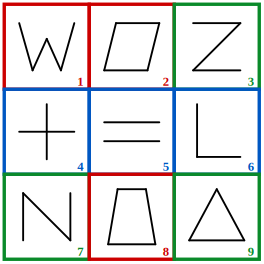
1, 2, 8 are figures composed of four straight lines. 4, 5, 6 are figures composed of two straight lines. 3, 7, 9 are figures composed of three straight lines.
Question 21
Study the nine figures below and find the option that groups them properly into three classes, each figure used only once.
Explanation
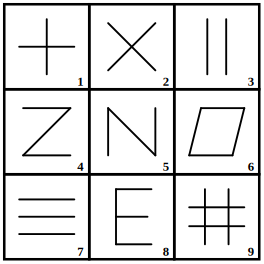
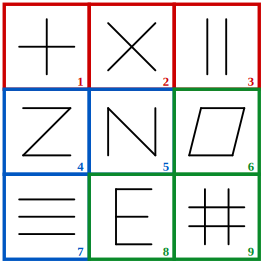
1, 2, 3 are figures composed of two straight lines. 4, 5, 7 are figures composed of three straight lines. 6, 8, 9 are figures composed of four straight lines.
Question 22
Divide the nine figures shown into three classes of three, using every figure exactly once. Select the correct grouping.
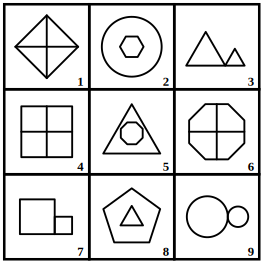
Explanation
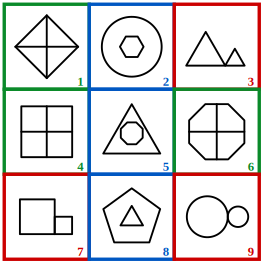
3, 7, 9 have two similar elements (unequal in size) attached to each other. 2, 5, 8 have one element placed inside a different element. 1, 4, 6 contain two mutually perpendicular lines dividing the figure into four parts.
Question 23
The grid below shows nine numbered figures. Which option divides them correctly into three classes, with each figure used once?
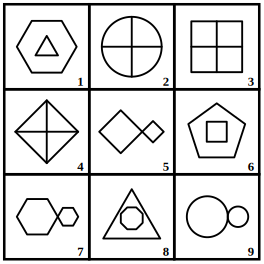
Explanation
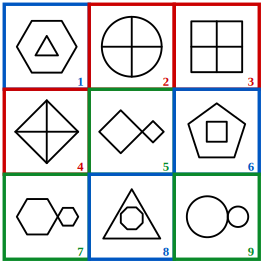
2, 3, 4 contain two mutually perpendicular lines dividing the figure into four parts. 1, 6, 8 have one element placed inside a different element. 5, 7, 9 have two similar elements (unequal in size) attached to each other.
Question 24
Sort the nine figures in the grid below into three classes, using each figure only once. Choose the correct grouping.
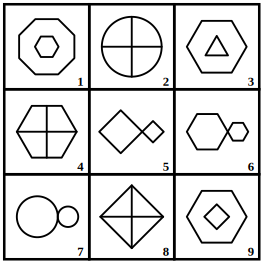
Explanation
2, 4, 8 contain two mutually perpendicular lines dividing the figure into four parts. 5, 6, 7 have two similar elements (unequal in size) attached to each other. 1, 3, 9 have one element placed inside a different element.