Practice Non Verbal Reasoning questions on Paper Cutting, covering folded-paper patterns, cutting and punching, unfolding shapes, symmetry, hole positions, and predicting the final pattern after the paper is opened. Takes about 20–25 minutes and is useful for placement, TCS NQT, SSC, banking and MBA entrance exams.
Question 1
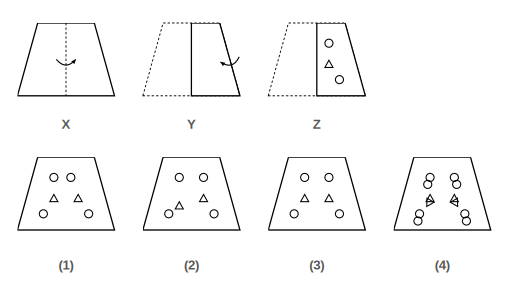
Choose a figure which would most closely resemble the unfolded form of Figure (Z).
Explanation
The paper is folded in half down the middle, so each cut is repeated as a mirror image on the other side of the fold line. The 3 cuts become 6: 4 circles and 2 triangles, placed symmetrically. Only option (3) shows all the cuts in the right places; the other figures have cuts missing, misplaced or turned the wrong way.
Question 2
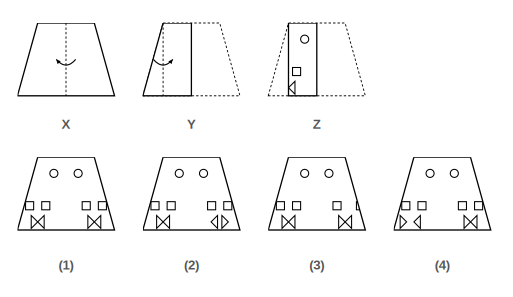
Select the figure that most closely matches how Figure (Z) looks once the paper is unfolded.
Explanation
The paper is folded twice, so each cut is repeated as a mirror image across both fold lines (and a cut that touches a fold line opens into a joined shape). Only option (1) shows all the cuts in the right places; the other figures have cuts missing, misplaced or turned the wrong way.
Question 3
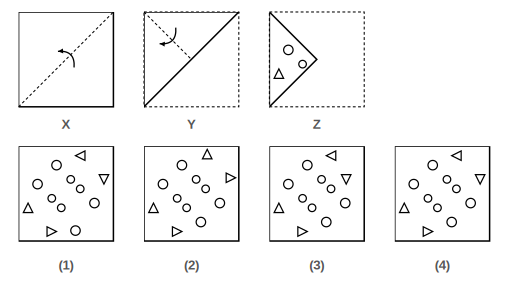
Identify the figure that shows the unfolded form of the paper in Figure (Z).
Explanation
The paper is folded along one diagonal and then along the other, so each cut is repeated as a mirror image in all four quarters (across both diagonals). The 3 cuts become 12. Only option (4) shows all the cuts in the right places; the other figures have cuts missing, misplaced or turned the wrong way.
Question 4
Which figure would you get by unfolding the paper shown in Figure (Z)?
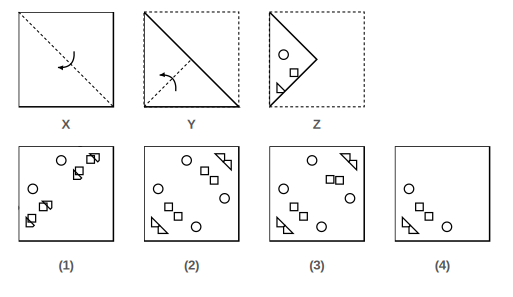
Explanation
The paper is folded along one diagonal and then along the other, so each cut is repeated as a mirror image in all four quarters (across both diagonals). The 3 cuts become 12: 4 circles, 4 squares and 4 right-angled triangles. Only option (2) shows all the cuts in the right places; the other figures have cuts missing, misplaced or turned the wrong way.
Question 5
Find the figure that most closely resembles Figure (Z) after the paper is opened out.
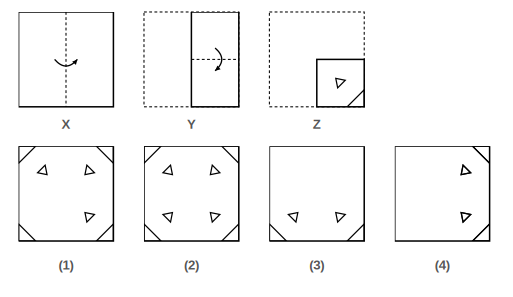
Explanation
The paper is folded in half and then in half again, so each cut is repeated as a mirror image in all four quarters (across the vertical and the horizontal centre lines). The result has 4 triangles (pointing outwards on each side) and 4 cut corners. Only option (2) shows all the cuts in the right places; the other figures have cuts missing, misplaced or turned the wrong way.
Question 6
Determine which figure represents the unfolded paper of Figure (Z).
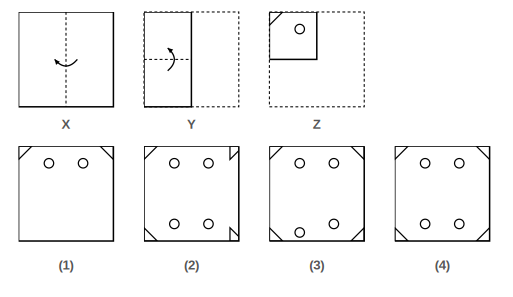
Explanation
The paper is folded in half and then in half again, so each cut is repeated as a mirror image in all four quarters (across the vertical and the horizontal centre lines). The result has 4 circles and 4 cut corners. Only option (4) shows all the cuts in the right places; the other figures have cuts missing, misplaced or turned the wrong way.
Question 7
Pick the figure that results when the paper in Figure (Z) is unfolded completely.
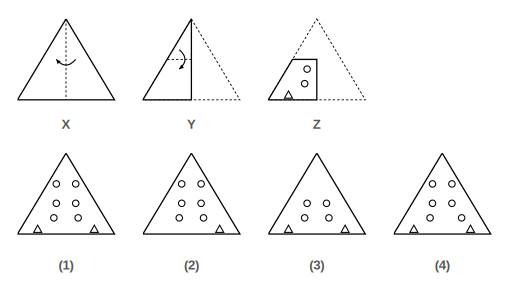
Explanation
The paper is folded twice, so each cut is repeated as a mirror image across both fold lines (and a cut that touches a fold line opens into a joined shape). Only option (1) shows all the cuts in the right places; the other figures have cuts missing, misplaced or turned the wrong way.
Question 8
Work out which figure the paper in Figure (Z) will show after it is unfolded.
Explanation
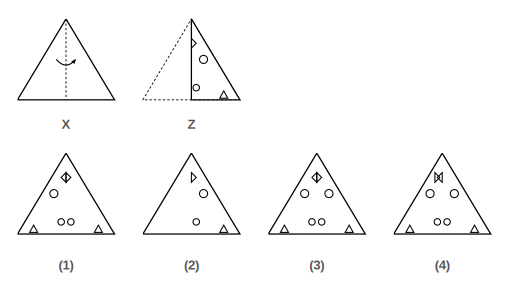
The paper is folded in half down the middle, so each cut is repeated as a mirror image on the other side of the fold line. Only option (3) shows all the cuts in the right places; the other figures have cuts missing, misplaced or turned the wrong way.
Question 9
Choose the figure that best shows the paper of Figure (Z) once it has been unfolded.
Explanation
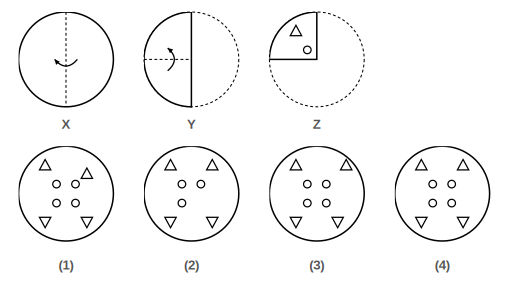
The paper is folded in half and then in half again, so each cut is repeated as a mirror image in all four quarters (across the vertical and the horizontal centre lines). The result has 4 circles and 4 triangles. Only option (4) shows all the cuts in the right places; the other figures have cuts missing, misplaced or turned the wrong way.
Question 10
Figure out which of the figures is the unfolded version of Figure (Z).
Explanation
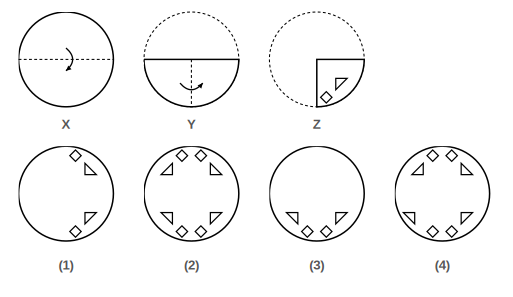
The paper is folded in half and then in half again, so each cut is repeated as a mirror image in all four quarters (across the vertical and the horizontal centre lines). Only option (2) shows all the cuts in the right places; the other figures have cuts missing, misplaced or turned the wrong way.
Question 11
Select the figure that most closely resembles the unfolded form of the paper in Figure (Z).
Explanation
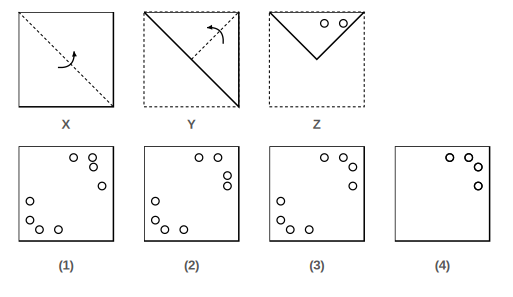
The paper is folded along one diagonal and then along the other, so each cut is repeated as a mirror image in all four quarters (across both diagonals). The 2 circles become 8 circles, two along each side of the square. Only option (3) shows all the cuts in the right places; the other figures have cuts missing, misplaced or turned the wrong way.
Question 12
Find out how the paper in Figure (Z) will look when fully unfolded, and choose that figure.
Explanation
The paper is folded along one diagonal and then along the other, so each cut is repeated as a mirror image in all four quarters (across both diagonals). Only option (1) shows all the cuts in the right places; the other figures have cuts missing, misplaced or turned the wrong way.
Question 13
Choose the figure that you would see if the folded paper in Figure (Z) were opened out.
Explanation
The paper is folded along one diagonal and then along the other, so each cut is repeated as a mirror image in all four quarters (across both diagonals). The 3 cuts become 12. Only option (1) shows all the cuts in the right places; the other figures have cuts missing, misplaced or turned the wrong way.
Question 14
Decide which figure matches the paper of Figure (Z) after all its folds are undone.
Explanation
The paper is folded along one diagonal and then along the other, so each cut is repeated as a mirror image in all four quarters (across both diagonals). The 3 cuts become 12. Only option (3) shows all the cuts in the right places; the other figures have cuts missing, misplaced or turned the wrong way.
Question 15
Pick out the figure that most nearly gives the unfolded form of Figure (Z).
Explanation
The paper is folded twice, so each cut is repeated as a mirror image across both fold lines (and a cut that touches a fold line opens into a joined shape). Only option (2) shows all the cuts in the right places; the other figures have cuts missing, misplaced or turned the wrong way.
Question 16
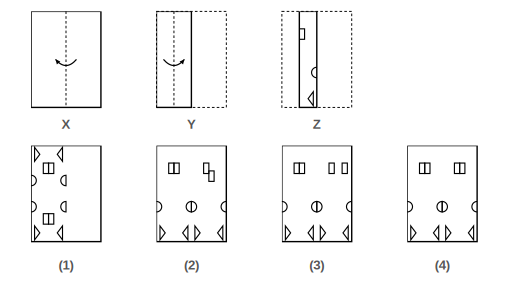
Which of the given figures shows the paper of Figure (Z) when it is unfolded?
Explanation
The paper is folded twice, so each cut is repeated as a mirror image across both fold lines (and a cut that touches a fold line opens into a joined shape). Only option (4) shows all the cuts in the right places; the other figures have cuts missing, misplaced or turned the wrong way.
Question 17
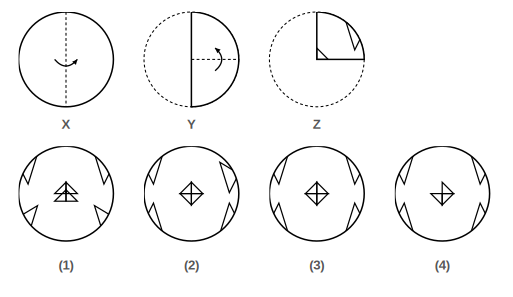
Select the figure which is the closest match for Figure (Z) when the paper is unfolded.
Explanation
The paper is folded in half and then in half again, so each cut is repeated as a mirror image in all four quarters (across the vertical and the horizontal centre lines). Only option (3) shows all the cuts in the right places; the other figures have cuts missing, misplaced or turned the wrong way.
Question 18
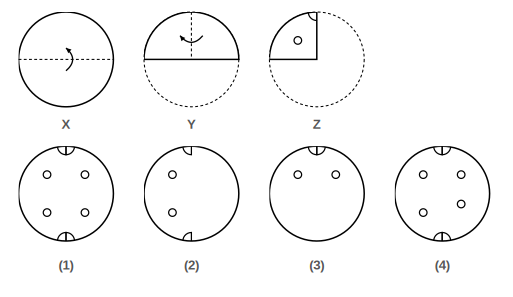
Find the figure that shows how the paper in Figure (Z) will appear after unfolding.
Explanation
The paper is folded in half and then in half again, so each cut is repeated as a mirror image in all four quarters (across the vertical and the horizontal centre lines). Only option (1) shows all the cuts in the right places; the other figures have cuts missing, misplaced or turned the wrong way.
Question 19
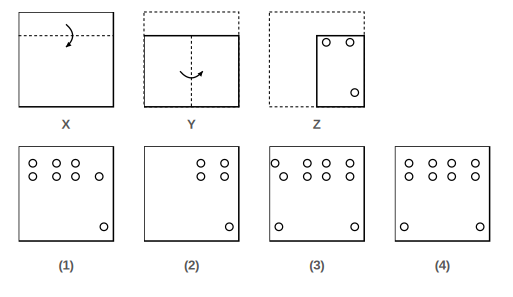
Work out the figure that the cut paper of Figure (Z) forms when it is unfolded.
Explanation
The paper is folded twice, and a part of the paper is folded over the rest, so each cut is repeated as a mirror image across the fold lines, but only where the folded-over part covers that place. The result has 10 circles. Only option (4) shows all the cuts in the right places; the other figures have cuts missing, misplaced or turned the wrong way.
Question 20
Identify which figure most closely resembles the opened-out form of Figure (Z).
Explanation
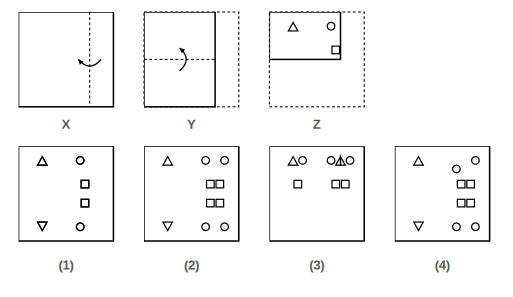
The paper is folded twice, and a part of the paper is folded over the rest, so each cut is repeated as a mirror image across the fold lines, but only where the folded-over part covers that place. Only option (2) shows all the cuts in the right places; the other figures have cuts missing, misplaced or turned the wrong way.
Question 21
Choose the figure that the paper in Figure (Z) will turn into once it is unfolded.
Explanation
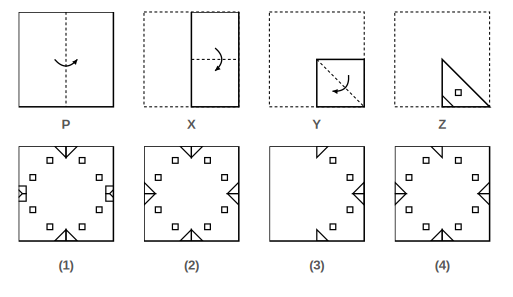
The paper is folded three times (in half, in half again, then along a diagonal), so each cut is repeated eight times as mirror images across the fold lines. Only option (2) shows all the cuts in the right places; the other figures have cuts missing, misplaced or turned the wrong way.
Question 22
Determine the figure that you get when the paper shown in Figure (Z) is unfolded.
Explanation
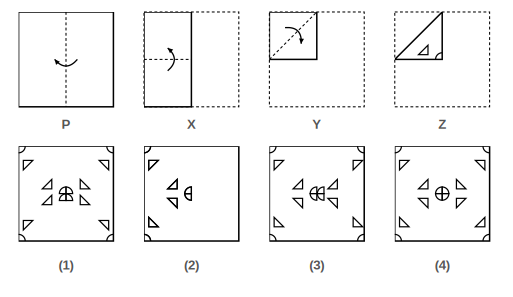
The paper is folded three times (in half, in half again, then along a diagonal), so each cut is repeated eight times as mirror images across the fold lines. Only option (4) shows all the cuts in the right places; the other figures have cuts missing, misplaced or turned the wrong way.
Question 23
Select the figure that shows the unfolded paper corresponding to Figure (Z).
Explanation
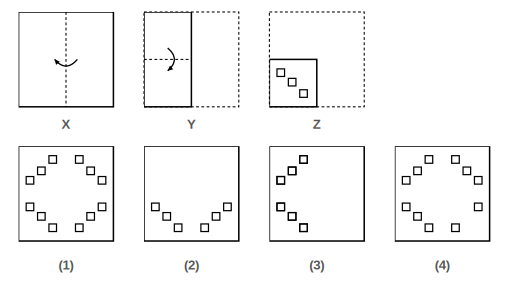
The paper is folded in half and then in half again, so each cut is repeated as a mirror image in all four quarters (across the vertical and the horizontal centre lines). The 3 squares become 12 squares. Only option (1) shows all the cuts in the right places; the other figures have cuts missing, misplaced or turned the wrong way.
Question 24
Find which figure best represents Figure (Z) after the paper has been unfolded.
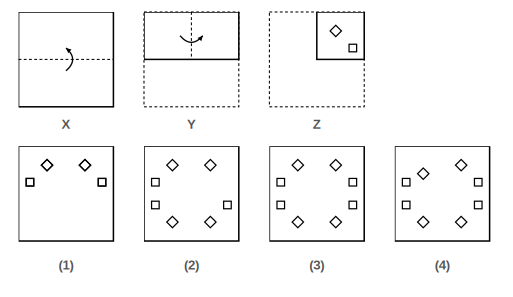
Explanation
The paper is folded in half and then in half again, so each cut is repeated as a mirror image in all four quarters (across the vertical and the horizontal centre lines). Only option (3) shows all the cuts in the right places; the other figures have cuts missing, misplaced or turned the wrong way.
Question 25
Figure out the unfolded form of Figure (Z) and choose the figure that most closely matches it.
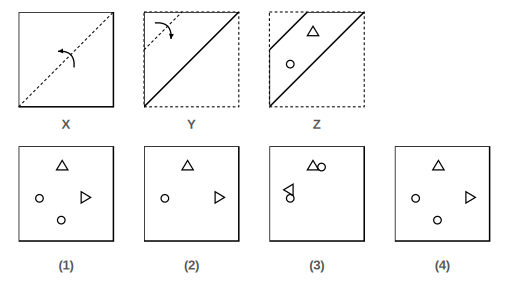
Explanation
The paper is folded twice, and a part of the paper is folded over the rest, so each cut is repeated as a mirror image across the fold lines, but only where the folded-over part covers that place. Only option (4) shows all the cuts in the right places; the other figures have cuts missing, misplaced or turned the wrong way.
Question 26
Pick the figure that most closely shows the paper of Figure (Z) when opened out.
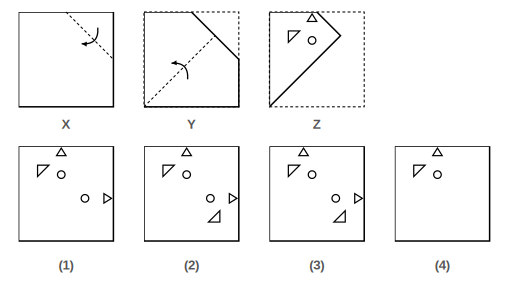
Explanation
The paper is folded twice, and a part of the paper is folded over the rest, so each cut is repeated as a mirror image across the fold lines, but only where the folded-over part covers that place. Only option (2) shows all the cuts in the right places; the other figures have cuts missing, misplaced or turned the wrong way.
Question 27
Decide which figure is the unfolded form of the paper shown in Figure (Z).
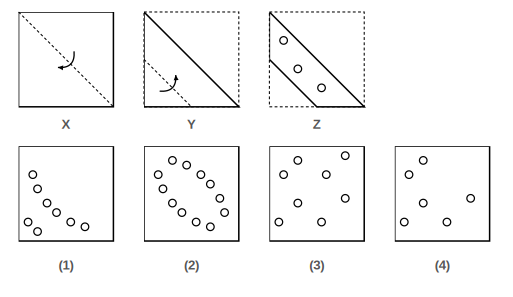
Explanation
The paper is folded twice, and a part of the paper is folded over the rest, so each cut is repeated as a mirror image across the fold lines, but only where the folded-over part covers that place. The 3 circles become 8 circles. Only option (3) shows all the cuts in the right places; the other figures have cuts missing, misplaced or turned the wrong way.
Question 28
Choose the figure that would appear if the paper in Figure (Z) were completely unfolded.
Explanation
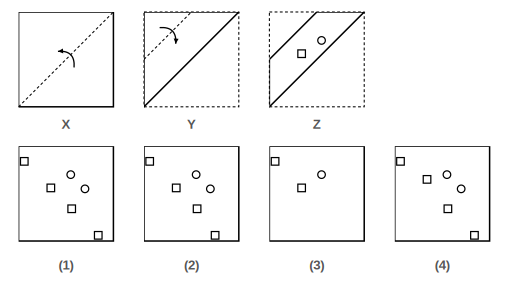
The paper is folded twice, and a part of the paper is folded over the rest, so each cut is repeated as a mirror image across the fold lines, but only where the folded-over part covers that place. Only option (1) shows all the cuts in the right places; the other figures have cuts missing, misplaced or turned the wrong way.
Question 29
Work out which of the figures most closely matches the unfolded paper of Figure (Z).
Explanation
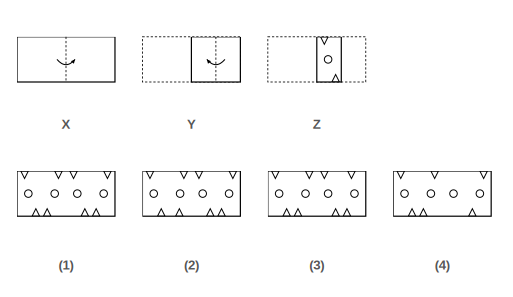
The paper is folded twice, so each cut is repeated as a mirror image across both fold lines (and a cut that touches a fold line opens into a joined shape). The 3 cuts become 12. Only option (1) shows all the cuts in the right places; the other figures have cuts missing, misplaced or turned the wrong way.
Question 30
Find the figure which gives the unfolded form of the folded and cut paper in Figure (Z).
Explanation
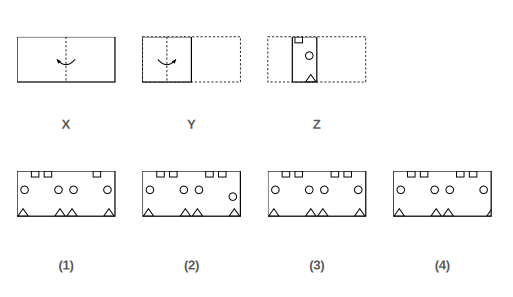
The paper is folded twice, so each cut is repeated as a mirror image across both fold lines (and a cut that touches a fold line opens into a joined shape). The 3 cuts become 12. Only option (3) shows all the cuts in the right places; the other figures have cuts missing, misplaced or turned the wrong way.
Question 31
Which figure shows the paper of Figure (Z) when it is opened out after all the folds are undone?
Explanation
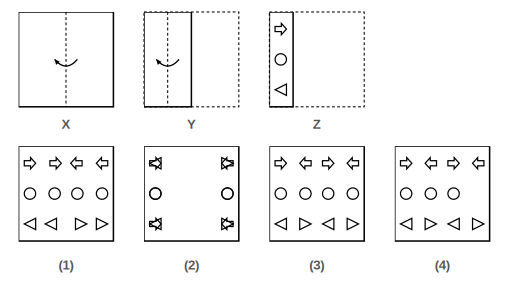
The paper is folded in half and then in half again, and the cuts lie in the left-most quarter. They are repeated as mirror images across the two fold lines, giving four columns: right-pointing and left-pointing arrows alternating along the top, four circles in the middle and triangles pointing left, right, left, right along the bottom. Only option (3) shows all the cuts in the right places; the other figures have cuts missing, misplaced or turned the wrong way.
Question 32
Find the figure that the cut paper in Figure (Z) forms once it has been fully unfolded.
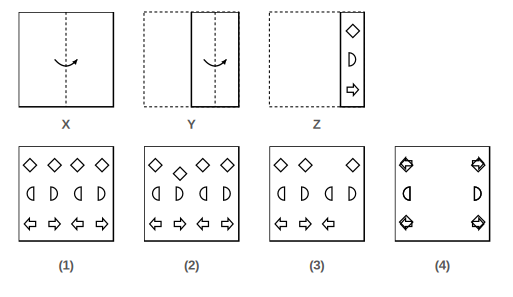
Explanation
The paper is folded in half and then in half again, and the cuts lie in the right-most quarter. They are repeated as mirror images across the two fold lines, giving four diamonds in the top row, half-discs facing left, right, left, right in the middle and arrows pointing left, right, left, right along the bottom. Only option (1) shows all the cuts in the right places; the other figures have cuts missing, misplaced or turned the wrong way.
Question 33
Select the figure that you would obtain by unfolding the paper shown in Figure (Z).
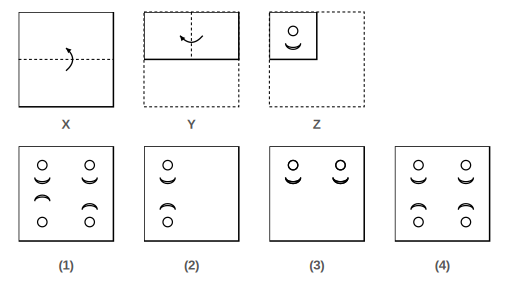
Explanation
The paper is folded in half and then in half again, and the cuts lie in the top-left quarter (a circle above a curved cut). Mirroring across both centre lines gives four sets: at the top each circle is above the curve, and at the bottom the curve is above the circle. Only option (4) shows all the cuts in the right places; the other figures have cuts missing, misplaced or turned the wrong way.
Question 34
Pick the figure that most closely matches the paper in Figure (Z) after unfolding.
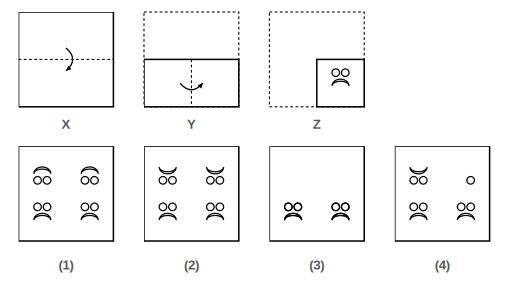
Explanation
The paper is folded in half and then in half again, and the cuts lie in the bottom-right quarter (two circles above a curved cut). Mirroring across both centre lines gives four sets: at the top the curve is above the two circles, and at the bottom the two circles are above the curve. Only option (2) shows all the cuts in the right places; the other figures have cuts missing, misplaced or turned the wrong way.
Question 35
Decide which of the four figures gives the unfolded form of the paper in Figure (Z).
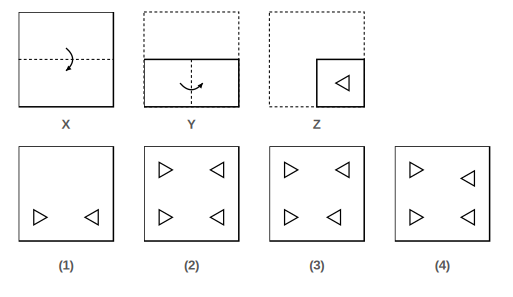
Explanation
The paper is folded in half and then in half again, and the single triangle cut is mirrored into all four quarters: the triangles point inwards, right-pointing on the left side and left-pointing on the right side, at equal heights. Only option (2) shows all the cuts in the right places; the other figures have cuts missing, misplaced or turned the wrong way.
Question 36
Choose the figure that Figure (Z) turns into when the folded paper is spread out flat.
Explanation
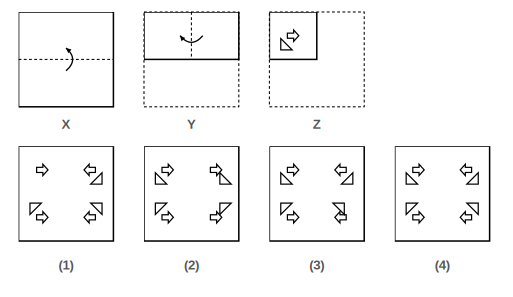
The paper is folded in half and then in half again. The arrow and the small triangle in the top-left quarter are mirrored into the other three quarters, so the pattern is the same in all four quarters, reversed left to right and top to bottom. Only option (4) shows all the cuts in the right places; the other figures have cuts missing, misplaced or turned the wrong way.
Question 37
Work out the unfolded form of Figure (Z) and select the matching figure.
Explanation
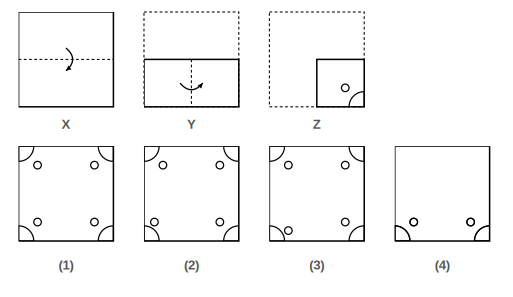
The paper is folded in half and then in half again. The circle and the curved corner cut in the bottom-right quarter are mirrored into all four quarters, giving four circles and four cut corners. Only option (1) shows all the cuts in the right places; the other figures have cuts missing, misplaced or turned the wrong way.
Question 38
Identify the figure that results from opening out the folded and cut paper of Figure (Z).
Explanation
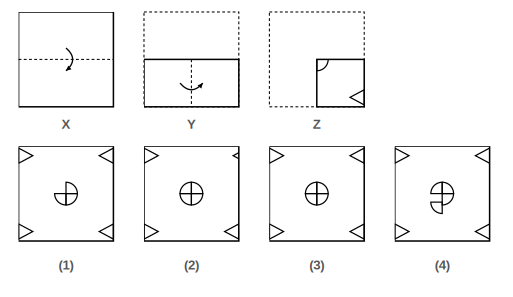
The paper is folded in half and then in half again. The curved cut at the centre of the paper is repeated in all four quarters and makes a full circle with a cross, and the triangle cut on the edge is repeated at the four corners (right-pointing on the left side and left-pointing on the right side). Only option (3) shows all the cuts in the right places; the other figures have cuts missing, misplaced or turned the wrong way.
Question 39
Which one of the figures is the opened-out form of the paper shown in Figure (Z)?
Explanation
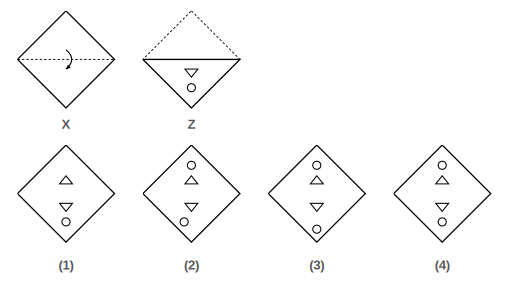
The square sheet is folded in half along its horizontal diagonal. Each cut is mirrored across that line, giving a column of four cuts: a circle, an upward triangle, a downward triangle and a circle. Only option (4) shows all the cuts in the right places; the other figures have cuts missing, misplaced or turned the wrong way.
Question 40
Choose the figure which would be formed when the paper in Figure (Z) is unfolded and laid flat.
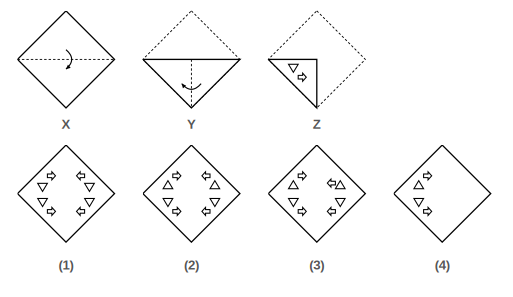
Explanation
The square sheet is folded along its horizontal diagonal and then along its vertical diagonal. The cuts in the corner are mirrored across both lines, giving four sets of a triangle and an arrow, one set in each quarter. Only option (2) shows all the cuts in the right places; the other figures have cuts missing, misplaced or turned the wrong way.
Question 41
Determine the figure that most closely resembles Figure (Z) after the folds are reversed.
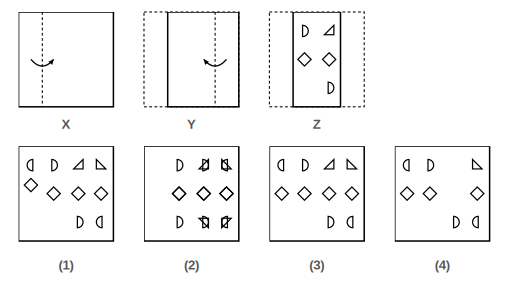
Explanation
The paper is folded twice, so the cuts lie in the middle strip and are mirrored across the two fold lines. The half-discs and triangles are reversed on the other side of each fold, and each diamond is repeated, giving four diamonds in the middle row. Only option (3) shows all the cuts in the right places; the other figures have cuts missing, misplaced or turned the wrong way.
Question 42
Select the figure that correctly shows Figure (Z) once the paper is completely unfolded.
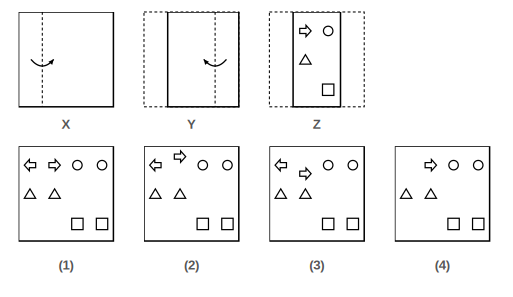
Explanation
The paper is folded twice, so the cuts lie in the middle strip and are mirrored across the two fold lines. Each arrow is reversed on the other side of a fold, so there are left-pointing and right-pointing arrows at the top, two triangles in the middle and two squares at the bottom. Only option (1) shows all the cuts in the right places; the other figures have cuts missing, misplaced or turned the wrong way.
Question 43
Find which figure best shows the unfolded paper that Figure (Z) came from.
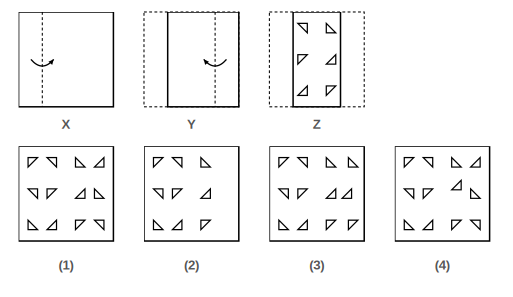
Explanation
The paper is folded twice, so the cuts lie in the middle strip and are mirrored across the two fold lines (left of the left fold and right of the right fold). Each of the 6 triangles gives 2 more, so there are 12 triangles in all. Only option (1) shows all the cuts in the right places; the other figures have cuts missing, misplaced or turned the wrong way.
Question 44
Pick the figure which represents the paper of Figure (Z) after it has been unfolded.
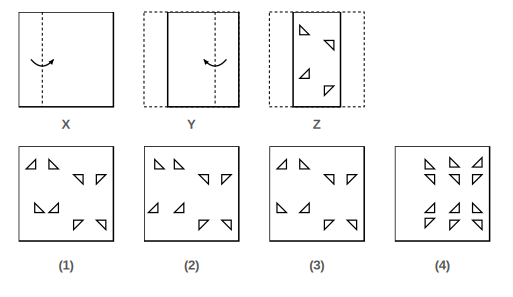
Explanation
The paper is folded twice, so the cuts lie in the middle strip and are mirrored across the two fold lines. The 4 triangles in the strip are joined by their 4 mirror images, so the left and right halves are each symmetrical about their own fold line. Only option (3) shows all the cuts in the right places; the other figures have cuts missing, misplaced or turned the wrong way.